For universities & business schools
Your students will manage AI.
Who teaches them how humans behave around it?
I am Dima Levin: I have spent the last 12+ years implementing AI in businesses around the world, and I still run them day to day. I teach the part schools usually miss: LLM behaviour and human judgment — how the models actually behave, and how people actually work with them. One practical business case, one inspectable student output, one exam your students will remember.
-
Taught from live systems, not case studies
Everything in the room traces to software running this week: a deal-intelligence platform doing the work of analysts, a bank-statement platform that has processed $1B+ across 30+ banks and payment providers, and a record of 150+ enterprise AI projects. When a student asks "but does this actually work?", I answer from last week.
-
A name for the gap
Schools teach how models are built. Almost nobody teaches how they behave — why a fluent answer can hide an unsupported commitment — or how professionals keep judgment when the machine drafts. That is the teachable surface, and it is where your graduates become dangerous (in the good way).
-
An exam students remember
Students design a real business workflow with AI, test the output, and defend the human decision. Then: open book with a familiar problem, closed book with a new one. The skill that survives is the one they keep.
- 12+ yrs implementing AI in industry
- 150+ enterprise AI projects
- €50M+ in client savings
- 290+ banks on platforms he co-built
- 3 AI ventures co-founded
Cone Red · GetDeal.AI · BankStore — operator record, principal public company data.
Teaching record
- Institute of International Relations, Taras Shevchenko National University of Kyiv: regular lectures on applied AI, since 2019.
- Bricks University: Expert and Senior Lecturer; designed and delivered university study programs for the economics, management and international relations departments.
- TNW Conference, Amsterdam 2024: workshop for C-level bankers on credit processes with AI agents.
- Omdena: workshops on AI for SMEs, knowledge management and fine-tuning (2024) and on AI pipelines for sales (2023).
- Corporate: practical GenAI course for Raiffeisen Bank International top management; five internal AI courses authored.
- Talks: All-Ukrainian AI Conference (2023); Prompt Engineering 101 at Mindcraft week, Poland, for 200+ attendees (2023).
The session, concretely
One business case. One artifact they can defend.
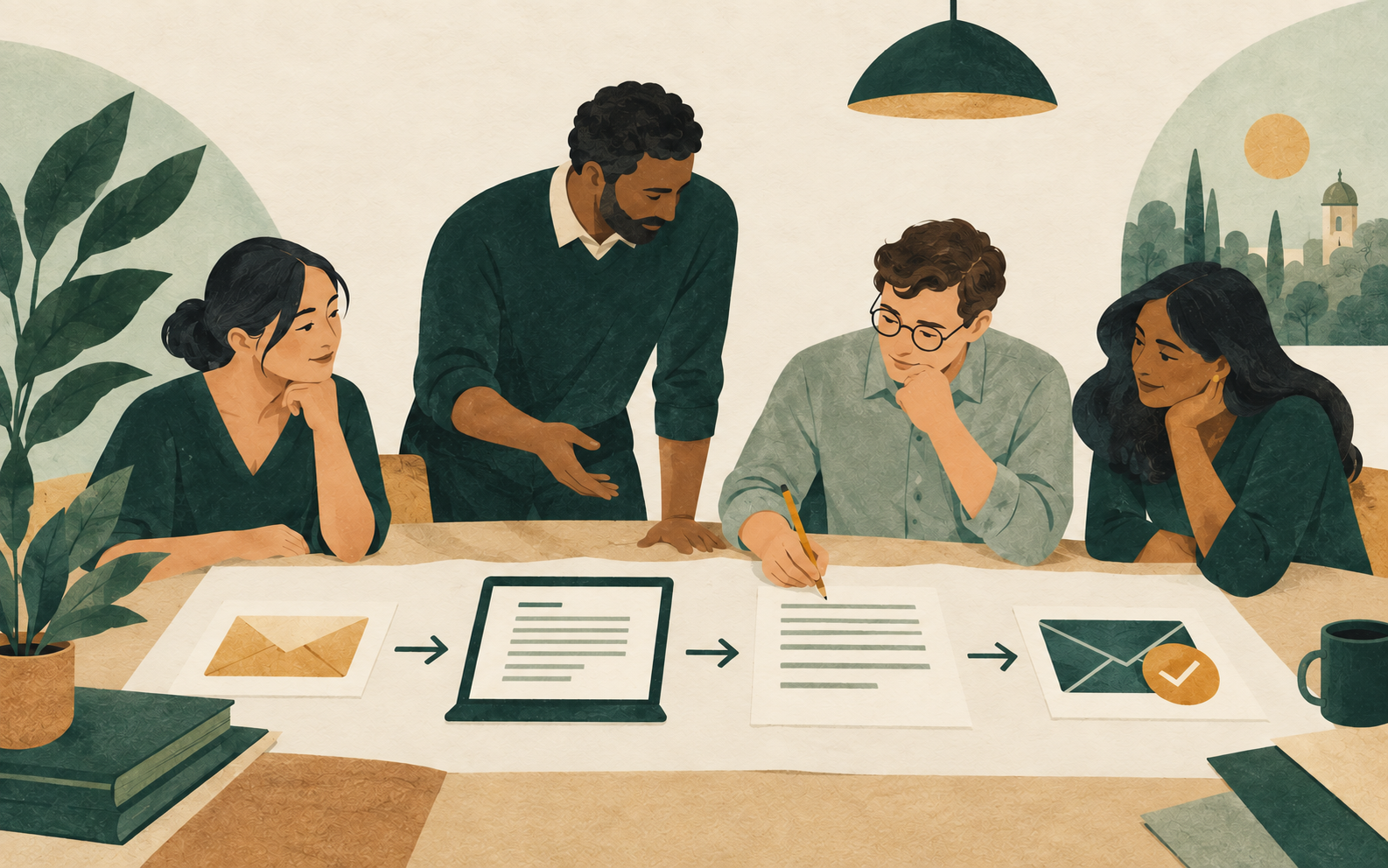
In a single session, students take a real business request, design an AI-assisted workflow for it, test what the machine produces, and decide what a professional may and may not sign. They leave with a completed workflow blueprint — an artifact you can grade and they can show.

- Design — turn a real request into an AI-assisted workflow.
- Test — find the spot where a fluent answer hides an unsupported commitment.
- Defend — decide, and argue, what the human signs and what goes back.
Formats
Start free. Continue paid. Decide on fit.
-
Step 1 · free
Guest session
60–90 minutes · no fee
The full method live with your students: the case, the workflow, the exam moment. You see exactly what a paid engagement buys before spending anything.
-
Step 2 · paid
Case lab
90 minutes · fee set with the programme
A working session built around your course's business context. Students produce and defend the artifact; grading rubric provided.
-
Step 3 · paid
Module
4 × 90 minutes · scoped with the course lead
The full arc — from business request to defendable human decision — adapted to your semester, level and accreditation structure.
Teaching in English, Barcelona on campus or by video call. Level, cases and scope are adapted with the course lead.
Before we meet
Read how he thinks.
- The shape of partnership — what human-AI partnership looks like when it actually works.
- Your notes are not the deal — where AI helps in dealmaking, and where judgment stays human.
- Case study: Vesco mining — AI implemented in a hard, physical industry.
One call decides if this fits your course.
Twenty minutes: your cohort, the level, the learning need. If there is a fit, I propose an adapted outline, format and fee. My assistant joins the call to coordinate scheduling.