Perspective AI
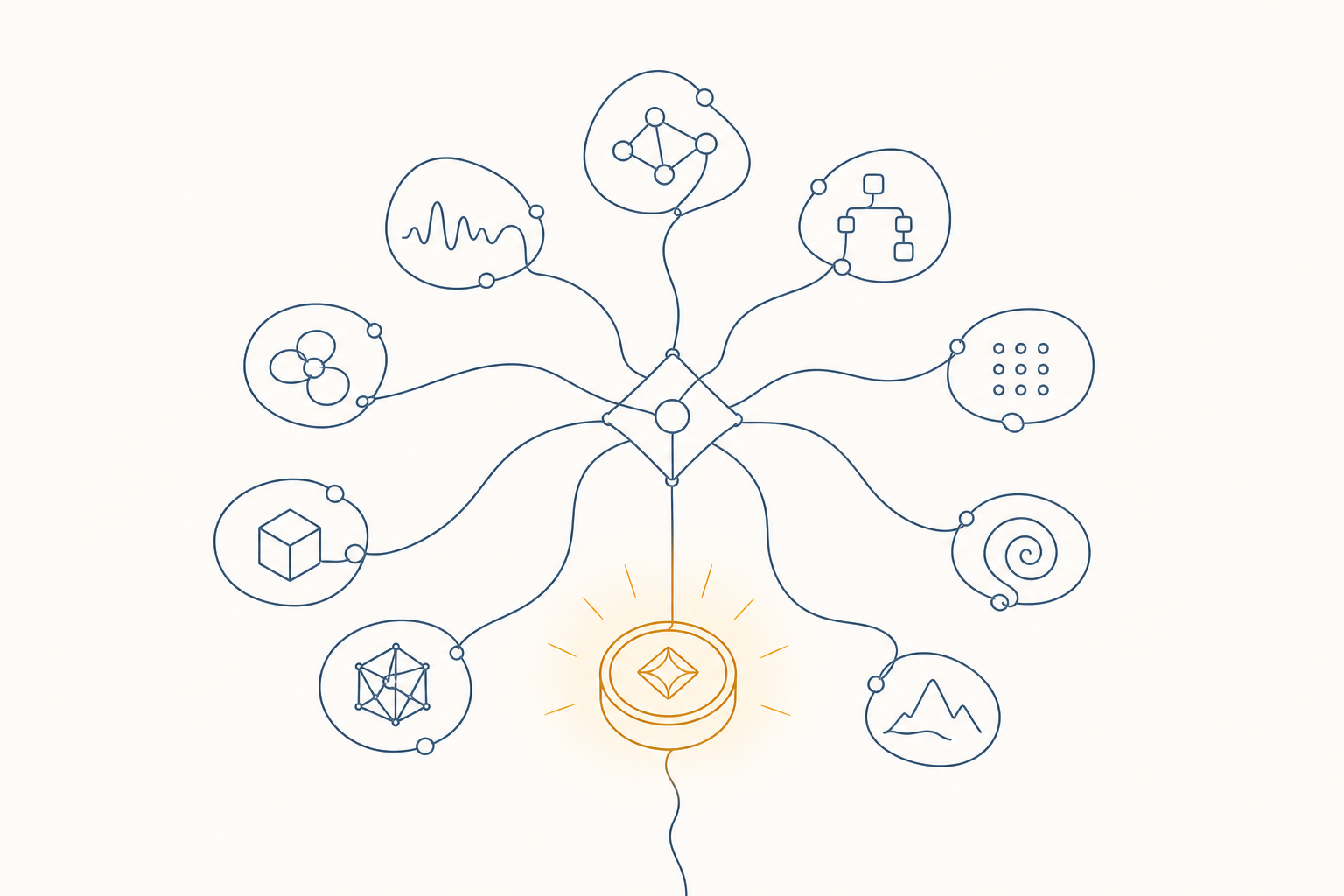
Most of the intelligence we use every day runs through a handful of doors. A few companies hold the models, the compute, the training data, and the rules about what those models will and will not say. That concentration is efficient. It is also fragile, and it quietly decides things on our behalf.
This piece is a blueprint, not a manifesto. It describes one architecture, Perspective AI, for breaking that concentration apart: a decentralized, peer-to-peer marketplace where model creators, model users, and the machines that run the network each hold a real stake. The goal is not “blockchain for its own sake.” The goal is a specific property that centralized AI cannot offer: shared intelligence without shared ownership of your data.
I want to walk through how the pieces fit, where the design is strong, and where it still has to prove itself.
The problem is structural, not moral
It is easy to frame centralized AI as a villain story. The more useful frame is structural. When data, compute, and decision-making collapse into a few entities, three failures follow almost mechanically.
- Bias becomes a single point of capture. A model trained and tuned inside one organization inherits that organization’s defaults. There are documented studies showing measurable partisan lean in leading consumer chatbots, and at least one high-profile image-generation incident where a model rewrote historical fact to satisfy a tuning objective. The specifics matter less than the pattern: when one entity sets the dials, everyone downstream lives inside that calibration. Some of the bias is loud. Most of it is subtle enough to go unnoticed.
- Contribution and reward are severed. Users generate the most valuable raw material in the system, their behavior, feedback, and data, and receive none of the upside. Meanwhile independent model creators struggle to reach diverse data at scale or to monetize what they build without a platform taking the middle.
- One global default cannot fit a plural world. A single centrally tuned model cannot reflect the norms of every community that uses it. Without local input and local governance, “alignment” means alignment to whoever owns the server, and cultural relevance is left to chance.
Centralized AI is not failing because the people running it are careless. It is failing because the shape concentrates power, and concentrated power optimizes for the center.
The fix has to be architectural. You cannot regulate your way out of a bad topology.
The shape of the alternative
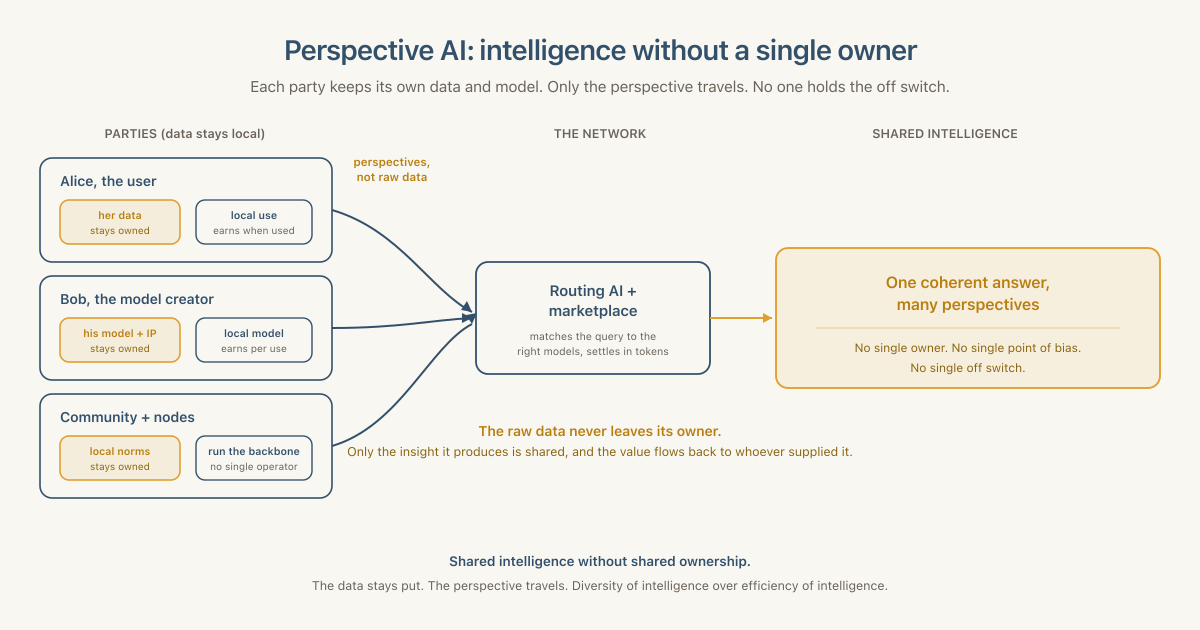
Perspective AI proposes a marketplace with three kinds of participant, and a network that settles the value flowing between them.
Borrowing the old cryptography habit of naming the cast, call them Alice and Bob.
Alice is the user. She reaches a wide range of specialized models through a single account. The difference from today is what happens underneath. Alice keeps ownership of her data. When her data, her feedback, usage patterns, contributed examples, is used to improve a model, she is compensated for it. Access stops being the only thing she gets. Contribution becomes an income line.
Bob is the model creator. He gets what is hardest to get today as an independent builder: reach into a large, diverse pool of data to train against, and a distribution channel to a user base he did not have to market to one account at a time. His intellectual property stays his. When his model is used, he earns, continuously, rather than selling it once or renting it to a platform that owns the relationship.
The nodes are the backbone. The network itself is run by independent operators who are paid in the network’s token for providing a specific utility. No single operator can take the system down, and no single operator can decide what the system is allowed to do.
That third leg is the one that makes the first two real. Without a neutral substrate, “decentralized marketplace” is just a centralized platform with extra steps.
Utility blocks: the network as composable parts
The most build-ready idea in the blueprint is treating infrastructure as a set of utility blocks: specialized node types, each owning one job, each independently rewarded for doing it. Instead of one monolith, the network is a set of cooperating functions:
- Data storage for models and datasets.
- Computation for training and inference.
- Validation for consensus and transaction integrity.
- Payment for settling token transactions.
- Smart contracts for enforcing marketplace rules and agreements.
- Access control for authentication and authorization.
- Caching for frequently accessed content.
- Incentive distribution for routing rewards to participants.
- Encryption for protecting data and privacy across the wire.
This decomposition is the part an engineer can actually start from. Each block has a contract: an input, an output, a reward condition. The surrounding system concerns, interblock communication, load balancing across available nodes, security controls, and failover to backup services, are the standard distributed-systems problems, and they have standard distributed-systems answers. For storage and compute that are not yet economical to run natively, the design leans on existing third-party decentralized storage and compute networks as a backstop during growth.
That last point is the honest one. Which brings us to the part of the blueprint I respect most.
Gradual decentralization is the adult move
The weakest version of any decentralization pitch promises a fully trustless system on day one. That promise almost always ships as either vaporware or something centralized wearing a costume.
This blueprint says the quiet part out loud: start partially centralized, decentralize each component as it becomes technically and economically feasible. Storage might decentralize before high-throughput inference does. Payment rails might harden before governance fully opens. Each utility block crosses over on its own timeline, when the engineering and the economics both clear the bar.
Decentralization is a destination you migrate toward one subsystem at a time, not a switch you flip at launch.
This is the difference between a roadmap and a slogan. It also gives the system a fighting chance at stability while it grows, instead of asking users to trust an unproven mesh with their data on the first day.
Routing AI: two doors, not one
A marketplace of specialized models has an obvious usability tax. If there are hundreds of narrow models, how does anyone know which to use?
The answer is to offer two doors.
- Direct access for the advanced user. Hand-pick the exact model, or set of models, for the job. Full control.
- Routing AI for everyone else. An intelligent intermediary sits on top of the marketplace, reads the query, and dispatches it to the most suitable model or combination of models. The user asks one question and gets one comprehensive answer, never seeing the routing underneath.
This is the layer that makes a fragmented marketplace feel like a single coherent assistant. A medical question goes to a diagnostic model. A farming question goes to a model tuned on local agronomic data. A credit question goes to a community-governed scoring model. The user does not need to know the map, but the map is still there, and an expert can always open the hood.
Routing is also where a lot of the real product quality will live. A marketplace is only as good as its matchmaker.
The token does three jobs
There is a network token (the blueprint calls it POV). It is worth being precise about what a token is actually for here, because “token” is a word that has been spent into near-meaninglessness.
In this design the token does three concrete jobs:
- Settlement. It is the unit that moves value between Alice, Bob, and the node operators. Usage pays creators. Contribution pays users. Utility pays infrastructure.
- Incentive. It is the reason a stranger runs a node or contributes high-quality data. The reward for maintaining the network is ownership of a piece of it.
- Governance. Token holders vote on proposals and protocol upgrades. Staking amplifies influence, tying a participant’s voice to their committed stake in the system’s health.
The governance leg is the one to watch closely. Done well, it is how a plural set of communities tune the network to their own norms instead of inheriting one global default. Done poorly, it is how a system that was supposed to break concentration quietly re-concentrates around whoever accumulates the most tokens. The architecture enables community governance. It does not, by itself, guarantee it. That is a design tension worth naming, not papering over.
Where this actually pays off
Abstract architecture earns its keep in concrete cases. A few where the data-ownership property changes the economics, not just the branding:
- Healthcare. A specialist builds a model to flag early-stage disease in scans. Through the marketplace, it reaches hospitals worldwide without a sales org, and it improves against a diverse pool of anonymized scans that no single institution could assemble alone. Contributors of that anonymized data are rewarded for advancing the work. The privacy property is not a nice-to-have here. It is the precondition for the data existing at all.
- Finance. Community-governed credit scoring, where users contribute financial data, keep control of it, and earn from its use. The contrast with opaque, centrally imposed scoring is the entire point.
- Local and cultural fit. Models tuned to a specific region’s norms, built on data contributed by that community, owned by that community. A single global model cannot do this. A marketplace of locally governed models can.
- Agriculture. Models tuned to local growing conditions and practices, trained on data from the farmers who retain ownership and get paid. Generic centralized tools routinely miss exactly this kind of specificity.
- Government and enterprise. Organizations that cannot expose sensitive data to a third-party cloud can deploy and improve models without surrendering confidentiality. For a whole class of regulated buyers, the centralized option is simply off the table.
The thread through all of these is the same: value flows back to the people who supply the raw material, and the model that serves a community can be shaped by that community.
What I would stress-test before building
I find this blueprint genuinely compelling, which is exactly why it deserves a hard look rather than applause. If I were taking it from vision to system, four questions would set the agenda.
- Data provenance and reward accounting. “Pay users when their data is used” is a beautiful sentence and a brutal engineering problem. Attributing a model improvement back to specific contributions, fairly and at scale, is unsolved at the margins. The incentive-distribution block carries more weight than its one-line description suggests.
- Governance capture. Stake-weighted voting aligns incentives and concentrates power in the same motion. The plan needs explicit defenses against the network re-centralizing around large holders, or it reinvents the problem it set out to solve.
- The “censorship-resistant” surface area. A network where no entity can restrict outputs is a feature for suppressed voices and a liability the moment it is pointed at genuinely harmful content. This is a real design decision, not a tagline, and it deserves a deliberate answer rather than a default one.
- Cold-start economics. Marketplaces live or die on the two-sided bootstrap. Creators need users, users need models, nodes need volume to be worth running. The gradual-decentralization plan helps, but the first turn of the flywheel is always the hardest, and the token has to make that first turn pay.
None of these are reasons not to build it. They are the build, the load-bearing problems that separate an architecture diagram from a running system.
The bet underneath
Strip away the marketplace mechanics and the token and the routing, and there is one bet at the bottom of this design: that diversity of intelligence is worth more than efficiency of intelligence.
The centralized path is genuinely more efficient. One model, one tuning pass, one set of servers, one set of rules. It is also a single point of bias, a single off switch, and a single answer to questions that should have many. Perspective AI trades some of that efficiency for plurality, ownership, and resilience, and it tries to make the trade pay by aligning everyone’s incentives instead of relying on anyone’s goodwill.
That is the right shape for the problem. Whether it ships is a question of execution, of solving provenance and governance and cold-start, not of vision. The vision is sound. Now someone has to build the hard parts.
Related reading: The Internet of Agents - the companion blueprint, where independent agents stop holding data and start coordinating decisions across silos at machine speed.