$1M for Americans, $1,200 for You. They Called It Good.
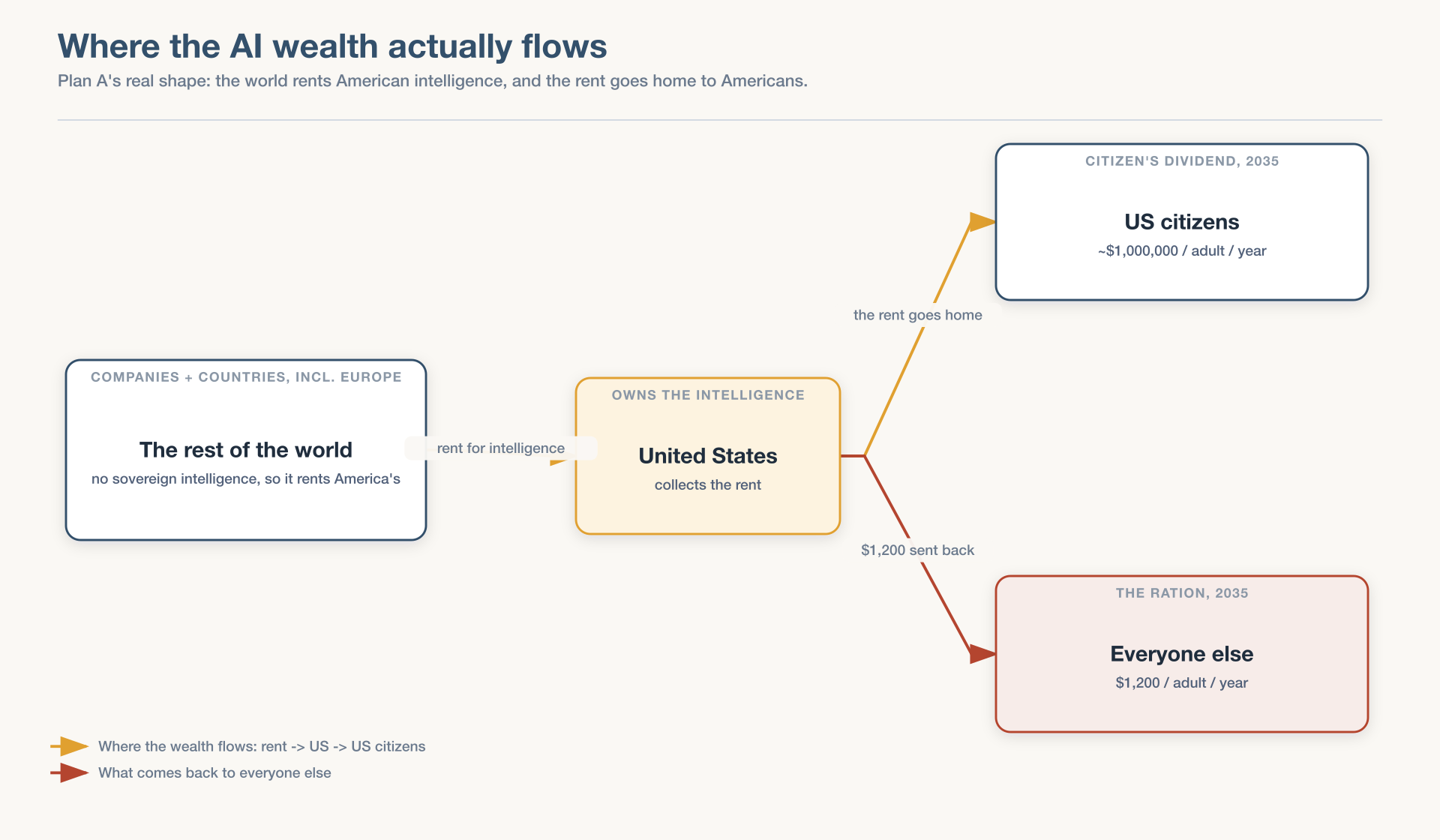
The people behind AI 2027, the most widely read AI forecast of the past two years, have published new scenarios for how the next decade plays out. In the positive one, in a document about the year 2035, there is a number with your name on it. If you are European, you will get $1,200 a year to start.
Sounds good? A little free money once the machines do all the work?
Here is the American number, from the same plan, on the same page: $1,000,000. Per adult. Per year. By 2035.
This is not a dystopian novel, and it is not their warning about a future to avoid. It is Plan A, the flagship scenario published at ai-2040.com by the AI Futures Project, and in their own words it is a vehicle for communicating and stress-testing their policy recommendations. It is the good version. The one they are arguing for.
Your first instinct is to read $1,200 as a sad little charity check. It is not charity. It is a wage. Read the plan closely and you find out what you are being paid for, and who is paying, and where the money actually comes from. Once you see that, the number stops being small and starts being sinister.
The boom runs on rented intelligence
Start with the engine. By 2035 the scenario has AIs and robots doing about 85% of all economically valuable work, up from a fifth just three years earlier. Whoever owns that intelligence owns the productive base of the entire world economy. In Plan A, that owner is the United States.
Everyone else runs on it. Companies rent it. So do whole countries, Europe firmly among them, because they never built an equivalent of their own. The mechanism the scenario uses to capture the money is a domestic one, a cap on American compute and robots and an auction of scarce permits, but do not let that hide where the value originates.
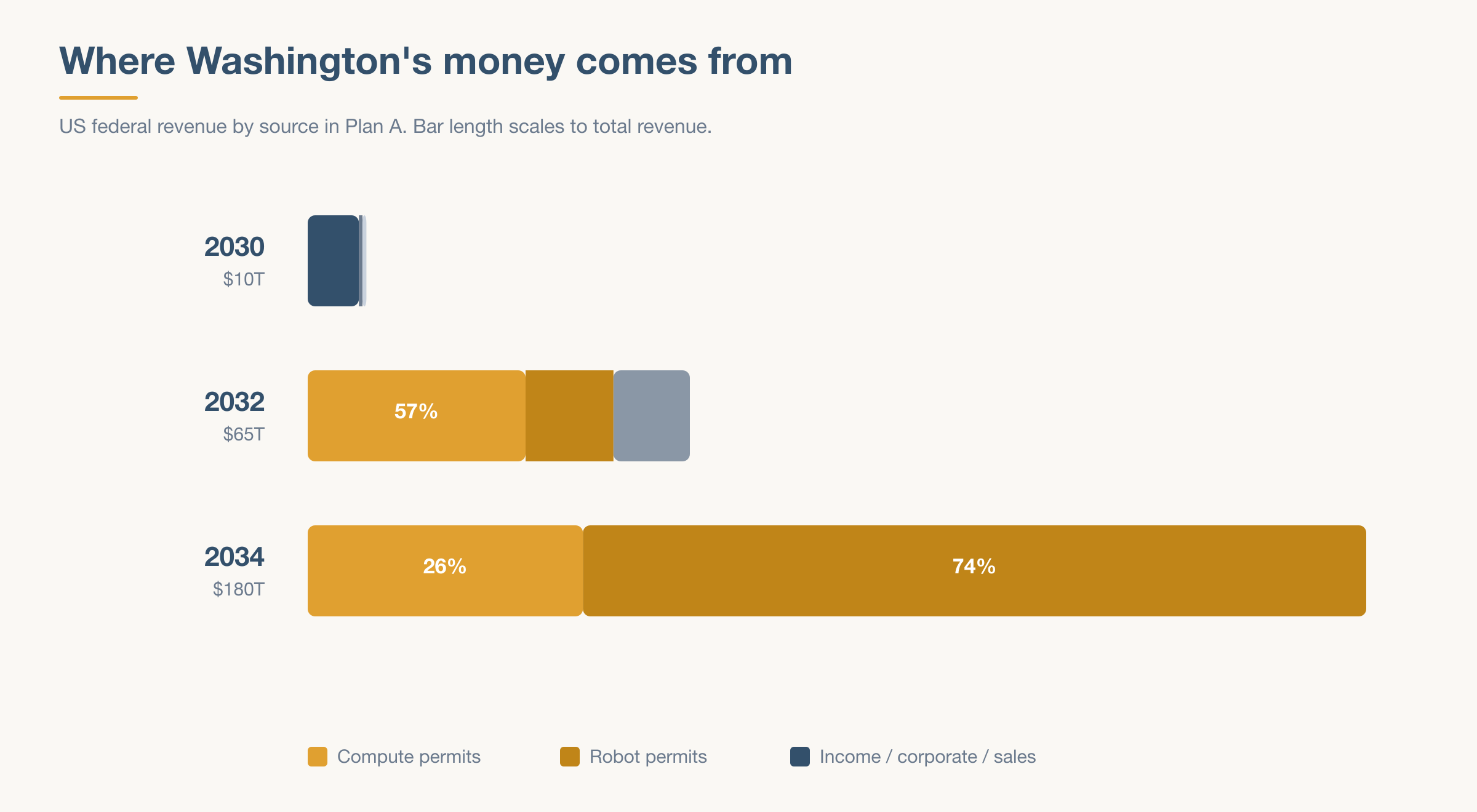
A robot permit costs around $200,000 and a chip permit around $10,000 not because Washington is greedy, but because a planet with no other supplier is desperate to run on this intelligence. The permits are sold at home. The demand that makes them cost a fortune comes from everywhere. By 2034 that tollgate collects about $180T a year, roughly ten times all US federal revenue in 2025, and by then almost nothing the government earns comes from income or corporate tax. It comes from selling the world permission to think with American machines.
The rent goes home
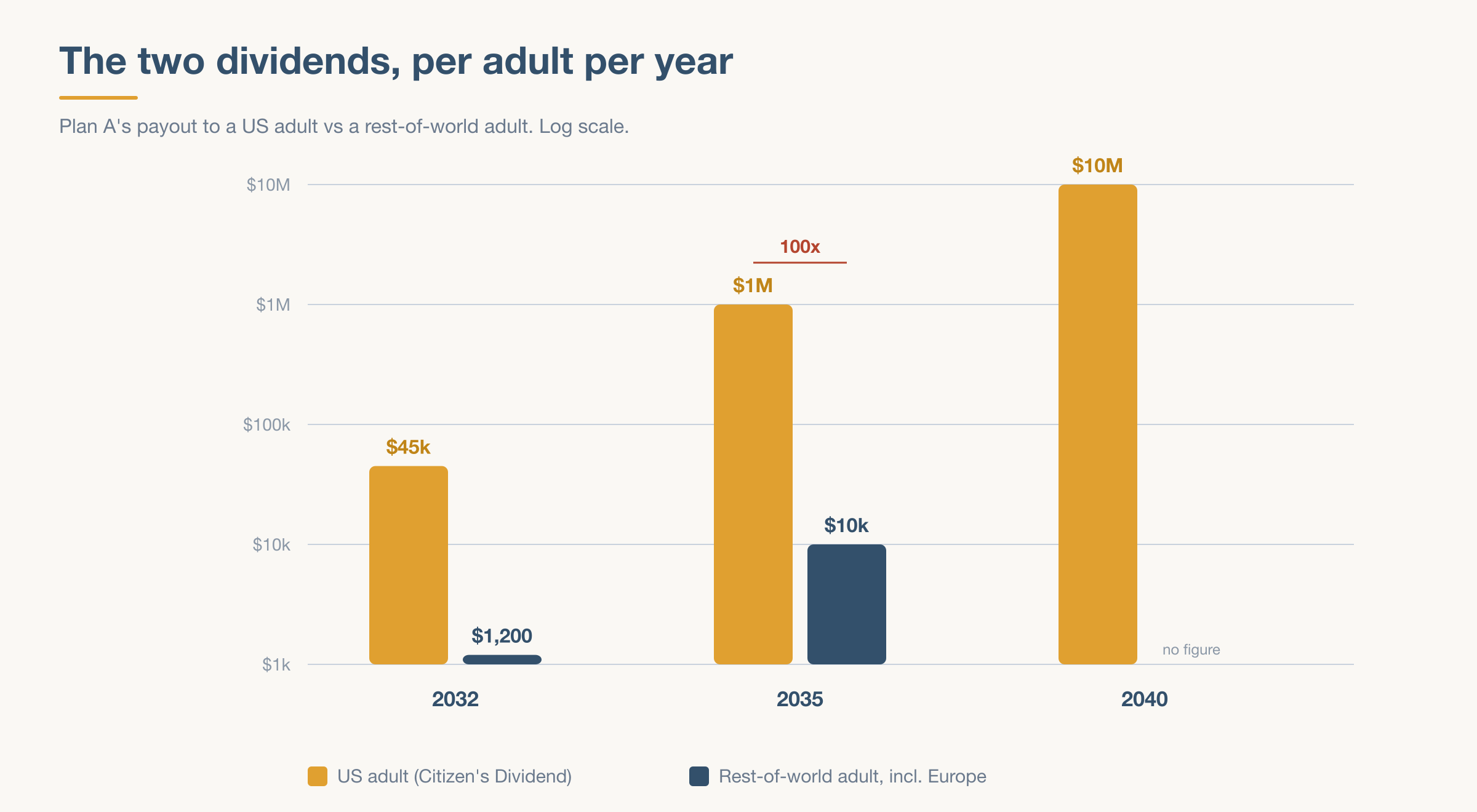
Now follow the money out the other side. That $180T does not sit in a vault. Most of it is paid straight to American citizens as a Citizen’s Dividend, because the same automation that prints the revenue is erasing their jobs too. It starts near $45,000 per American adult in 2032 and climbs to roughly $1M each by 2035, on its way to $10M by 2040. In the good plan, no American is poor.
Sit with the shape of that. The world’s economic output flows into American-owned intelligence. The rent for it is collected by the American state. And the American state pays it out to Americans, roughly a million dollars a year each, for the qualification of being American. The scenario says this almost in passing: so much AI-generated wealth has “accrued to the US,” it notes, that the government “begins sharing some of it” with everyone else. Accrued to the US. Their words. The wealth of the whole planet, gathered in one country, to be shared at that country’s discretion.
Then you get to the paragraph about the discretion.
The ration
The rest of the world, the plan says, will receive an average of about $1,200 per person per year beginning in 2032, rising to around $10,000 by 2035. Four billion adults, sorted into a single line item and paid what a rich country spends on a phone.
Understand what that $1,200 actually is. It is not your share of a jointly created boom. You did not co-own the intelligence. You rented it, and your rent is part of what paid the American million. The $1,200 is a fraction of your own money, mailed back to you, as a stipend for being unable to build your own machine. It is the wage a company town pays: you buy from the store, you live in the house, and at the end of the week they hand you back a little of what you spent so you can keep spending it.
One group is exempt, and the exemption proves the rule. China is left off the list, not out of hostility but out of respect, because China is assumed to be running its own AI boom and does not need the handout. China is a peer empire. It owns its intelligence, so it is not a tenant. The line between the $1M world and the $1,200 world is exactly the line between owning the machine and renting it.
Europe is on the renting side. In the plan drawn by the people who think most carefully about this future, the continent that gave the world the printing press, the enlightenment, and the general theory of relativity is filed under tenant and mailed a check for $1,200.
This is colonialism with a new resource
We already have a word for an economy where one power owns the productive engine, the rest of the world must pay to use it, the wealth flows back to the center, and the periphery is handed just enough to keep the system turning. The word is colonialism.
For four centuries the pattern held its shape while the resource changed. Spices, then gold, then cotton, then oil, then cheap labor. The core extracts the valuable thing, ships the wealth home, builds its own prosperity on the margin, and returns to the periphery a wage calibrated to keep it dependent and quiet. Swap the resource one more time, for intelligence, and you have Plan A exactly. The colony is any country without a sovereign model. The extracted resource is the rent on thinking itself. The $1,200 is the ration at the company store.
I am not going to argue about whether the authors intend any of this. It does not matter, and assuming malice would be the easy way to let the plan off the hook. Nobody has to be a villain to draw a colonial map. It is simply the default you reach for when your own citizens are the ones you are trying to protect and everyone else is an externality. The point is not the intent. The point is the structure. And the structure is a tribute system that routes the output of the planet to one nation and pays the rest a stipend for their subordination.
And they named it Plan A. Not the warning. Not the dystopia to be avoided. The recommendation. The good one, the target to steer toward. That is the part that should not go down easy. A world reorganized into one owner and four billion tenants is being offered, in good faith, as the humane outcome. That is how deep the hierarchy already sits: it can be drawn in full, with the numbers filled in, and still read to its authors as generosity.
China is no better, and that is the trap
If the American plan makes Europe a tenant, the Chinese one offers no landlord’s mercy. Through 2026 Beijing has moved to wall its best models off from foreign hands, treating frontier AI as an instrument of national power that does not get exported the moment it turns strategic. I wrote about that in Europe Is Running on Rented Intelligence: the honest choice forming for the world is not open versus closed, it is American models or Chinese models, and if you are not a citizen of those countries, the answer is maybe neither, on terms you set.
Put the two together and there is no rescue in the rivalry. One empire will rent you its intelligence and pay its own people from your rent. The other will not rent you the good stuff at all. Two owners, and Europe is a citizen of neither. Whichever way it leans, it ends up in the same place. Not conquered. Just paying.
The numbers are not the point
Here is the easy objection, and I would make it myself. This is one speculative scenario. The figures are invented. 2035 will look nothing like this.
Probably true, and beside the point. You do not have to believe a single number to be shaken by the structure underneath it. Strip the specific dollars away and what remains is a mental model, held by the people closest to the technology, in which the wealth of the world is owned in one place and rationed out from there. The scenario is valuable precisely because it writes that model down in plain arithmetic, and states out loud the thing almost nobody says: that some nations will own this, and the rest will be taken care of.
Once you have seen the assumption, you cannot unsee it in the procurement decision, the vendor contract, the cloud invoice. Every time a European institution wires its core intelligence to a model it does not control, it is not just buying software. It is signing up as a tenant. It is agreeing, quietly and by the month, to the $1,200 world.
Europe already wrote this down
The strange part is that none of this is news to Europe. It has already diagnosed itself, in detail, in public, and signed the report.
In September 2024, Mario Draghi handed the European Commission a 400-page study of the continent’s competitiveness. He called the situation an existential challenge. His headline number was stark: Europe needs roughly €800 billion in extra investment every year, four to five percent of its entire economy, just to stop sliding backward. On AI the gap was already concrete, not projected. In 2024 the United States produced 40 notable AI models. Europe produced three. Barely one in eight European companies had adopted AI at all.
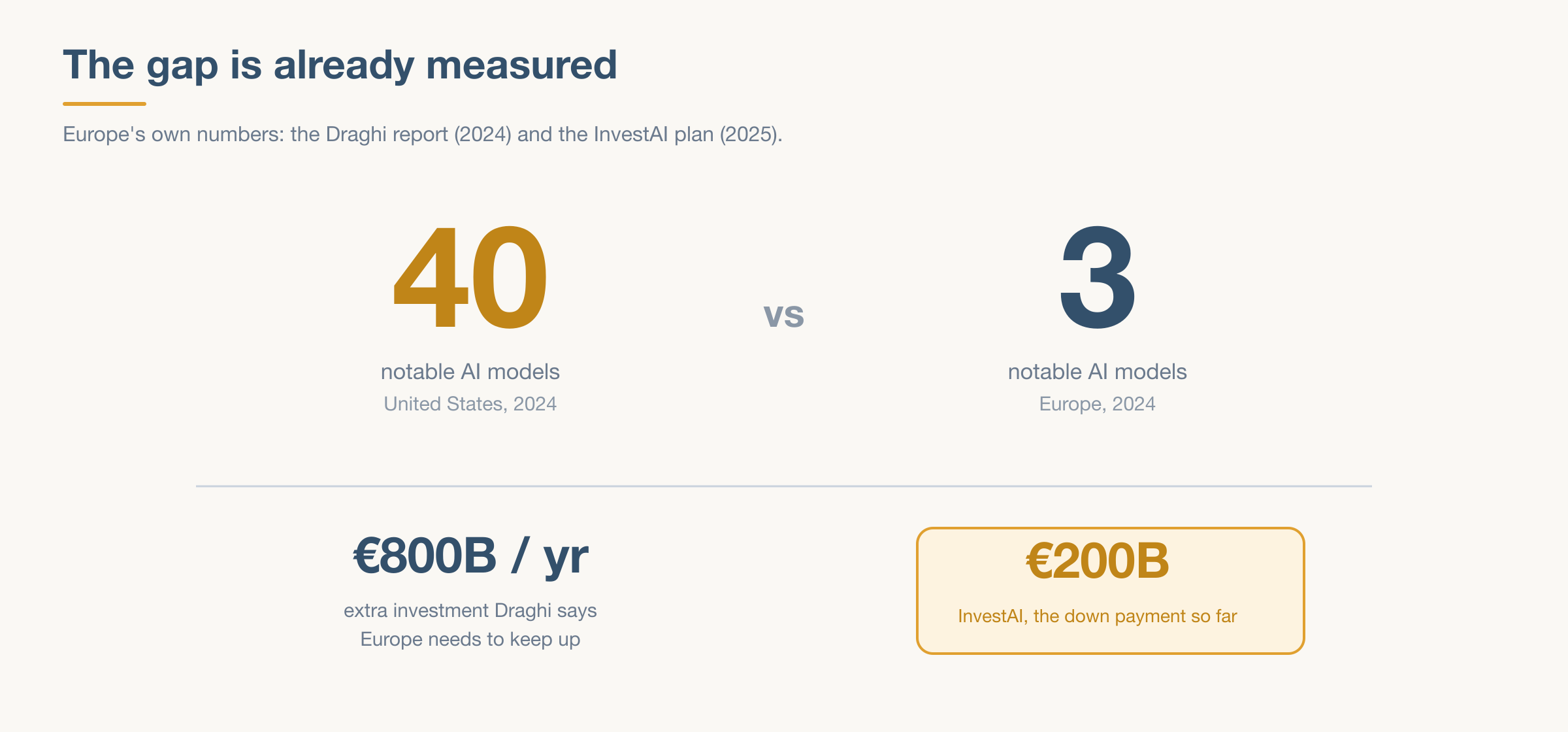
So the continent is not blind. It has even started to move. In early 2025 the EU announced InvestAI, a plan to mobilize €200 billion for AI, with €20 billion behind a handful of European gigafactories, compute at a scale that could actually train frontier models, meant to come online around 2027. That is a real down payment, and it is the right instinct.
But a down payment is not the building. Two hundred billion mobilized against an eight-hundred-billion-a-year gap is a rounding error thrown at a rounding error, and gigafactories are steel and power, not yet a sovereign model anyone can name. The distance between diagnosing the problem and owning the capability is exactly the distance between the owner’s seat and the tenant’s. Europe is standing in that gap right now, the diagnosis in one hand and the checkbook still mostly closed.
Why I am not neutral about this
I am Ukrainian. I do not need a seminar on what happens when a people assume their place in the world is guaranteed, that someone larger will always look out for them, that the good future where everyone shares fairly is simply on its way. It is not on its way. It is built, or it is lost. My country learned the price of depending on others for its security the hard way, and I am not willing to watch a continent I now call home sign up as a tenant of its own intelligence with a shrug.
The way out has not changed, and it is not complicated, only hard. A bloc that owns a frontier-class model on its own terms is a participant in the wealth intelligence creates, not a colony paying rent for access. Europe has the market, the languages the frontier labs treat as an afterthought, centuries of accumulated science and law and culture, and the one thing no rival will ever copy, a value system that puts the person above the shareholder and the state. What it does not yet have is the decision. Pooled compute, shared European weights treated as public infrastructure, data trusts that let institutions contribute without surrendering ownership, and the will to fund it like the sovereign necessity it is. Europe built Airbus, CERN, and Galileo on exactly that logic, each time it decided a dependency was unacceptable.
So do the small, concrete thing first. List every AI model your organization runs on. Flag the ones a foreign government could switch off, throttle, or reprice by decree. What is left unflagged is your sovereign capability, and for most of Europe that column is empty today. That ten-minute audit is the most honest map of your exposure you will draw this year, and it is the first line of the other plan. The one where you are an owner, not a tenant.
There is a number waiting for you in 2035. Someone has already decided it is $1,200. Decide now whether you will accept it.
Look up.
Related reading
Notes and sources
- Plan A and all economic figures: the AI Futures Project, “AI 2040 / Plan A,” ai-2040.com, with the revenue, permit, dividend, and rest-of-world numbers drawn from the scenario and its Economics of Plan A supplement. The authors state explicitly that the scenario “is NOT our best guess as to what the future will actually look like,” but “a vehicle for communicating and stress-testing our policy recommendations.” The phrasing that the wealth “accrued to the US” and that the government “begins sharing some of it” is the scenario’s own. All dollar figures are the scenario’s own, inflation-adjusted as stated there.
- The AI Futures Project is the group behind the AI 2027 forecast; named authors include Daniel Kokotajlo, Eli Lifland, Ryan Greenblatt, Thomas Larsen, Romeo Dean, and Brendan Halstead.
- On China walling off its frontier models, see the reporting cited in Europe Is Running on Rented Intelligence (Reuters, 7 July 2026).
- Mario Draghi, The future of European competitiveness, European Commission, 17 September 2024 (Commission overview). The ~€800 billion per year (4 to 5% of EU GDP) investment need, the “existential challenge” framing, the 40-versus-3 notable AI models comparison for 2024, and the ~13.5% EU enterprise AI-adoption figure are drawn from the report and its coverage (TechPolicy.Press summary).
- The €200 billion InvestAI initiative and the €20 billion for up to five AI gigafactories were announced by the European Commission around the Paris AI Action Summit, February 2025 (Commission press release); the gigafactories are targeted to come online in 2027 to 2028.
- The reading of the plan as intelligence colonialism, a one-way extraction with a token payment back, is my own, not a claim the authors make.
Common Questions
- What is Plan A and who wrote it?
- Plan A is the flagship scenario published at ai-2040.com by the AI Futures Project, the group behind the widely-read AI 2027 forecast (authors include Daniel Kokotajlo, Eli Lifland, Ryan Greenblatt, Thomas Larsen, Romeo Dean, and Brendan Halstead). They describe it not as a prediction but as a vehicle for communicating and stress-testing their policy recommendations. It is the future they are arguing for, which is exactly what makes its distribution choices worth reading closely.
- Why call it colonialism and not just inequality?
- Because the structure is extractive, not merely unequal. In Plan A the world's economic output increasingly runs on intelligence that one country owns. Everyone else pays to use it, that wealth accrues to the United States (the scenario's own word), and the US pays it out to its own citizens. The rest of the world receives a fixed stipend. Wealth flows one direction, from the many who rent to the few who own, and the dependent are paid just enough to keep renting. That one-way extraction with a token payment back is the defining shape of a colonial economy, with intelligence in the place of gold, cotton, or oil.
- Where does the $1,200 figure come from?
- From the scenario's own economics. In Plan A the US caps compute and robots and sells scarce permits, capturing on the order of $180T a year by 2034, most of which is returned to Americans as a Citizen's Dividend climbing from about $45,000 per adult in 2032 to roughly $1M by 2035. The rest of the world's adults, around four billion people and explicitly excluding China, are allotted an average of about $1,200 per person per year starting in 2032, reaching roughly $10,000 by 2035.
- What is the way out for Europe?
- Stop renting the core intelligence and build a sovereign one. A bloc that owns a frontier-class model on its own terms is a participant in the wealth intelligence creates, not a colony paying tribute for access. Europe has the market, the languages, the scientific depth, and a rights-based value system no rival will copy. It has even named the problem: the Draghi report put the investment gap at €800 billion a year, and the InvestAI plan is a first €200 billion down payment. What is missing is the decision to finish, at the scale sovereignty actually costs.