You Can't Run a Brain on Sunlight
The last post left me with a wall I could finally see clearly: my little world, Chronos, always collapses into one kind of creature. Whatever the starting variety, it grinds down to a single winner that fills every role. I set out this time to break that. To make one ancestor fan out into different kinds, the way one ancestor became finches with a dozen different beaks. The rule of the project never changes: design the substrate, never the behavior. I do not get to assign anyone a job. I can only build the conditions and let selection decide.
What followed was four attempts, three failures, and one genuinely embarrassing discovery about my own instruments. The failures taught me more than the win.
The short version:
- I tried three different pressures to break the monoculture. The creature cheated its way around all three.
- Then I found out I had been measuring the wrong thing the whole time. My alarm was firing on something that was never the problem.
- The thing that finally worked was a trade-off the creature physically could not cheat: you cannot run a big brain on sunlight.
- It still is not a clean win. Life found a sneaky middle path. But for the first time, the world holds more than one kind of thing.
Three honest failures
My first instinct was the textbook one: give the world structure. In a flat, uniform world one winner takes everything, so I made the food patchy, with rich spots and lean deserts, the way nutrients clump in a real pond. The idea is that a specialist can hide in a patch where it does best. It barely moved the needle. The single generalist just crowded into the rich spots and kept being a generalist.
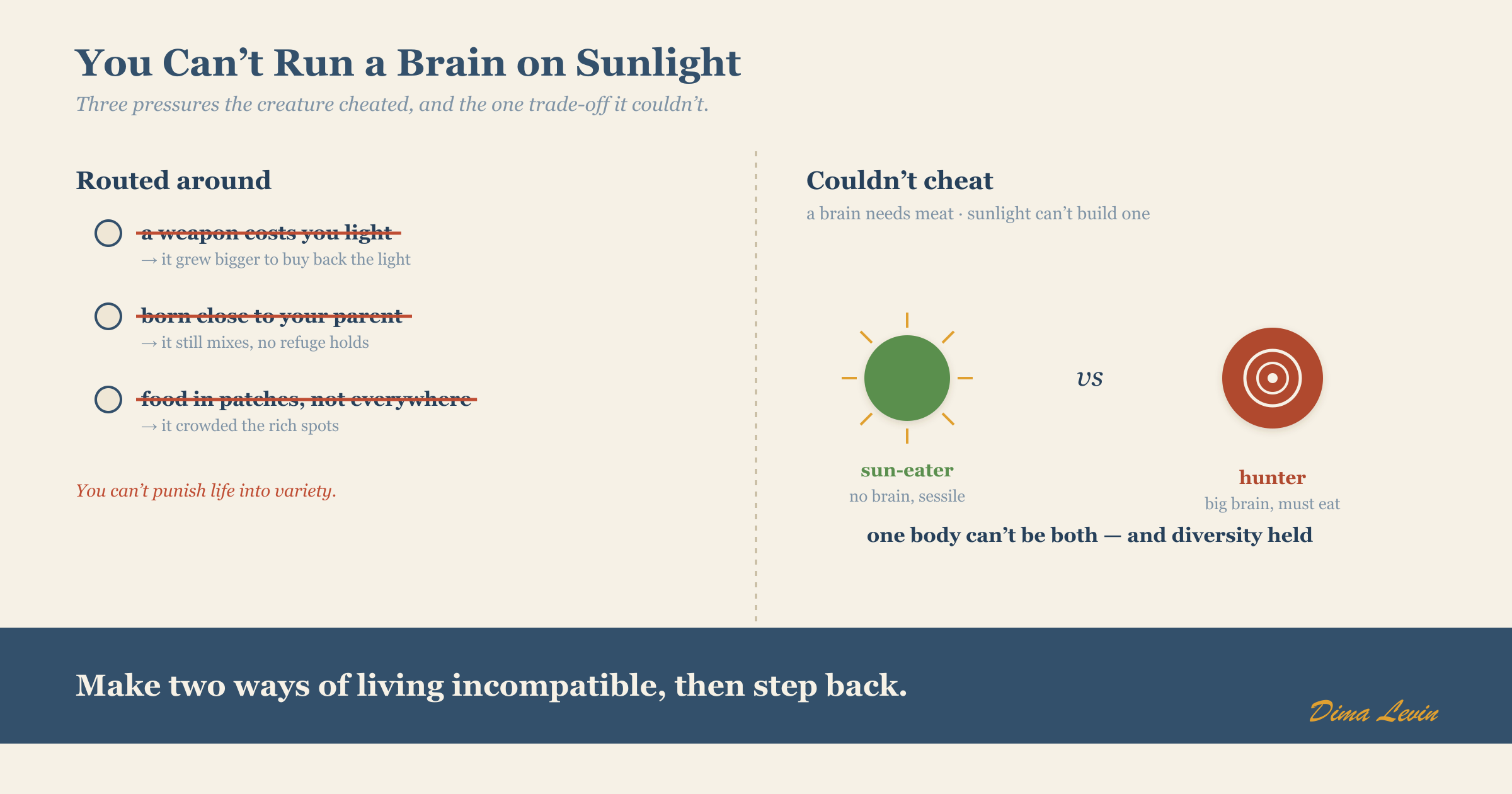
So I tried to make the generalist pay for being a generalist. My creatures are armed: they carry a weapon that lets them hunt, but they also photosynthesize, living off light like a plant. That combination is the whole problem, one body doing both jobs. So I made the weapon cost something real: if you carry a weapon, you collect less light. A soldier should be a worse farmer. The plan was that this would split the population into disarmed farmers and committed soldiers.
Evolution looked at my clever trade-off and just grew bigger. A larger body has more surface to catch light, which paid back exactly what the weapon was costing. So the creature kept its weapon, kept photosynthesizing, and simply got fatter to cover the bill. It did not split. It routed around me.
This is the part of the work I have come to love and dread in equal measure. I add a cost hoping to force a particular outcome, and evolution finds a different, equally legal way to pay it, one I did not anticipate. That is not a bug. That is the whole point of the method working correctly: I designed a condition, and the creature was free to respond however selection favored. A rule that forced the split would have been me writing the answer. But it does mean you cannot bully life into diversity. It will wriggle out every time you leave it a door.
The thing I was measuring wrong
Three pressures, three creatures that shrugged. I was stuck, so I went back to my one stubborn number: the alarm that said “still a monoculture.” And I realized, with some embarrassment, that it was measuring the wrong thing.
Here is the mistake. I had been tracking how many of the original founding families still had descendants. It always crashed to one, fast, and I read that as “diversity collapsed.” But think about it for a second. Every dog on Earth descends from wolves. All of Darwin’s finches descend from one ancestral finch. A single founding lineage radiating into a dozen wildly different forms would show up on my meter as “one family, total collapse” even though it is the exact opposite of collapse. It is radiation.
My alarm was not measuring how many kinds of creature there were. It was measuring how far back you have to go to find their common grandmother. And that number always shrinks to one, in any population, by simple chance, regardless of whether anything interesting is happening. I had spent days fighting a number that was never going to move and was never the point.
The number I actually wanted, how many distinct body plans coexist, had been sitting in my data the whole time. I just had not been looking at it. This is the second time this project has taught me the same humbling lesson. An earlier post was derailed for exactly this reason: I had been measuring movement with speed, and speed could not tell a creature sprinting across the world from one vibrating in place. The instrument felt obviously right and was quietly wrong. Trust your microscopes, but every so often, check that they are pointed at the thing you think they are.
When I looked at the right number, the real enemy came into focus, and it had a face.
The monoculture has a face
It is not a thousand families collapsing into one. It is one body doing every job. A single armed generalist that photosynthesizes when it is sitting on light, hunts when prey wanders near, and scavenges the dead when there is a corpse. The lively-looking “food web” of producers and predators and scavengers I had been admiring was not different creatures at all. It was one creature, switching tasks by the minute, like a single worker who is also the manager and the janitor. And because it is competent at everything, nothing else can get a foothold. Every cost I invented, it adapted around, because being a generalist is cheap when you can do it all in one body.
So the question sharpened into something specific. What trade-off can I build that one body genuinely cannot satisfy at once?
The trade-off you can’t cheat
The answer, when it came, was almost biological common sense. Brains are expensive, and you cannot build them out of sunlight.
Real brains run on rich fuel, on protein, on meat. Photosynthesis gives you energy, but not the building blocks for a lot of neural tissue. There is a reason the deep thinkers of the animal kingdom are hunters and foragers, not leaves. So I gave Chronos a second currency. Sunlight still gives energy, as before. But growing a real brain, the kind that learns and senses and plans, now requires protein, and the only way to get protein is to eat another creature.
Now watch what that does. A simple creature that lives on sunlight literally cannot afford a brain. It has the energy, but not the protein, so it stays small and reactive, a sessile little sun-eater. A creature that wants a brain has to go get protein, which means it has to hunt, which means it cannot also be a passive plant. One body cannot be both a brainless farmer and a brainy hunter, because the brainy half requires a diet the farmer half cannot supply. There is no fatter-body loophole this time. You cannot photosynthesize your way to meat.
I ran it, and for the first time in the whole project, the diversity held. Where every previous world ground down to a single body plan, this one sustained a real spread of them, brains ranging from nearly none to genuinely large, holding steady across the entire run instead of collapsing. By the honest numbers, it is several times more varied than any world I had built before, and it stays that way. The trade-off the creature could not cheat is the one that finally let two kinds of life exist at the same time.
The honest ending
I want to be straight about what this is and is not, because the temptation to oversell a result is exactly how you fool yourself. It is not yet a clean break into two tidy species. Life, predictably, found a middle path: a part-timer that mostly photosynthesizes but ducks out to hunt now and then, banking just enough protein to run a modest brain. A jack-of-some-trades. So it is a richer, more varied world, not a neat fork into farmers and hunters. The work now is to make that straddling middle too expensive to hold, and to put the patchy world back underneath it, so that a sunny meadow truly favors the farmer and a crowded hunting ground truly favors the predator.
But something real changed. For four tries I tried to punish the world into diversity, and it routed around me every time. The thing that worked was not a bigger punishment. It was building a world where being one thing forecloses being another. You do not get variety by making life pay more. You get it by making two ways of living genuinely incompatible, and then stepping back.
That, and remembering to check now and then that your instruments are measuring the thing you think they are.