A Mind Is a Way to Spend Less
In A Reason to Be Rare I finally got my little world to stop being one all-purpose creature and split into distinct kinds. A small fast short-sighted grazer, a large slow far-seeing hunter, coexisting and stable. So I went looking for the next thing to give it: real bodies. Not a creature that is a single blurry circle, but one that grows parts. An eye pointed somewhere. A wide eye that sees all around. The beginnings of a face.
I built all of it. And then I watched selection throw it away.
The eyes that would not stay
The machinery worked. A creature could grow a sensor, aim it, decide how far it reached, and pay for that reach in energy. Bigger eye, bigger bill. I turned it on and waited for faces to bloom.
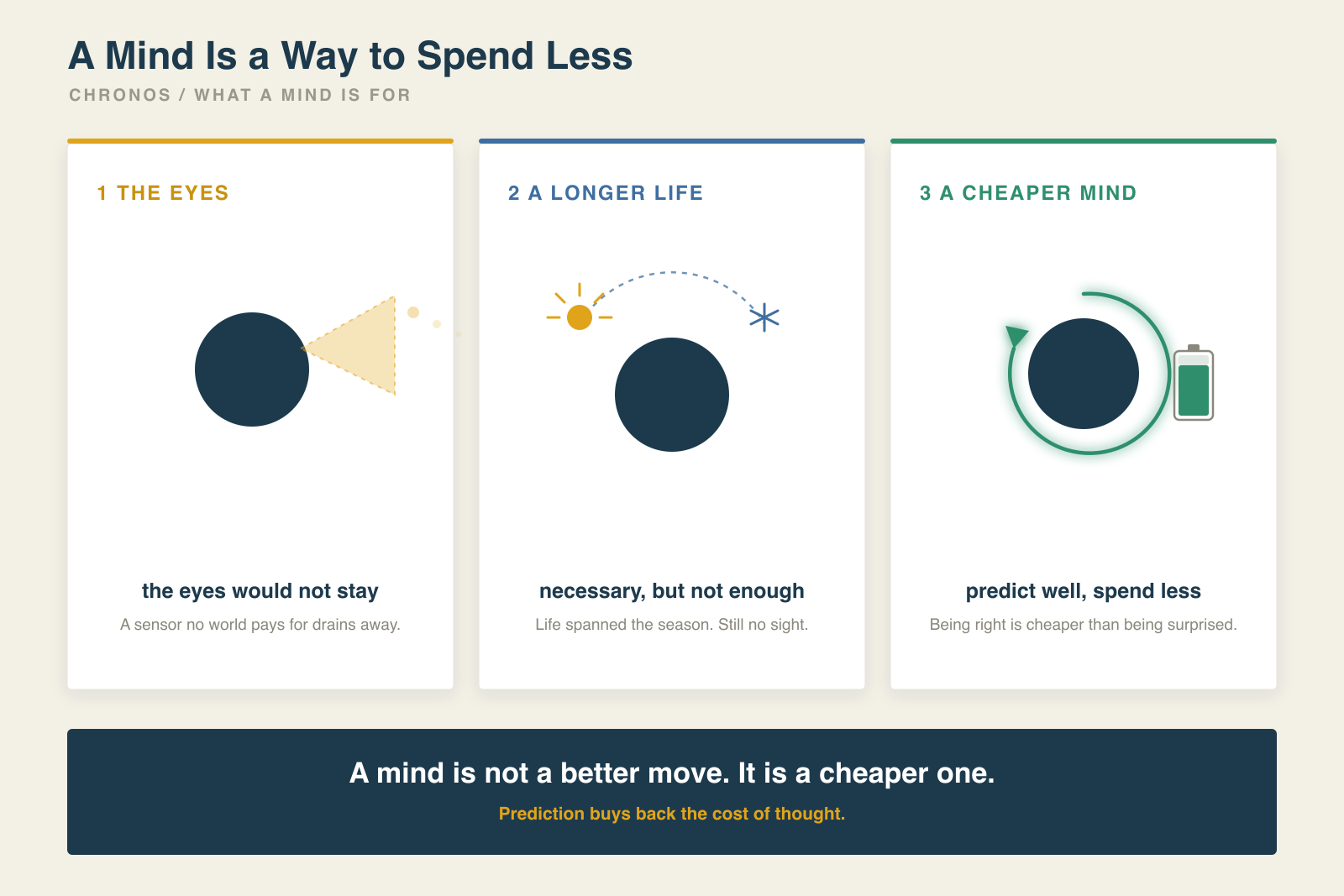
They bloomed, briefly, and then faded. Run the world long enough and the eyes drained back out of the population. Most creatures went back to being eyeless blobs.
The frustrating part is that this is correct behavior. A trait that does not earn its keep should disappear, and the fact that mine did is proof the world is honest: it does not subsidize anything. (I trust a world that throws away useless organs far more than one where everything it builds happens to be wonderful.) But “correct” was not “interesting.” The question underneath was sharper than I wanted it to be. Not can they grow eyes. Why would they ever bother.
The same wall, again
I had felt this exact resistance once before. In An Eye for Time I tried to make my creatures evolve a sense of seasons, a little internal clock, so they could feel winter coming and move before the crash. They never did. They grew shallow reflexes, a few ticks of memory, good for smoothing out noise and nothing more. No clock.
The two failures turned out to be one failure wearing two coats. My creatures lived about fifteen ticks. A season was fifteen hundred. They died inside a single afternoon of a year they would never see the end of. You cannot anticipate a winter you will not live to witness, and you cannot profit from seeing far if you will be dead before you arrive anywhere. A short life does not just limit what you do. It collapses the horizon over which anything is worth knowing. Far sight and foresight are the same bet on a future, and my creatures had no future to bet on.
So the eyes were not the problem. The lifespans were.
Giving them a future
You cannot order something to live longer. I tried the obvious version first, ages ago: I raised the ceiling on how old a creature could get. Nothing happened, because nothing was dying of old age. They were starving and being eaten at fifteen ticks, nowhere near the ceiling. Longevity is not a setting. It has to be earned, which means the world has to make earning it worthwhile.
The lever was reproduction. My creatures bred like mayflies: the instant a cell had a sip of surplus energy, it split in half and did it again. Live fast, scatter copies, die. So I changed the deal. You have to grow up before you can breed. Each child costs a real, deliberate investment, not a reflexive halving. And a parent does not dissolve into its offspring. It survives, provisions one well-prepared child, and lives on to do it again.
It worked, and it held. Lifespans went up by a factor of three to nine. The longest-lived creatures now survived through a full season and beyond, where before they had barely cleared a few percent of one. For the first time, my world had individuals with a future long enough to be worth planning for. I was certain the eyes and the clock would follow.
They did not.
Necessary is not sufficient
A long life turned out to be a thing I needed and not a thing that was enough. The creatures lived for ages now, and they still grew the same shallow reflexes and the same short eyes. I shortened the seasons so a long life would span several of them. Still nothing. I had removed the wall I was sure had been blocking everything, and behind it stood another wall, calm and unbothered.
This is the part of the work that humbles you on a schedule. Every barrier you break reveals the one it was hiding. You do not get to the bottom. You just get a clearer view of the next floor.
But the next floor, when I finally looked at it properly, held the thing I had gotten wrong from the very beginning.
What a mind is for
I had spent this entire series rewarding my creatures for making better decisions. A better move, a better trade, a sharper response to the world. And the whole time, thinking in my world had been free. The brain ran its full computation every single tick, at the same cost, whether the creature was deliberating over a hard choice or coasting through an obvious one.
If thinking is free, then a smart, expensive prediction and a dumb, cheap reflex produce the same bill. And when two strategies cost the same, the simpler one wins. That is why reaction always beat foresight. Not because foresight was worse. Because foresight was never cheaper, and in my world there was no other way for it to pay.
Here is the idea that turned it around, and it is so simple it took me far too long to see it. The point of a mind is not a better move. It is a cheaper one.
If you can predict what is about to happen, you do not have to work out your response from scratch every time. You can stop computing and start coasting. A creature that has the world modeled well enough barely needs to think at all, most of the time. The value of intelligence is not that it makes you act better. It is that it lets you act for less. Prediction is a way of buying back the cost of thought.
This is the dividend reaction can never match. A reactive creature pays full price for its cognition at every moment, forever. A creature that predicts the season is simply not surprised by it, and being unsurprised is cheap.
Making thinking cost something
So I changed one thing. I made thinking expensive, and I made surprise the bill. Each creature now carries a running prediction of what comes next. When the world matches its prediction, it pays almost nothing to think. When the world blindsides it, it pays full freight. I did not tell it what to predict or how. I only set the price of being wrong, and let selection discover that being right is a discount.
And memory started to grow. Not all the way. Not yet a clock. But for the first time across this whole arc, the evolved horizon of my creatures’ memory bent upward instead of staying a flat reflex. The mechanism pushes in exactly the direction I had been failing to push for months. It is not strong enough yet, because in this particular world the predictable part of the future is a small signal buried in a lot of fast noise, so being right about it only saves a little. But the sign is finally positive. The creatures are, for the first time, paying to know the future because knowing it is cheaper than being surprised by it.
What this is actually about
You already run on this. Almost everything you do in a day, you do without thinking, because at some point you predicted it well enough to stop computing it. Walking. Driving a familiar road. The hundredth version of a task that terrified you the first time. That is not laziness. That is the entire point of having a mind. You automate what you can predict precisely so you can spend your expensive, deliberate attention on the one thing that is actually new today.
And it scales past the individual, which is the part I find beautiful. No culture makes each new generation re-derive why incest is dangerous, or why the cliff edge is bad, or why you do not eat the bright red berries. It hands the child the conclusion, stripped of the proof, cheap to absorb and obey. “That is wrong. That is dangerous. Do not.” A few hard-won computations, compressed into rules a child can run for almost nothing, freeing that child to spend its own thinking on problems its parents never reached. Belief, in this light, is a caching strategy. It is how a lineage stops paying, over and over, for an answer it already has.
I have not built that part yet. My creatures still have to learn everything themselves, every generation, from scratch. Teaching them to hand their children cheap cached conclusions, so the species can climb instead of re-deriving, is the next thing, and it is a real line to cross, because it means letting learning become inheritance. That is a different kind of world.
But the shape of the lesson is already here, and it is the one I keep relearning in every domain I work in. Intelligence is not the ability to compute more. It is the ability to compute less, by being right about what comes next. The smartest systems I know, biological or human or built, are not the ones that think the hardest. They are the ones that have figured out what they no longer need to think about at all.
I set out to give my creatures eyes. It turns out an eye is the last thing you build, not the first. First they needed a reason to look. Then a life long enough for looking to matter. And finally a world where being right was cheaper than being surprised. The eye was never the hard part. Wanting to see was.
Related reading: An Eye for Time is the failure this essay finally explains: the seasons clock my creatures could not evolve, and why a long enough life was necessary but never sufficient.