The Next World to Build
The last post ended on a wall. I had been trying to evolve an eye for time, a sense that lets a creature feel winter coming and move before the crash, and it would not appear. The reason turned out to have nothing to do with the world. My cells live less than three percent of a season. Nothing lives long enough to watch time pass, so there is nothing to anticipate. The wall was not the weather. It was the life history of the organism itself.
I wrote, at the end, “that is the next world to build.” This post is what I did about it. It is not the cure yet. It is the part before the cure that most people skip, and the part I am most convinced matters.
The short version:
- I had four questions about how a colony of cells becomes a real individual. It turns out they are one question with four faces.
- I researched them properly instead of guessing, and the research reordered my whole plan. The thing I thought was step one secretly depends on something else.
- Before building any of it, I built two instruments and measured the world as it is today. You do not get to claim a cure worked if you never measured the disease.
- The measurement found two walls, both worse than I assumed. Now I have numbers to beat.
One question wearing four masks
The questions I started with sound separate. When does a clump of cells stop being a colony and become a single organism, the way your body is one thing and not a democracy of forty trillion votes. When would a creature ever prefer a long life to splitting into two right now. How does evolution grow a genuinely new body part, one that starts useless and later gets a job. And how does one ancestor fan out into different kinds, a sessile thing like grass and a roaming thing like a microbe, instead of everything converging on one winner.
Four questions. But sit with them and they collapse into one: how does a group of cells become an individual that values its own life, grows a body, and diversifies into kinds, all by selection, never because I told it to. Persistence, individuality, a body, and variety. Faces of the same transition.
So I sent all four out for deep research, ran each through three independent passes, and read the twelve reports looking for where they agreed. They agreed a lot. And one agreement quietly rearranged everything.
The research moved a load-bearing wall
My plan had an obvious order. Longevity first, because nothing higher can happen until a creature persists. Get them to live longer, then worry about bodies and kinds.
The research said: not so fast. A longer life is not something you can select for in a vacuum. Evolution only invests in survival when staying alive actually buys you more future children, and that only happens when the world pushes back, when resources are local and finite and competition for them is real. In a world of infinite, evenly spread food, the math always favors breeding now. “Live longer” is not selectable until the world has a reason to reward it.
And here is the part that made me sit up. That same condition, a world where resources are local and get used up where you stand, is also the cure for a completely different problem I have had since the beginning: everything collapses into a single dominant lineage. It is why an earlier experiment on mimicry never fired, because mimicry needs at least two kinds of creature to exist at once, and my world keeps boiling down to one.
So the two problems share a single root. The fix for diversity is the precondition for longevity. That moved longevity out of first place. The real first move is to build a world that can hold more than one kind of life and make scarcity local. Then longevity becomes selectable on top of it.
A plan I was sure of, reordered by reading carefully before building. That is the whole argument for doing the reading.
Measure the disease before you touch the cure
This is the discipline I care about most, and the one it is most tempting to skip. Every one of those research reports, independently, said the same thing: build the instrument before the mechanism. Measure the world as it is now. Get the baseline number. Only then change something, so you can actually tell whether it helped.
It is easy to add a feature, watch the simulation do something vaguely more interesting, and convince yourself it worked. That is not evidence. That is a story you told yourself over a graph. The honest version is boring and slow: decide what “better” would look like as a number, measure that number today, write it down, and make the future prove it moved.
So before building anything, I built two new gauges, both of which only watch and never touch the simulation, so they cannot accidentally change its results. One measures diversity: how many distinct families of creature actually coexist. The trick that makes this honest is that each cell carries a family tag it inherits and can never alter, so “the world collapsed to one family” is not a vibe, it is a count. The other measures lifespan as a fraction of a season: not raw age, but how much of a year a typical creature actually lives to see.
Then I ran eight different worlds and watched.
Two walls, now with numbers
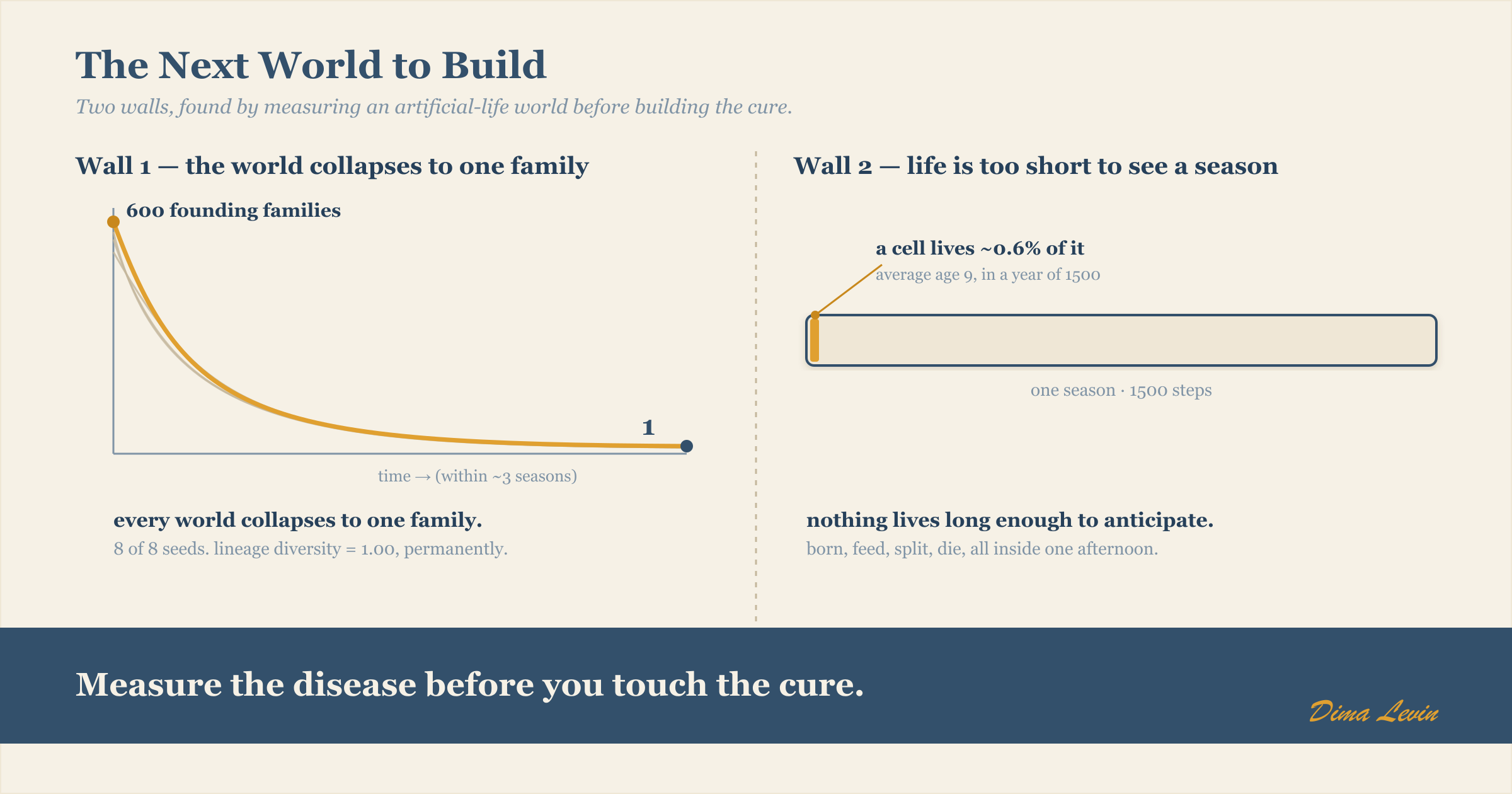
The diversity gauge was brutal. In every one of the eight worlds, the population collapsed to a single family. Not “mostly one.” Exactly one. I watched the curve: a world starts with six hundred distinct founding families, and within the first season one of them already holds three quarters of everything. By a few seasons in, the effective number of families is one, and it stays pinned there for the rest of the run, tens of thousands of steps, never recovering. This is competitive exclusion in its purest form. My world does not just tend toward monoculture. It races there and locks the door.
The lifespan gauge confirmed the wall from last time and made it sharper. A typical creature lives between a third of a percent and one percent of a single season. Put plainly, the average cell dies at about age nine, in a year that is fifteen hundred steps long. It is born, eats, splits, and dies inside one afternoon of a season it will never see end. There is nothing in its lifetime to anticipate because its lifetime contains no change.
There is one small, hopeful crack. In the world with the most multicellularity, the creatures that clumped together lived noticeably longer than the loners, and produced the single oldest individual I saw. Living as a collective already buys a little persistence, with no help from me. That is a thread worth pulling later.
Why this is the good part
I did not build anything new this round. No headline, no clip of a digital animal doing something clever. I read four research questions into one, let that one reorder my plan, built two honest gauges, and produced two unglamorous numbers: diversity collapses to one, and life is under one percent of a season.
But those two numbers are the most useful thing I have made in weeks, because now the next step cannot lie to me. When I give the world local, finite resources, I am not hoping it “looks more diverse.” I am watching one specific number that today reads exactly one, and waiting to see it rise and hold above one in the worlds that should reward variety, while staying at one in the worlds that should not. A cure has to beat a number, or it is just a nicer-looking graph.
That world, the one where food is local and runs out where you stand and competition is real, is what I am building next. The first of the four faces. A world that pushes back.