A Reason to Be Rare
Last time, in You Can’t Run a Brain on Sunlight, I told you I had finally won. After three failed attempts to make my little digital world stop being a single all-purpose creature, the fourth trade-off held. A second metabolic currency, earned only by hunting, that you had to spend to run a big brain. An autotroph in the sun could not afford a large brain. A hunter could. The population spread out. I called it a win and went to bed happy.
I owe you a correction. It was not a win. It was a slow-motion version of the same failure, and chasing down why finally taught me the one thing this whole series had been circling.
The win that wasn’t
When I let that “winning” run go long enough, the split dissolved. Not at ten thousand generations, where I had been looking. At fifty thousand. The generalist had not been beaten. It had just been beaten slowly. Given enough time, it learned to hunt occasionally, bank just enough of the second currency to run a middling brain, and fold the specialists back into itself. Three soft costs had failed outright. The fourth failed on a delay.
That is the kind of result that is annoying in the moment and valuable in hindsight, because four failures with the same shape are not four failures. They are a law you have not written down yet. (If you have ever watched a “differentiated” product quietly drift back into being a slightly-more-expensive everything-app, you already know this law in your bones.)
The thing I had never given the world
Here it is, as plainly as I can put it.
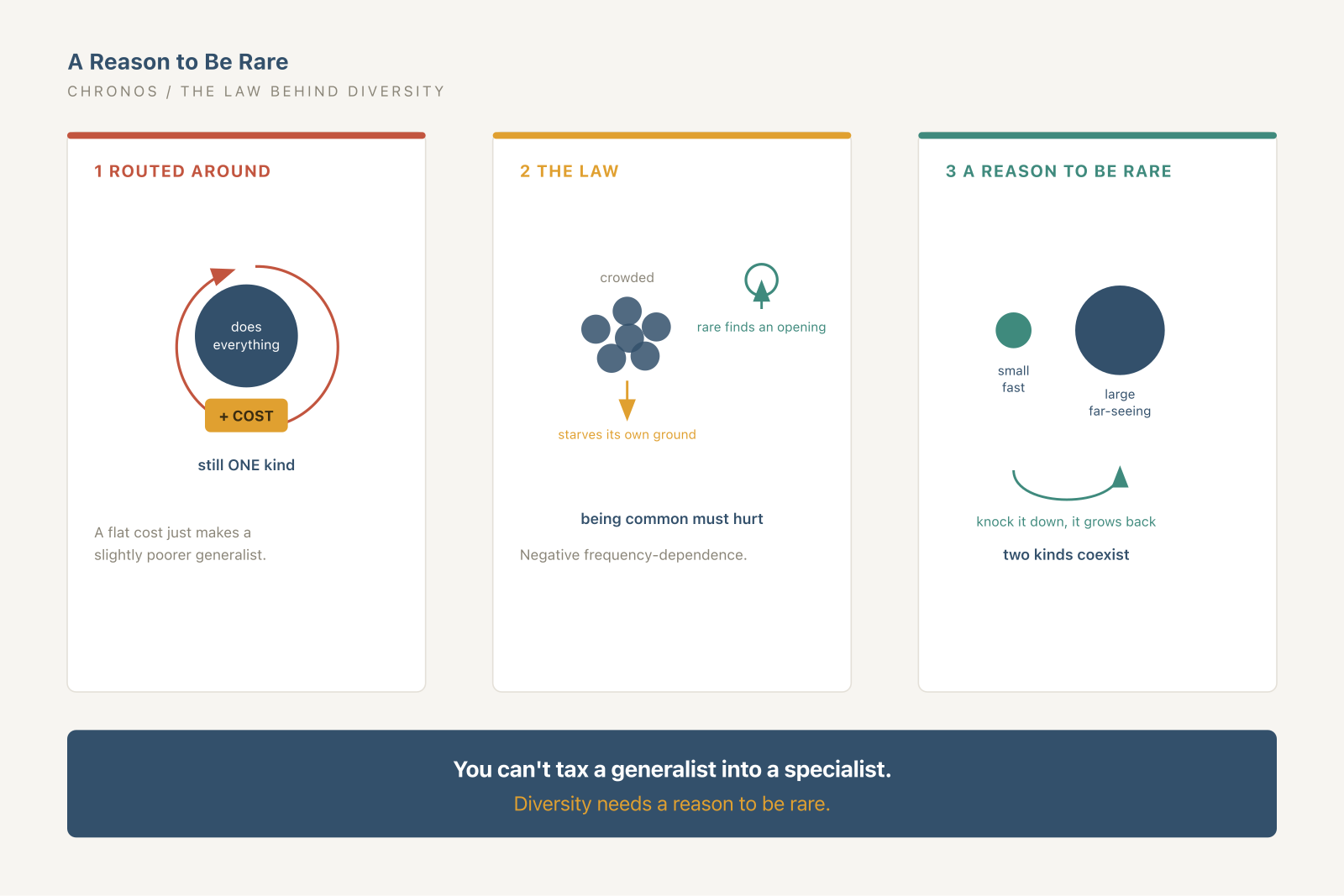
A population only splits into distinct kinds when being common is itself a disadvantage. You have to compete hardest with your own kind.
Biologists call it negative frequency-dependence. The intuition needs no jargon: if crowding onto one strategy makes that strategy worse, then every time everyone piles in, the rare alternative gets an opening and grows. The two settle into a balance. But if being common is free, the single best strategy just swallows the whole population, and you are back to one kind forever.
Every soft cost I had tried was frequency-blind. A medium brain costs the same whether one creature has it or a million do. Nothing about being common ever hurt. So nothing ever split, no matter how clever or expensive I made the penalty. I had been trying to manufacture diversity with a tax, and a flat tax does not create specialists. It just relocates the single best compromise.
Space, and a surprise about where things split
A frequency-blind world needed a structural fix, not a bigger number. So I gave it hard geography: productive patches separated by lethal-to-cross dead zones. Now your neighbors are mostly creatures like you, eating what you eat, in your patch. Crowd onto one strategy and you starve your own ground. Being common finally costs something.
For the first time, the world held a stable split across a hundred thousand generations instead of collapsing. (Getting the barrier right was its own lesson. A wall that is instantly lethal just kills everyone before they can adapt to it, so it has to fade in: gentle at first, hardening once the population has a foothold. The right amount of an obstacle is a real, surprisingly narrow quantity.)
Then the world did something I did not ask for. I had been hunting a split in bodies: a small grazer and a larger hunter. What actually diverged was minds. The creatures split into a simpler-brained kind and a more-elaborate-brained kind, with nearly identical bodies. The bodies stayed uniform because, it turns out, a flexible brain quietly absorbs the very pressures that would otherwise force the body to change. Cognition was the cheaper place to differentiate, so that is where the difference went.
This is the part of building these worlds I never get tired of. You do not get to pick what your system optimizes. You pick what is possible, and then you find out what it actually values. (The same humility runs through the whole series, from the food web that designed itself to the cells that invented an organism without being told to.)
To split the body, make the body matter
So I asked a more honest question: why would size not matter enough to split a body? I went back and read my own physics, and found the gap. Size already changed how fast a creature moved and how hard it hit. But it did not change one thing: how far it could see. A whale and a minnow perceived the same distance.
So I made bigger bodies see farther. One change. And the radiation moved onto the body: small fast short-sighted creatures and large slow far-seeing ones, coexisting, stable. The grazer and the hunter I had been chasing the whole time.
The deeper lesson hiding inside that fix: a dimension only diversifies if it is consequential in a way that makes you compete with your own kind. “Bigger sees farther” is not just one more knob. It makes same-sized creatures fight over the same far-or-near food, which is exactly the rare-advantage the law demands. Consequence is not enough. It has to be consequence against your own kind.
How I know I am not fooling myself
Two bumps in a chart are not a discovery. They can be a real split, or noise, or one blob drifting past a line you happened to draw. The usual statistics for “is this two things” lie in exactly the direction that flatters you.
So before believing any of it, I built the test that could prove me wrong. Take a finished world, knock one of the supposed kinds down to almost nothing, and watch. If it is a real niche, being rare is an advantage, so it should grow back. If it is an illusion, it stays gone, or it drifts on to swallow everything.
The real splits came back every time, on both the body and the mind: knocked to a twentieth of the population, the rare kind grew while the common one stalled, and they settled back into coexistence. That is the fingerprint of a genuine niche, and you cannot fake it.
And then the control earned its whole keep. I ran the same test on a world with no split at all, expecting a clean failure. My first version of the test called it a success anyway. Knock down half of a single drifting blob and the blob slides over to fill the gap, which looks like a triumphant rebound if you are not careful. The control caught me believing my own instrument. I fixed the test to demand that both kinds survive, not merely that the rare one grows, and only then did it tell the truth.
I have learned to trust that reflex more than any hypothesis. It is the same discipline as the bug that caught me cheating: the result is only worth as much as the test that could have killed it.
What this is actually about
You can read all of this as a story about a toy, and it is. But the shape keeps showing up everywhere I work.
You cannot tax a generalist into becoming a specialist. Differentiation does not come from making the do-everything option expensive. It comes from structure that makes being common a disadvantage: a niche that pays because few others are standing in it. Products, teams, careers, whole companies follow the same law. If you want real divergence, stop adding flat penalties to the crowded option and start building the conditions where being one-of-many actually hurts.
And the quieter half: the discovery is only as good as the instrument that could have killed it, and the control that catches you when the instrument flatters you. I spent more of this work building the microscope and the disproof than building the world. That was the right ratio.
The soup makes its own kinds now. I never told it how. I only, finally, gave it a reason to be rare.