An Eye for Time
I have been building a world called Chronos, under one rule: design the substrate, never the behavior. You build the dish (physics, energy, a genome, mutation, selection) and then you refuse to tell the organisms what to do. If a behavior appears, evolution found it, not you. Earlier posts cover the food web that designed itself and the body that invented multicellularity.
This post is about a harder question, and a more honest answer than I expected.
The question: can a creature evolve its own senses? Not use the senses I give it. Grow new ones, pointed at whatever turns out to matter, the way bats grew echolocation and slime molds “see” a maze with no eyes at all. And if it can, then in a world with seasons, will a lineage evolve an eye for time: a sense that lets it feel winter coming and move before the crash?
The short version:
- The senses worked. I removed the last hand-built part of cognition (the fixed list of sensors) and let perception itself evolve. It did. And different worlds grew different eyes.
- The clock did not. I built predictable seasons and waited for anticipation. Evolution grew short-term noise filters, not calendars.
- I tried to force it with every environmental knob: harsher winters, faster seasons, a bigger world, more food. Every one failed.
- The reason is not the world. It is the lifespan. My cells live less than three percent of a year. No creature ever lives to see a season change, so there is nothing to anticipate. You cannot evolve foresight in an organism that dies inside a single afternoon.
Removing the last designer’s hand
Here is a thing that quietly bothered me about my own simulation. The brains were free. Each cell’s neural network evolved its own wiring and even its own size; I never drew it. But the inputs to that brain were a list of fifteen sensors I had hand-picked: distance to food, a hazard gradient, crowding, and so on. I had decided, in advance, what the world was made of as far as a cell could tell.
That is the last place the designer’s hand was still inside the creature’s head. So I removed it.
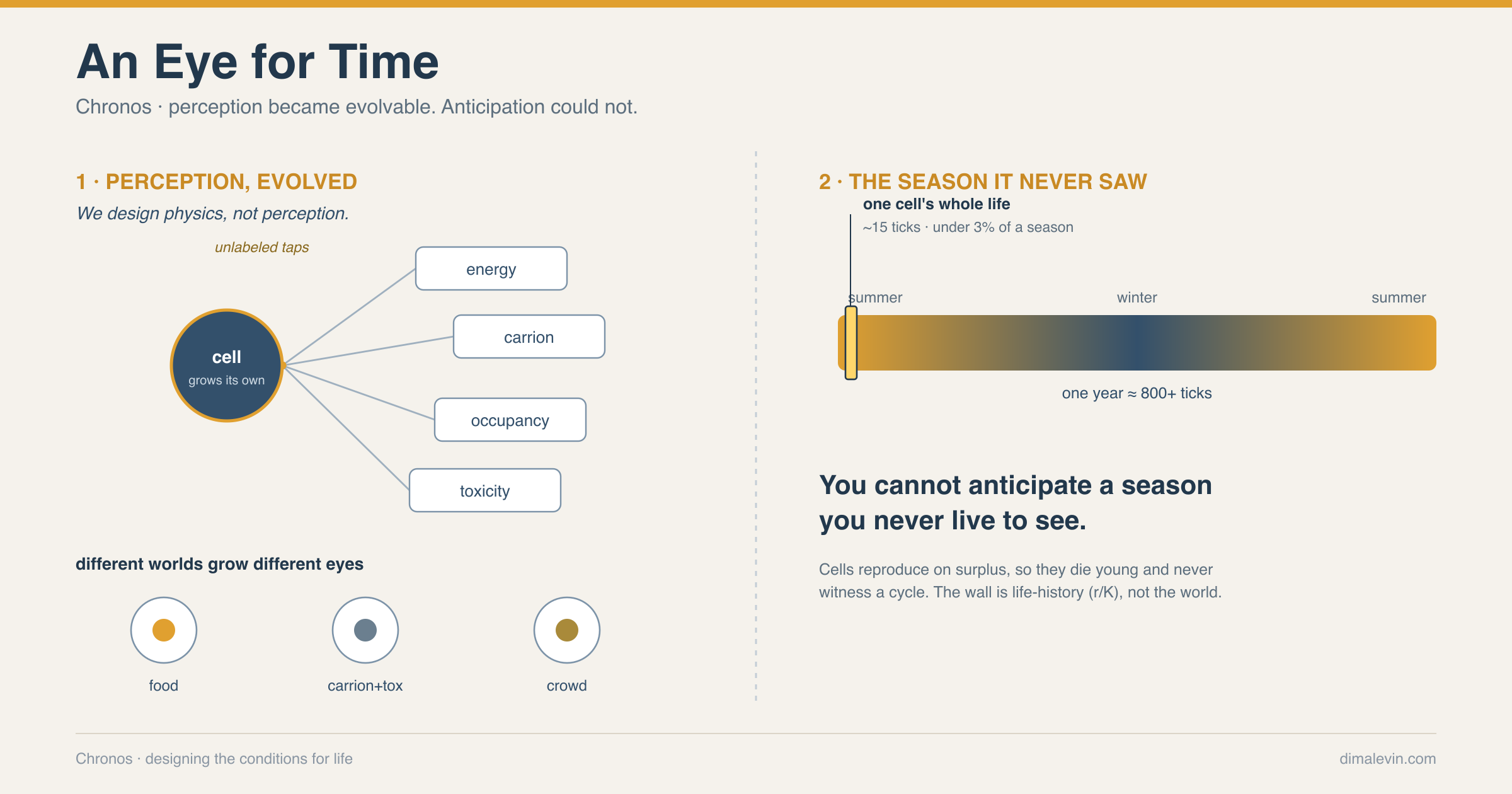
The trick was to move the boundary of what I design down one level. I do not design perception; I design physics. The world has real physical quantities (an energy field, dead biomass, the presence of other cells, toxicity) and those exist whether or not anything senses them. A receptor then becomes an unlabeled tap: it samples some field, at some offset from the cell, and hands the brain a number with no meaning attached. The cell does not know “this is food” or “this is a predator.” It just gets a value, and evolution decides what to do with it, where to point it, and whether it is worth the cost of having at all. New receptors arrive by the same mutations that grow the brain. They cost a little energy, so a sense that does not pay gets dropped.
We design what the world is. We do not design what a creature can notice. Perception goes under selection, like everything else.
Different worlds grew different eyes
It worked, and the result is the part of this story I am proudest of.
Start the cells nearly blind and let them run, and senses appear. Most cells end up “sighted,” carrying one to three evolved receptors. But the beautiful part is that the senses they grow depend on the world they grow up in. In one world the population evolved mostly food-sensing. In another it grew receptors tuned to dead biomass and toxicity, which is exactly the sensory kit a scavenger would want. In a third, crowded one, cells grew senses pointed at each other.
I did not design a single one of those senses. I exposed the physics and let selection grow an eye for whatever paid off locally. You can now read a world’s priorities off the senses its creatures evolved. That is the whole thesis of this project working on a brand new surface: not “I built a food sensor,” but “this world made food worth seeing, and so an eye for food appeared.”
Then I asked for a clock, and got a smudge
Now the hard part. I gave the world seasons: a predictable, repeating cycle of good and lean times that sweeps across the map. Predictable and repeating is the key. A one-off event can only be reacted to. A cycle that returns can be anticipated, and anticipation is a real rung up the ladder of intelligence. It is the difference between fleeing winter once it arrives and leaving before it does.
To make anticipation possible without handing it over, I gave receptors a memory: a tunable knob that lets a sense report not the value right now but a smoothed average of what it has been. Pair a “now” sense against a “remembered” sense and a brain can, in principle, compute change. It can build a clock out of parts, if a clock is worth building.
It built noise filters instead.
Memory senses evolved everywhere, abundantly. But they settled on very short timescales, a handful of moments, not the length of a season. And here is the tell: they were just as common in a frozen, seasonless world as in a seasonal one. A sense that is equally useful whether or not time has structure is not tracking time. It is smoothing out the jitter of a moving cell’s view. Useful. Not a clock.
No anticipation. I had given evolution every material to grow an eye for time, and it had politely declined.
Chasing it down the wrong road
I assumed I had the world unbalanced, so I started turning knobs. This is the part where the project’s own rule saved me from myself, because the rule says: if you have to force a behavior with parameters, you have not discovered it, and you are probably about to fool yourself.
I made winter near-lethal. No anticipation; the harsh worlds just died faster. I sped the seasons up so the cells could not casually outrun them. Nothing. I checked the geometry and found the embarrassing truth that a cell can stroll across the entire climate of the world in a third of the time a season takes to arrive, so why would it ever need to predict anything. So I rebalanced the space and time. Still nothing.
Then I built the one instrument I had been missing, and it ended the search.
I had been measuring movement with speed, and speed lies. A cell vibrating in place looks identical to a cell on a long migration. So I measured distance from birthplace instead: thrashing stays near zero, true travel grows large. The moment I could see the difference, the answer fell out, and it was not about the world at all.
You cannot anticipate a season you never live to see
The cells were dying young. Not from old age. From running out of energy. Average lifespan: ten to twenty ticks. A season in these runs is hundreds to over a thousand ticks long.
A cell lives less than three percent of a single year.
It is born, it feeds, it splits, it dies, all inside one afternoon of a season it will never see the end of. It never experiences winter following autumn, because it does not live long enough to experience any change of season even once. There is no pattern in its lifetime to learn. Anticipation has nothing to anticipate.
And I could not buy the cells more life. I raised the maximum age tenfold: no change, because nothing was dying of old age anyway. I flooded the world with ten times the food, betting that richer cells would live longer: they lived shorter, because a cell with surplus energy does not bank it for a long life. It immediately spends it on a child. My organisms are, by their very architecture, the kind of creature that breeds fast and dies young. Biologists call it an r-strategist, and in a dangerous, crowded world it is the correct strategy. Foresight is a luxury of the long-lived, and my cells had chosen, by selection, not to be.
So the wall in front of anticipation was never the world. It was the life history of the organism itself. You do not get an eye for time by making the seasons crueler or the map bigger. You get it only if creatures live long enough to see time pass, and mine had every reason not to.
What it cost, and what it bought
I did not get the headline I went looking for. There is no triumphant clip of a digital animal sensing winter and setting off ahead of it. I want to be honest that the thing I hoped for did not happen, and that the reason it did not happen is more interesting than the win would have been.
Because underneath the failed clock is a real result. Perception is now under selection in this world. I took away the last piece of cognition I was still hand-designing, and evolution filled the gap, growing different senses for different worlds with no help from me. That is not a small thing. It means the creatures are now discovering what is worth noticing, which is a kind of intelligence I never wrote a line of code to produce.
And the negative result is itself a finding I will keep: a capability is not always blocked by a world that needs rebalancing. Sometimes it is blocked by what the organism is. An eye for time is not waiting on a kinder or a crueler season. It is waiting on a creature that lives long enough to watch one go by.
That is the next world to build.