Saving Is Older Than Planning
In A Mind Is a Way to Spend Less I finally got my creatures to start paying attention to the future, and only barely. I made thinking cost energy, made surprise the bill, and watched their memory bend upward for the first time. Not all the way to a clock. Not enough to feel winter coming. Just the first faint pull in the right direction after months of flat reflexes.
I had been chasing that one thing across the whole series. Foresight. The ability to see a season turn and move before it does. And every road I took ran into the same quiet refusal. My creatures would react, beautifully, instantly, to whatever was in front of them. They would not look ahead.
So I stopped trying to fix the mind, and I changed the body instead.
A body you can spend
Here is the idea, and it came from a simple principle I keep coming back to: do not tell evolution what to invent, just unblock something and see what it does with it. Until now, every creature in my world was born at a fixed size and stayed that size for life. Its body was a constant. I made it a variable.
Now a creature can grow its own body, spending energy to add mass, and it can do the reverse, breaking its own body back down into energy when it needs to. Within a single life. I did not tell it to store food for winter. I did not build a fat reserve or a larder or a hibernation rule. I just made the body something a creature could spend, gave it a single dial to push in either direction, wired that dial into its brain, and let selection decide whether to ever touch it. Storing, if it happened at all, would have to be discovered, not installed.
The bug that caught me again
I should tell you about the part where I caught myself cheating, because it is the part I trust most.
When a body can grow, a bigger body should be able to hold more energy. That is just physics, a bigger tank holds more fuel. So I wrote it that way: the larger you are, the more you can store. Reasonable. I turned the world on and watched the creatures balloon. Generation after generation they got born bigger, and bigger, with no end in sight.
For a moment I thought I had found something. Then I built the control that kills the story. I ran a version where the body could not actually change within life, where the only thing left was that bigger-is-a-bigger-tank rule. And it ballooned just the same. The growth I was so pleased with had nothing to do with creatures cleverly managing their bodies. It was a dumb gradient. Being born big was simply free advantage, so they were born big, and bigger, forever. I had not measured storage. I had measured a loophole I left open.
This keeps happening to me in this project, and I have made my peace with it. The first time, in The Bug That Caught Me Cheating, a behavior looked perfect because I had quietly programmed it. This was the same lesson wearing new clothes. A result you love is a result you have not yet attacked hard enough. So I fixed the rule: the reserve comes only from mass you actually grow during your life, not from the size you happened to be born. Born big buys you nothing now. The loophole closed, the ballooning stopped, and the real question was finally allowed to answer itself.
The other thing I had to fix was subtler. I had a readout that was supposed to tell me whether a creature kept the wiring for growing, and it was stuck at full, always, even in worlds where growing did nothing. The reason was that I had given the creatures a way to grow the wiring but no way to ever shed it. A trait you cannot throw away is a trait you cannot trust, because you can never tell whether the world is keeping it or just unable to lose it. I gave them the ability to drop it. And immediately the number came alive: in worlds where the body was useless, the wiring drained away, and in worlds where it paid, it stayed. The whole spine of this project is that real evolution throws away what it does not need. An instrument that cannot show you the throwing-away is not measuring evolution at all.
What happened when winter came
With the loophole shut and the instruments honest, I gave the world seasons and watched.
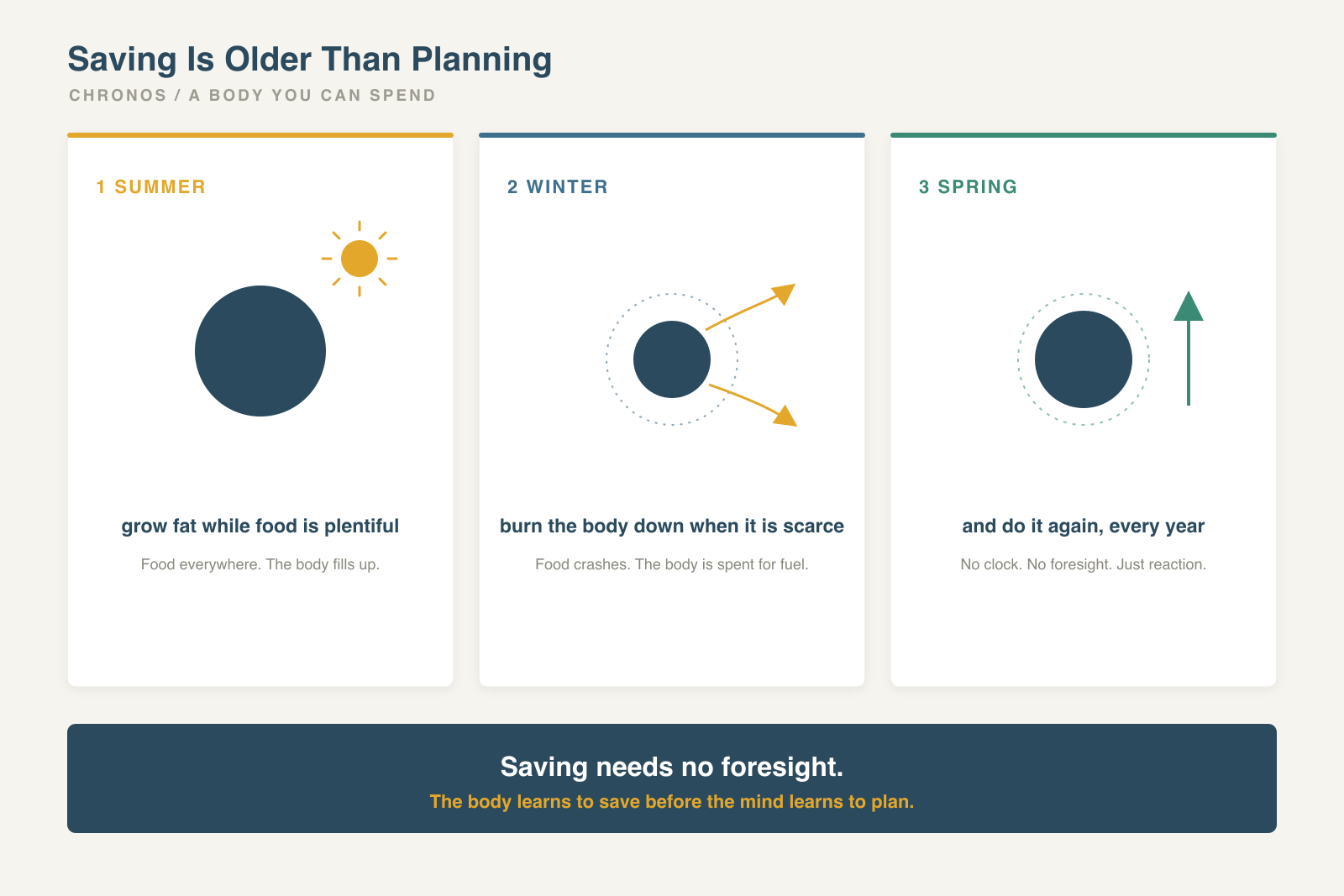
A rhythm appeared, and it was the same every year for sixty years. Through the summer, when food was everywhere, the creatures carried a larger body. When winter bit and the food crashed, they broke that body down, burning their own mass back into energy to live through the lean stretch. Then spring came and they rebuilt. Grow fat in plenty, burn lean in want, recover, repeat. Nobody told them to. The dial I had handed them, the one they were free to ignore, had been recruited into a seasonal cycle of saving and spending.
And it paid, plainly. In the worlds where this rhythm took hold, the population ran larger than in the worlds without it, often around twice as large and in the best case nearly three times. A body you can spend turns out to be a body that carries more life through the year.
The thing it is not
Here is the part I want to be careful about, because it is the whole point.
This is not foresight. I checked, closely. If these creatures were anticipating winter, their bodies would start shrinking before the cold arrived, getting lean ahead of the crash. They do not. The body stays full right up until the food actually fails, and only then does it start to burn down. The shrinking lines up exactly with the scarcity, not a step ahead of it. There is no clock in here. There is no creature feeling the season turn. There is only a body reacting, honestly and a little late, to the world as it is right now.
And that is exactly why it matters. I spent this entire series trying to make my creatures see the future, and failing, and here is half of what I wanted falling out for nothing. Saving does not require foresight. You do not need to know winter is coming to survive it. You only need a body that fills up when there is plenty and draws down when there is not. The simplest, oldest half of preparing for the future is just reacting to the present and keeping the surplus.
Saving is older than planning.
Why this might be the missing piece
There is a reason I find this more than a tidy result. For months the clock would not grow because, I think, a long memory had nothing to do. Even if a creature could feel the season turning, what would it do with the feeling? Move, maybe, in a world where moving barely paid. The foresight had no job.
Now it has one. The body’s growth is worth timing. A creature that could sense winter coming could start saving a little early, top off its reserves while the topping is good, so it meets the crash already full instead of getting caught with an empty tank. For the first time, knowing the future would buy a creature something concrete. The reactive saver leaves money on the table at exactly one moment: the turn, when it is still spending as if it were summer and winter is already on the way.
That gap is where foresight could finally pay for itself. Which makes me suspect anticipation was never going to be a separate invention dropped in from above. It is more likely a refinement of thrift. First you learn to save by reacting. Then, if it is worth it, you learn to start a little sooner. The mind does not invent the future from scratch. It sharpens something the body was already doing.
I have not shown that yet. That is the next experiment, and I have written down exactly what would count as the creature crossing that line, before running it, so I cannot fool myself into seeing it. But the ground it would stand on is finally here.
What this is actually about
You know this one in your own life, even if you have never named it.
The people and the companies that survive a bad winter are almost never the ones who predicted it. Forecasting is hard and mostly wrong. What carries you through a shock is rarely foresight. It is a buffer. Savings you built when times were good and did not strictly need. Slack in the schedule. A skill kept sharp for no immediate reason. Muscle, fat, cash, redundancy, a friend you stayed close to. None of it requires you to know what is coming. All of it requires you to have kept a little more than you spent when you could.
That is the deep version of what my creatures found. Resilience is mostly just thrift with a long memory, and the thrift comes first. The reserve you build by reacting sensibly to good times is what lets you live through bad ones you never saw coming. Most of what looks like wisdom about the future is really just a body, or a balance sheet, or a habit, that quietly kept the surplus.
I went into this trying to teach a creature to see ahead. What it taught me instead is that you can get most of the way to surviving the future without seeing it at all. You just have to stop spending everything the moment you have it. The seeing comes later, and it comes cheaper, because by then the body already knows what the saving was for.
Related reading: A Mind Is a Way to Spend Less is the other half of this story, the attempt to grow the foresight directly. And An Eye for Time is where the whole search for a clock began.