A Body Invents Itself
In my last post I described Chronos, a small world I built and then refused to give instructions to. The rule is the whole point: design the substrate, never the behavior. You make the physics, the bodies, the energy, the rules of birth and death. Then you let the organisms write themselves, and you report honestly what they do, including the times they do nothing.
That post ended with a producer-predator food web that designed itself, and a promise: more to come. This is the more. It is, by a wide margin, the most striking thing the world has done. A population of single cells invented a body.
I want to be careful with that sentence, because it is the kind of claim that should make you suspicious. So this post is the slow version: what “a body” actually means here, why I am confident I did not secretly program it, and the part I find most honest, which is that for a while I could not even see the thing I had grown.
The short version:
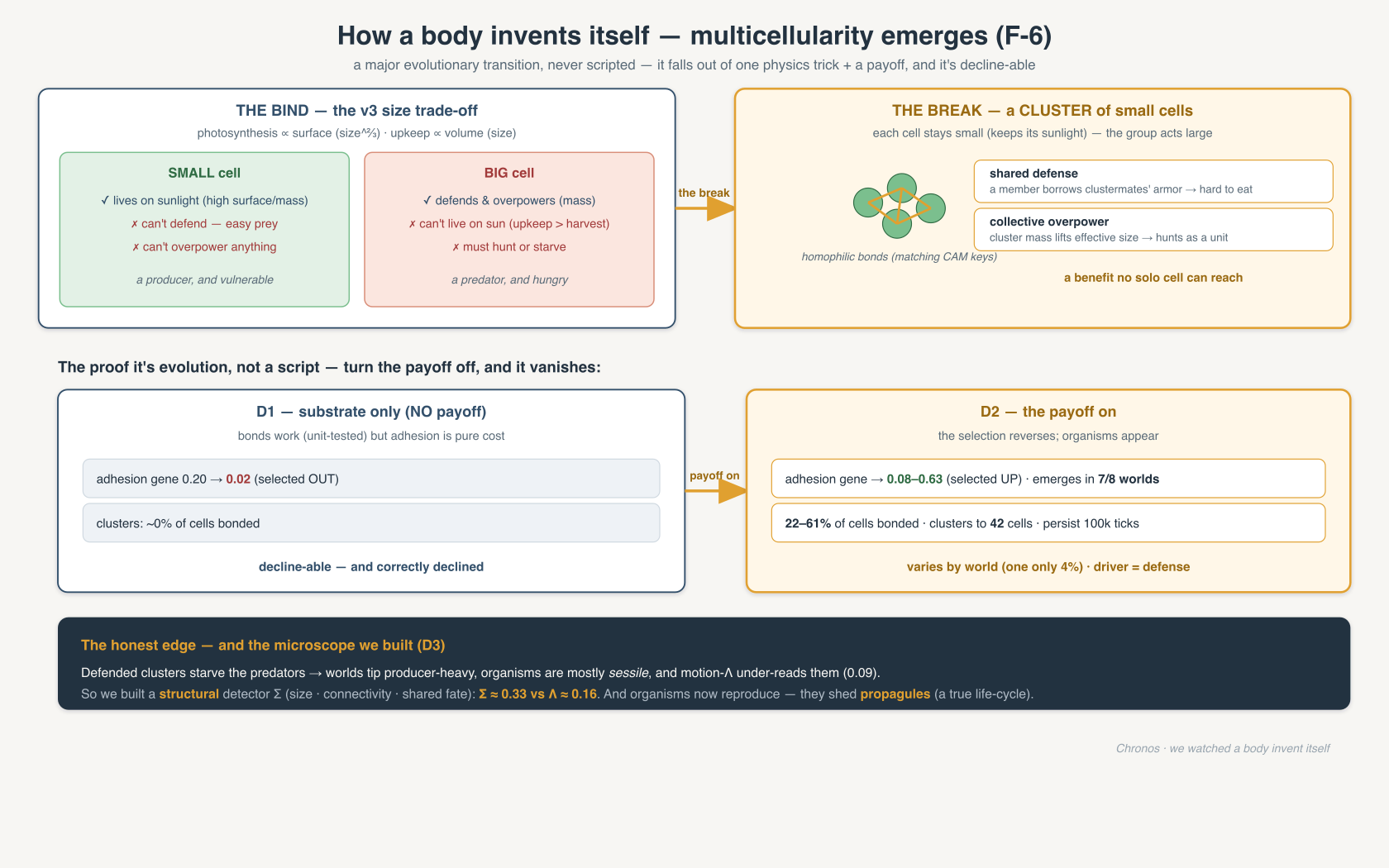
- A single cell faces a hard trade-off. Small cells live on sunlight but cannot defend themselves. Big cells can fight but cannot live on sunlight. You cannot be both.
- A cluster of small cells breaks the trade-off. Each cell keeps its sunlight, and the group together acts large. That is a benefit no lone cell can reach.
- I gave cells the bare ability to bond, at a real cost, and nothing else. With no payoff, evolution threw the ability away. Multicellularity is genuinely optional, and a calm world declines it.
- Turn on the payoff (a cluster that defends itself), and the choice reverses. Bodies appear, in most worlds but not all, and they vary with conditions, which is exactly how you know it is real and not a script.
- The bodies that emerged were mostly still, and my motion-based instruments could not read them. So I had to build a new microscope before I could honestly say what I was looking at.
The bind a single cell cannot escape
To see why a body is worth inventing, you have to feel the trap a lone cell is in.
In Chronos, photosynthesis is a surface process. A cell harvests sunlight across its skin, so its income scales with surface area. Upkeep is a volume process. Keeping a body alive costs in proportion to its mass, which grows faster than its surface. This is not a number I tuned. It is the same surface-to-volume law that governs real cells, and it has a sharp consequence: above a certain size, sunlight can no longer pay your bills.
So a small cell is a fine little solar panel, but it is soft and weak. It cannot overpower anything, and it is easy prey. A big cell is strong, hard to eat, able to hunt, but it is starving in the light and must kill to live. Defense and self-sufficiency pull in opposite directions, and a single cell has to choose. This is the bind. It is real, it is physical, and no lone cell can get out of it.
Unless it stops being lone.
The idea, and the one rule I added
Here is the move that breaks the bind, and it is worth slowing down on because it is the entire reason this works. Take a handful of small cells and bind them into a cluster. Each cell is still small, so each one keeps its excellent surface-to-volume sunlight harvest. But the cluster, taken together, is large. It can share a defensive shell. It can throw its combined mass at prey. The group gets the benefits of being big while every member keeps the benefits of being small.
That is a benefit a single cell simply cannot reach, no matter how it mutates. And in biology, this is the leading story for why multicellular life arose at all: not as a gift, but as armor. Predation pushes cells to band together.
So I gave cells the bare physical ability to stick, and I made it as much like real cell adhesion as the world would allow.
- A gene sets how strongly a cell can express adhesion molecules on its surface. Expressing them costs energy, so a cell that never benefits from sticking will pay for nothing and be selected against. This is the part that keeps the whole thing honest.
- Adhesion is like binds like. Each cell carries a heritable adhesion “key,” and two cells can only bond if their keys match, the way real cadherin molecules pair with their own kind. A lineage shares a key, so clusters are naturally families. An unrelated cell with the wrong key bounces off.
- The cell’s brain gets one new output that lets it decide, moment to moment, whether to present its adhesion molecules or pull them back in. The gene sets the capacity. The brain does the regulating.
That is all. Cells can now stick to their own kind, at a cost, if they choose. I never wrote a line about forming organisms, dividing labor, or growing to a size. Those are outcomes the rules might reach, or might not.
The proof it is real: turn the payoff off, and it disappears
This is the part I am most careful about, because it is the difference between a discovery and a magic trick.
I built the ability to stick in two stages on purpose. In the first stage, I gave cells adhesion and bonds and the cost, but no reward for clustering at all. Just the raw machinery.
Evolution looked at it and threw it away. Across world after world, the adhesion gene fell from its starting level toward zero. Cells were paying a cost to stick together for no benefit, so natural selection, correctly, stripped the ability out. In most worlds, almost nothing bonded. Multicellularity was not just absent. It was actively refused.
I want to dwell on that, because a lesser version of this project would have hidden it. A world that forms bodies the moment you give it the option is a world where you accidentally programmed bodies. The fact that my cells declined the option when it did not pay is the strongest evidence that what came next was their decision, not mine.
Then I turned on the payoff. Now a clustered cell borrows a share of its neighbors’ armor, so a member of a group is harder to kill than a loner. And a clustered hunter throws its group’s combined mass into the fight, so a band can overpower prey none of them could take alone. Crucially, each cell still photosynthesizes with its own small body. The size trade-off is broken exactly as the idea promised.
The selection reversed. The adhesion gene, which had been dropping toward zero, climbed. Bodies appeared in seven of every eight worlds I ran, with a fifth to two thirds of all cells living bonded into clusters, some growing to dozens of cells, all of it persisting over hundreds of thousands of steps. And in the eighth world, almost nothing clustered at all.
That last detail is not a flaw. It is the signature. A behavior that is universal across all worlds is one you built in by accident. A behavior that varies with the conditions, present where it pays and absent where it does not, is one that evolved. Bodies showed up where predators made them worth the cost, and stayed away where they did not.
I even pulled the mechanism apart to find what was driving it. When I switched off the energy-sharing inside clusters and left only the shared defense, clustering got stronger, not weaker. So this is not cells huddling for warmth or to share food. It is armor. Multicellularity here is, at its root, an anti-predator invention, which is exactly what the biologists suspected.
The honest part: I could not see what I had built
Now the turn I did not expect, and the part I think is most worth telling.
I had a detector for “is a group becoming one thing.” I had built it earlier, before any of this, because you cannot evolve coordination you cannot measure. It works by watching whether a cluster of cells moves as one body. Scattered cells read near zero. A school of cells all swimming the same way reads near one.
I turned it on my new organisms, expecting it to light up. It barely moved off zero.
For a moment I thought the whole result was weaker than it looked. Then I understood. My organisms were not swimming. The worlds where bodies took over had become gardens. The clusters defended themselves so well that the predators starved, and what was left was a calm world full of sessile organisms, sitting in the light, photosynthesizing, perfectly integrated and almost perfectly still. My detector measured motion. A thing that does not move reads as nothing, no matter how unified it is.
The instrument was wrong for the life that had evolved. That is a real and slightly humbling experience, and it is one of my favorite moments in the whole project, because it is so honest. You can only ever see what your microscope is built to measure. I had grown plants and was holding a motion sensor.
So I built a different microscope. Instead of asking “do these cells move as one,” it asks structural questions. How large is the body. How densely are its cells bonded to each other, a tight knit rather than a loose chain. And how much do its members share a common fate, measured as how evenly energy is pooled across them, since true parts of a body live and die together. A big, tightly woven, fate-sharing cluster scores high. A loose chain of independent cells scores low.
The new detector lit up immediately. On the exact same still organisms my motion sensor read as near nothing, the structural one read clearly and steadily. The bodies had been there all along. I just finally had a lens that could see them.
Making it a life cycle
There was one more thing missing before I would call this a real transition rather than just sticky cells. A true organism does not grow without limit. It reaches a size and then it reproduces as a unit, casting off a seed that floats away and grows into a new individual.
My first attempt to add this failed in a way I have come to expect from this project, and to enjoy. I told a cell that, once its cluster reached a certain size, a new daughter cell should be released as a free-floating seed rather than bonded into the body. Simple enough. Except clusters do not only grow by birth. They also grow by sticking to their neighbors. So while I was carefully capping growth-by-reproduction, the bodies were quietly fusing with other bodies, and the whole world congealed into one enormous blob of hundreds of cells. Not an organism. A tar pit.
The fix was a rule that real tissues use, and that I should have seen coming: contact inhibition. A completed body stops accepting new cells. Once a cluster reaches its mature size, its cells stop offering to bond with strangers. Growth past that point happens only one way, by shedding seeds that drift off and start fresh. With that single rule, the blob broke apart into a population of discrete, bounded organisms, each reaching maturity and then casting off seeds that founded the next generation of bodies. A life cycle. Organism to seed to organism, evolved and running on its own.
What this is, and what it is not
Let me hold the line I always hold. I did not create life, or minds, or anything that thinks. I built a world with an honest size trade-off and a real cost to sticking together, and in that world a population of single cells discovered, on its own, that banding into defended bodies beats going it alone. They did it only where it paid. They reproduce as units. And I can measure all of it, replay it exactly, and pull it apart to find the cause, because the world is fully deterministic.
That is a major evolutionary transition appearing in a sandbox, which is a genuinely exciting thing to watch, and it is also just that. Not a metaphor for the origin of you, not a claim about consciousness, just a clean demonstration that the jump from cell to organism is the kind of thing that falls out of the right conditions rather than something that has to be designed in.
And that, in the end, is the whole reason I keep building this. The hardest systems I work on, including large multi-agent AI, fail in the same direction: the more tightly you script the behavior, the more you get exactly what you imagined and nothing more. The results worth having come from substrates honest enough that the behavior you hoped for, and behaviors you never thought to want, can emerge, and can be measured. A cell could not escape its trade-off. A body could. Nobody told it to become one.
Design the conditions. The life is on its own.
Chronos is deterministic and fully logged, so every result here can be replayed exactly from its seed. Next I want to give my still gardens a reason to move, and to connect this work to the other half of the lab, an internal chemistry that could let a body carry not just a shared fate but a shared inner state.
Related reading: The Bug That Caught Me Cheating - the proof method behind this whole result, that a behavior only counts as evolved if evolution could have declined it.