Europe Is Running on Rented Intelligence
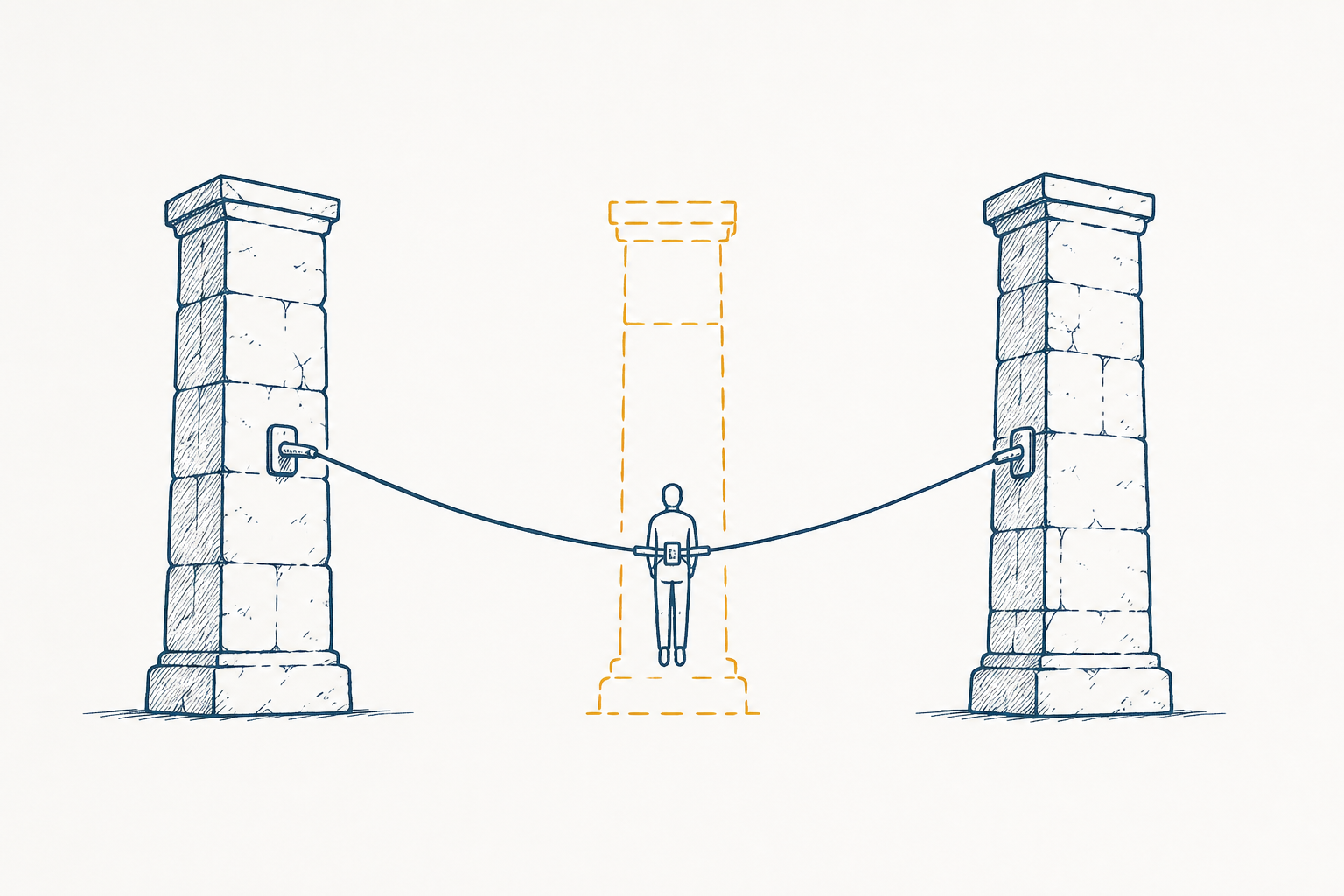
This week Beijing moved to keep its best AI models out of foreign hands. Reuters reported that China’s commerce ministry has spent the last month meeting its leading labs, Alibaba, ByteDance, and Z.ai, the team behind the GLM models, about restricting overseas access to their most advanced systems, including ones that have not shipped yet. Nothing is decided, but the direction is unmistakable. And the timing is not an accident. A frontier model, Anthropic’s Claude Mythos, has started finding real, exploitable software vulnerabilities at scale. A capability like that, aimed by Washington at Chinese interests, is exactly the kind of strategic edge that turns an export question into a national-security one.
Read that slowly, because it is not a product announcement. It is a border being drawn.
For two years the comforting story in Europe was that open weights would save us. Whatever the American and Chinese giants built, a good-enough version would leak, get published, or get open-sourced, and everyone could run their own. I want to say this plainly, as someone who builds on Chinese open weights every single day because they are the best value on the market right now: that story is ending.
Denis Shiryaev put the next part more sharply than I had seen it. The models with real economic weight will be proprietary. Nobody gives away a system that automates tens of billions of dollars of work, and even if a company wanted to, its government would not allow it. The frontier has become a matter of national power, and national power does not get open-sourced.
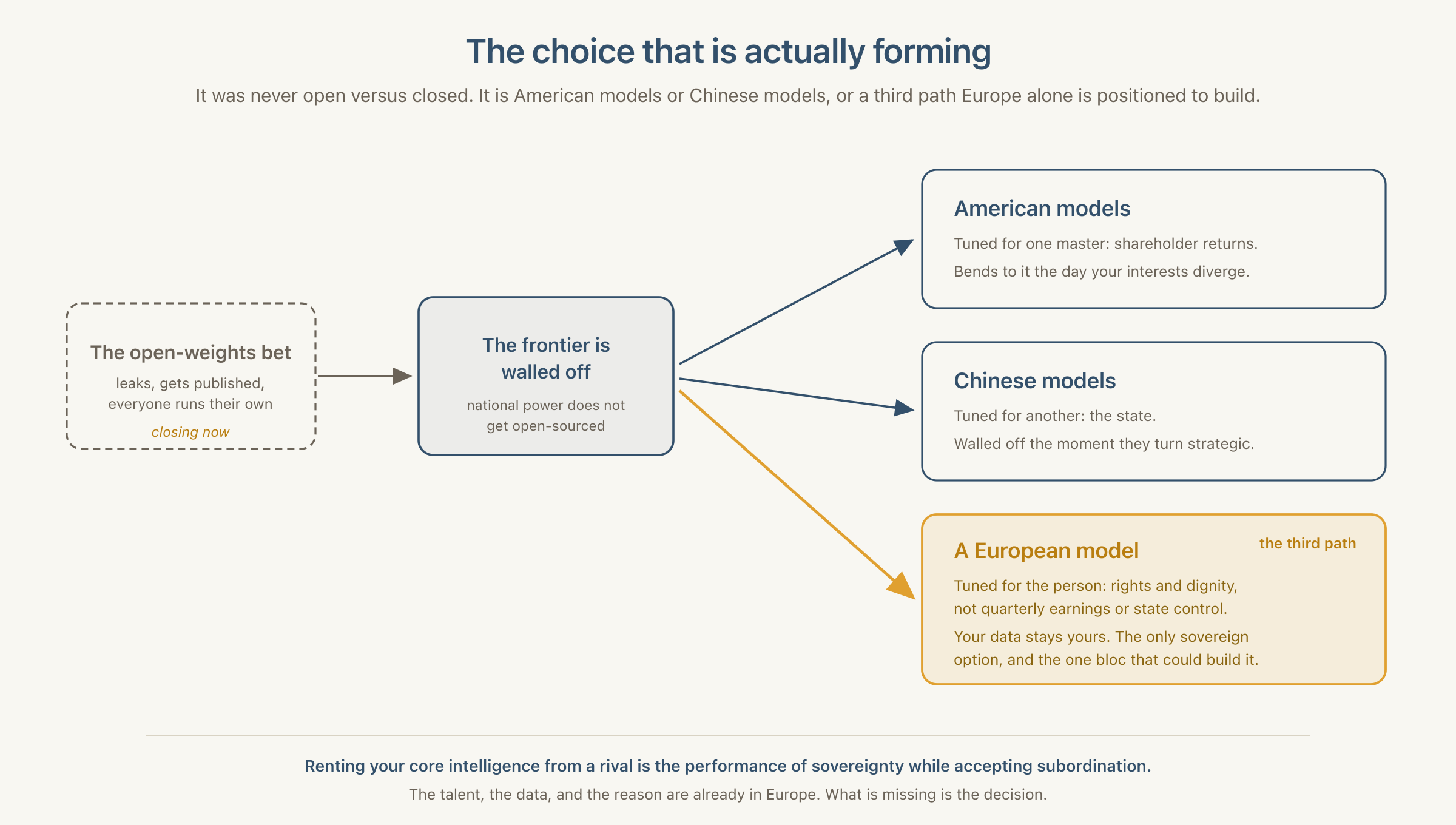
So strip away the wishful thinking and look at the choice that is actually forming. It is not open versus closed. It is American models or Chinese models. And if you are not a citizen of those countries, or a member of the right coalition, the honest answer is: maybe neither, on terms you do not set.
Dependence is a decision
That is the trap, and most of Europe is walking into it with its eyes open. Every time a European company wires its core workflow to a model it does not control, it makes a decision. Not a technical one. A sovereignty one. My own dependence is a choice I make by default every day. So is yours. So is the continent’s.
Put plainly: Europe is not being conquered. It is subscribing to its own subordination, monthly, per seat, and filing it under procurement.
It matters who owns the model, because a model is not neutral. Washington tunes its systems for one master, shareholder returns, and it will bend them to that master the moment the two conflict. Beijing tunes for another, the state, and has just shown you it will wall the best ones off the moment they turn strategic. Neither is built for you. Neither was ever going to be.
The word Carney used was subordination
At Davos in January, Mark Carney described the world we are now in with unusual honesty. There has been, he said, “a rupture in the world order, the end of a nice story and the beginning of a brutal reality where geopolitics among the great powers is not subject to any constraints.” Sovereignty, he argued, is no longer grounded in rules. It “will increasingly be anchored in the ability to withstand pressure.”
A country that cannot withstand pressure, that depends on a rival for the thing that now runs its economy, is not sovereign. It is, in his words, performing “sovereignty while accepting subordination.”
Then he named the way out. The countries in between, the middle powers, “have a choice: compete with each other for favour, or combine to create a third path with impact.”
Europe is that third path, and it is almost embarrassing how well positioned it is to take it.
Everything the effort needs is already here
Start with the raw inputs. The European single market is one of the largest economies on earth. The continent holds centuries of accumulated science, law, literature, and culture, sitting in exactly the languages the frontier labs treat as an afterthought. Spanish alone is a first language for nearly half a billion people, the second most spoken native language in the world after Mandarin, and it is chronically underserved by systems optimized for English. That is not a weakness to apologize for. It is a market and a moat.
Then the part nobody else can copy: values. GDPR is mocked as bureaucracy, but it is the only serious attempt any bloc has made to insist that a person’s data belongs to the person. Europe is the one place that could build intelligence anchored in human rights and human dignity rather than in quarterly earnings or state control. In a world where the model increasingly decides who gets a loan, a job, a diagnosis, or a benefit, the values baked into the model are not a soft feature. They are the whole game.
The objections, answered
I already hear them, because I make some of them myself.
Too slow. Europe regulates faster than it builds. True, and it has to change. But the same continent stood up Airbus against an American monopoly, and CERN and Galileo against the assumption that only superpowers do big science. Sovereign infrastructure is exactly what Europe builds when it finally decides a dependency is unacceptable.
Too fragmented. Twenty-seven countries, twenty-four languages, no single champion. That is the standard excuse, and viewed correctly it is the asset. The fragmentation is the multilingual, multicultural training signal a genuinely European model should be built on, not despite.
Too late, no compute, no capital. This is the real one, and it is why the answer is now and not later. Every month of waiting widens the gap and worsens the access terms. The move is not one national lab in one country. It is a coalition: pooled public and private compute, shared open European weights treated as public infrastructure the way roads and grids are, data trusts that let institutions contribute without surrendering ownership, and a mandate loud enough that capital follows. The cost of building this is large. The cost of not building it is the continent.
Draw your own map
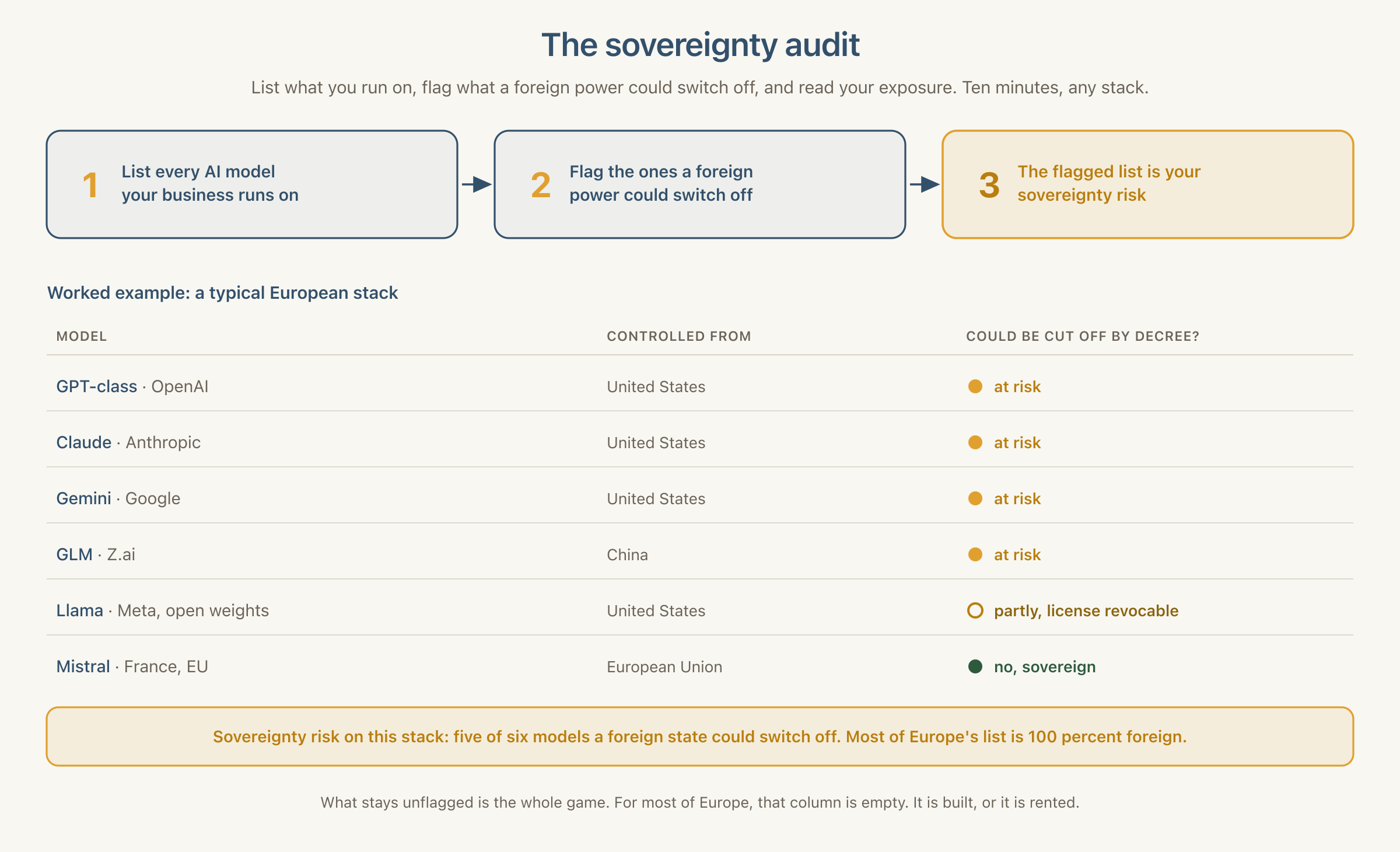
Before the abstraction hardens into fatalism, do something concrete. List every AI model your business actually runs on. Flag the ones a foreign government could switch off, throttle, or reprice by decree. What is left unflagged is your sovereign capability, and for most of Europe that column is empty today. This is not a thought experiment. It is a ten-minute audit, and it is the most honest map of your exposure you will draw this year.
Why I am not neutral about this
I am Ukrainian. I do not need a seminar on what happens when a people assume their sovereignty is permanent, that someone larger will always guarantee it, that the good future where everyone loves their neighbor and collaborates is simply on its way. It is not on its way. It is built, or it is lost.
So this is not a think piece for me. I want to help build this. I will put my time, my work, and my name behind any serious effort to start a European model as shared, sovereign, human-centered infrastructure. If you are working on this, or want to, I want to talk.
Europe does not have a technology problem. It has a will problem. The talent is here. The data is here. The reason is here. What is missing is the decision.
Look up.
Related reading
Notes and sources
- Mark Carney, Special Address (“Principled and Pragmatic: Canada’s Path”), World Economic Forum, Davos, 20 January 2026 (WEF, full transcript via Global News). The opening “rupture in the world order” line is translated from the French portion of the address.
- Reuters, “Beijing is looking at curbing overseas access to China’s top AI models, sources say,” 7 July 2026, on the commerce ministry’s month of meetings with Alibaba, ByteDance, and Z.ai (GLM). Reported as under discussion, not decided policy. Further coverage: TIME, Fortune.
- The vulnerability-finding capability refers to Anthropic’s Claude Mythos Preview, announced via Project Glasswing (April 2026). The link between that capability and China’s restriction talks is my own reading, not something Reuters reported.
- Spanish-speaker figures: Instituto Cervantes, El español en el mundo, which reports close to 500 million native speakers, second only to Mandarin.
Common Questions
- Why does Europe need to build its own AI model?
- Because the models that will run the economy are becoming instruments of national power, and national power does not get open-sourced. As the United States and China move to keep their best systems proprietary and restricted, any bloc that depends on them for its core intelligence is dependent on a rival for the thing its economy now runs on. Building a sovereign European model is the only way to hold that capability on your own terms.
- Isn't open-source AI enough for Europe?
- It was a reasonable bet two years ago and it is closing now. The open models that leak or get published tend to trail the true frontier, and the frontier itself is being walled off: reporting in 2026 shows China weighing restrictions on overseas access to its most advanced models, including unreleased ones. Open weights remain useful, but betting a continent's economic autonomy on the assumption that the best systems will always be freely available is no longer safe.
- Can Europe realistically build a frontier-class model?
- Yes, if it treats the effort like sovereign infrastructure rather than a startup. Europe has one of the largest single markets on earth, deep scientific and cultural knowledge, and hundreds of millions of speakers in languages the current labs underserve. What it lacks is not talent or reason but a decision: pooled compute, shared European weights treated as public infrastructure, data trusts that let institutions contribute without surrendering ownership, and the political will to fund it at the scale it requires. Europe built Airbus, CERN, and Galileo under the same logic.
- What would a European approach to AI values actually look like?
- It would anchor the model in human rights and human dignity rather than in quarterly earnings or state control. In practice that means data ownership that stays with the person, transparency about how decisions are made, and refusal to optimize purely for engagement or surveillance. In a world where the model increasingly decides who gets a loan, a job, or a diagnosis, the values baked into it are not a decorative feature. They are the product.