From Paper Chaos to Voice AI: How We Automated a €2.3M Clay Mining Operation
The problem
Picture this: a truck arrives at a clay quarry in rural Spain. What happens next is an absurd human relay race.
- The driver arrives and needs to communicate cargo details, but speaks Arabic, Romanian, or Spanish dialects
- Someone in the office relays information to the front-loader driver by walkie-talkie
- Someone manually writes three copies of a shipping document
- The front-loader driver confirms details and loads the truck
- The driver hunts down the completed paperwork
- Repeat. 20 times a day.
Total time per truck: 20 minutes. Total cost of this paper chain: €312,000 per year in staff salaries, delays, and inefficiencies.
This was the daily reality at VESCO Spain, a €2.3M clay mining operation supplying ceramic factories. The documentation process was not just slow. It was dangerous. Front-loader drivers were constantly distracted by walkie-talkie coordination while operating heavy machinery.
What we built
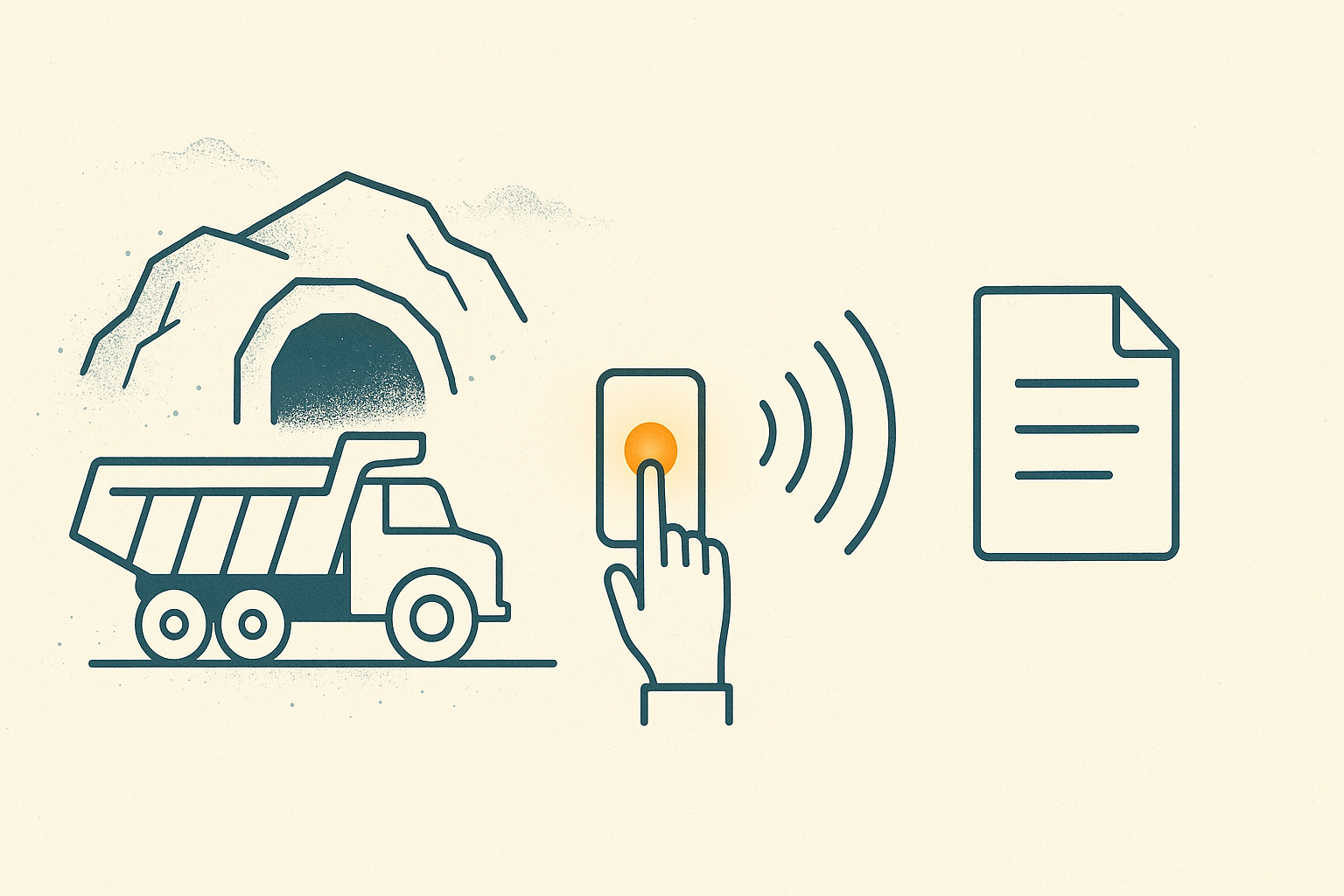
We replaced the entire 4-person paper relay with a one-button voice app.
How it works
- Driver presses one button on an industrial Android tablet mounted at the loading point
- Driver speaks in their native language: Spanish, Arabic, Romanian, anything
- AI transcribes the speech to text using whisper.cpp (runs on-device)
- AI extracts structured data (customer name, product type, quantity, destination) using Phi-3-mini
- Driver verifies the extracted data on screen, or corrects it by voice (“Cambiar destino a Valencia”)
- Legal documents auto-print on a connected thermal printer
- Front-loader loads the truck
Total time: 2 minutes. A 90% reduction.
The radical simplification
The system eliminated three roles entirely:
| Before | After |
|---|---|
| Gate staff checking paperwork | Truck enters freely, driver self-documents |
| Office staff relaying by walkie-talkie | Eliminated (no one to radio) |
| Weighing operator creating documents | AI generates documents automatically |
| Front-loader driver (the only person who actually matters) | Still there, now focused 100% on safe loading |
The insight: you do not optimize a paper relay. You eliminate it.
The technology
This was not a cloud API demo. It had to work in one of the harshest computing environments imaginable:
Environmental constraints
- Dust levels that kill standard electronics in 3-6 months
- Power failures 2-3 times per week
- Cellular coverage <30% reliability
- Temperatures from -5°C to 45°C
- Remote location 8km from paved roads
The AI stack (100% on-device)
Speech-to-Text: whisper.cpp base model
- 74M parameters, 142MB on disk, 388MB RAM
- Multilingual: handles Spanish, Arabic, Romanian
- ARM NEON accelerated for industrial tablets
- 1-3 second inference for 30-second audio
- MIT license
Entity Extraction: Phi-3-mini (INT8 quantized)
- Microsoft’s 3.8B parameter model, compressed to ~2GB
- Extracts structured data (customer, product, quantity, destination) from transcribed speech
- Outputs clean JSON for document generation
- Fallback: TinyLlama-1.1B for resource-constrained situations
Document generation: Automated legal shipping documents formatted per Spanish regulatory requirements.
Offline architecture: Local queue management for power failures. When the grid drops mid-document, the system queues the job and completes it when power returns. No data is lost.
This is the opposite of most AI systems today, which assume perfect connectivity, unlimited compute, and clean server rooms. RAG and AI agents are powerful in an office. In a quarry, you need AI that works when the power goes out.
Results
| Metric | Before | After | Change |
|---|---|---|---|
| Documentation time per truck | 20 min | 2 min | -90% |
| Staff required for documentation | 1.5 FTE | 0 FTE | -100% |
| Error rate | ~10% (illegible, wrong info) | <1% | -90% |
| Annual documentation cost | €312,000 | ~€0 operational | -100% |
| Safety risk | High (distracted operators) | Eliminated | n/a |
| Language barrier impact | 10 min delay per truck | Zero | n/a |
What we learned
The best AI is invisible. The truck driver does not know what whisper.cpp or Phi-3-mini is. They press a button, speak, and paper comes out. The complexity is hidden behind a single red button.
Offline-first is a competitive moat. Every competitor building a cloud-based solution fails the moment a truck enters the quarry. Cellular coverage is under 30%. Cloud AI is useless. On-device AI wins because it does not need permission to work.
Small models are production-ready. Phi-3-mini runs on an industrial tablet and extracts structured data with production-grade accuracy. You do not need a 70B parameter model for every job. The right model for the right constraint: that is what separates a demo from a deployment.
Industrial AI is a €100M opportunity. Every quarry, mine, cement plant, and steel mill globally has this same paper chain. VESCO was the prototype. The architecture is replicable: voice input, on-device extraction, document generation, offline-first. The market is not “AI for mining.” It is “eliminating paper chaos from industrial logistics.”
This system was designed and deployed by Cone Red. If you operate in mining, industrial logistics, or heavy industry and want AI that works where the internet does not, let’s talk.
Common Questions
- What did Cone Red build for VESCO?
- Cone Red built a voice-powered documentation system for VESCO's clay mining quarry in Spain. Truck drivers use a one-button Android app to speak their cargo details in any language. The AI transcribes the speech, extracts structured data (customer name, product type, quantity, destination), and auto-generates legal shipping documents. The system works 100% offline in a quarry environment with dust, power failures, and poor connectivity.
- How much did the VESCO mining system save?
- The system eliminated €312,000 in annual operational waste: €60,000 in unnecessary staff (1.5 FTEs dedicated to paper relay), €24,333 in language-barrier delays (10 minutes × 20 trucks × daily), plus unquantified costs from safety risks (distracted equipment operators) and competitive margin pressure. Documentation time per truck dropped from 20 minutes to 2 minutes, a 90% reduction.
- How does an AI system work offline in a mine?
- The system uses whisper.cpp (an optimized C++ port of OpenAI's Whisper model) for speech-to-text and Phi-3-mini (Microsoft's 3.8B parameter model, quantized to INT8) for entity extraction. Both models run on-device on an industrial Android tablet. No internet connection is required. The system handles dust, power failures (local queue management), and temperatures from -5°C to 45°C.
- Why use voice AI instead of a mobile form?
- Because the truck drivers speak Spanish, Arabic, and Romanian, and the quarry environment makes typing impractical. A form requires literacy in a shared language and two free hands. Voice AI requires neither. The driver presses one button, speaks naturally in their own language, and the system handles the rest. This is the difference between building software for an office and building software for a quarry.
- Can this system be applied to other mining or industrial operations?
- Yes. The architecture is site-agnostic: any industrial operation with truck-based logistics, documentation requirements, and multilingual workforces can use it. Quarries, mines, cement plants, steel mills, and construction sites all share the same paper-chain problem. Cone Red built this as a replicable system, not a one-off.