What is RAG in Easy Words
What is RAG?
RAG stands for Retrieval-Augmented Generation. It is a technique where an AI model searches a database of documents before answering a question, so its response is based on real, up-to-date information instead of whatever it happened to memorize during training.
In one sentence: RAG turns a language model from a know-it-all that guesses into a researcher that looks things up.
The open-book exam analogy
Picture two students taking an exam.
The first student memorized the textbook months ago. When you ask a question, they answer from memory. Sometimes they are right. Sometimes they confidently mix up details, fill gaps with plausible-sounding nonsense, and cannot tell you which page they got it from. That is a standard LLM.
The second student has an open book. When you ask a question, they flip to the index, find the relevant pages, read them, and then answer. Their answer is grounded, specific, and if you ask “where did you get that?” they point to the page. That is RAG.
The whole magic is this: the model still does the thinking, but it thinks about the right information.
How RAG works (step by step)
Here is what happens when a user asks a question to a RAG system:
-
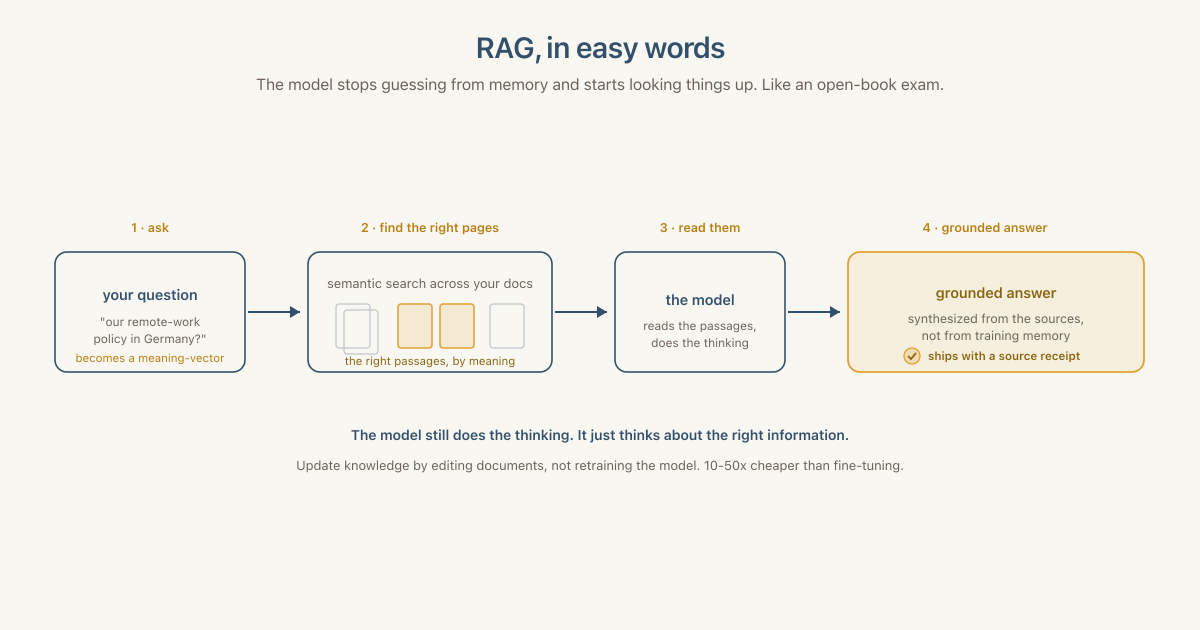
The question comes in. A user types something like “What is our policy on remote work for contractors in Germany?”
-
The question becomes a search query. The system converts the question into a vector embedding, a mathematical representation of its meaning. This lets it search by concept, not just keywords.
-
The system searches the document store. It compares the question embedding against embeddings of all your documents, finding the most relevant chunks. This is called semantic search, and it runs in milliseconds even across millions of documents.
-
The retrieved chunks go to the model. The system takes the top matching passages and includes them in the prompt, alongside the original question. The model now has the actual source material in front of it.
-
The model generates a grounded answer. Instead of answering from training memory, the model reads the retrieved passages and synthesizes a response. It can quote directly, cite sources, and say “I don’t know” when the retrieved material does not contain the answer.
Why RAG matters for business
Most companies do not have a knowledge problem. They have a retrieval problem. The information exists, somewhere, in a wiki, a SharePoint folder, a pile of PDFs, a Slack archive. Nobody can find it when they need it.
RAG fixes this at scale. Here is what it unlocks:
- Internal knowledge base. Employees ask questions in natural language and get answers grounded in company documents. No more digging through wikis or pinging the one person who knows.
- Customer support that cites sources. Support agents (or customer-facing chatbots) answer from your help docs, past tickets, and product manuals. Every answer links back to a source.
- Legal and compliance search. Lawyers search contracts, regulations, and case law in seconds. The system shows which clause it found and where.
- Sales enablement. Sales reps ask “do we have a case study for a German bank that reduced AML false positives?” and get the right document immediately.
The ROI is direct: hours saved per employee per week, faster response times, fewer escalations, and decisions made on actual data instead of gut feeling.
RAG vs fine-tuning: which should you use?
This is the question I get asked most often. The short answer:
| RAG | Fine-tuning | |
|---|---|---|
| What it changes | What the model knows | How the model behaves |
| Best for | Facts, documents, knowledge that changes | Style, format, reasoning patterns, domain language |
| Cost | Low (API calls + vector DB) | High (GPU compute + ML engineering) |
| Speed to deploy | Days to weeks | Weeks to months |
| Updating knowledge | Add or edit documents | Retrain the model |
| Citations | Yes, every answer links to a source | No, knowledge is baked into weights |
The practical rule I give my teams: start with RAG. Only fine-tune when RAG cannot solve the problem.
Fine-tuning is the right call when you need the model to consistently output a specific format, adopt a particular writing style, or apply domain-specific reasoning that no amount of context will fix. But for 80% of enterprise use cases, RAG delivers more value, faster, at a fraction of the cost.
When you’re ready for production-grade RAG
The RAG system described above is the foundation. It works, it ships, and it covers most business use cases. But when you need RAG for something where being wrong is expensive (compliance, legal, banking, healthcare), basic retrieval is not enough.
The next question becomes: how do you trust the answer? How do you know the model did not hallucinate a claim that sounds right but is not in your documents? How do you verify that retrieval pulled the right sources, not just plausible-looking ones?
I designed a system for exactly this. It is called VERA: Verified Enhanced Retrieval Architecture. The core idea: retrieval is the product, and generation is the garnish. Every answer ships with a receipt: the exact chunks it came from, the facts extracted from them, and a verification agent that checks the generated answer against those facts before the user ever sees it.
If you want to see what production RAG looks like when trust is a hard requirement (hybrid search, structured ingestion, a graph of facts, and a verify-before-ship gate), read the VERA blueprint.
Key takeaways
- RAG lets an AI search your documents before answering, grounding responses in real data instead of training-time memory.
- It is cheaper, faster, and more maintainable than fine-tuning for most enterprise use cases.
- The technique works for any scenario where people search documents to answer questions: support, legal, sales, internal knowledge.
- Start with RAG. Add fine-tuning later if the model needs to learn a style or reasoning pattern that context alone cannot teach.
- Every answer is traceable to a source, which makes RAG the go-to pattern for any business that needs accuracy and accountability from AI.
Common Questions
- What is RAG (Retrieval-Augmented Generation)?
- RAG is a technique where an AI model searches a database of your documents before generating a response. Instead of relying only on what it learned during training, it pulls relevant information, reads it, and then answers. This makes responses more accurate, more current, and traceable to a source.
- How does RAG work in simple terms?
- Imagine a student taking an open-book exam. Instead of answering from memory, they flip through their notes, find the relevant page, read it, and then write their answer. RAG does the same thing: the AI searches a document collection, retrieves the most relevant chunks, reads them, and generates a response grounded in what it found.
- What is the difference between RAG and fine-tuning?
- RAG gives the AI new information at query time by searching documents. Fine-tuning bakes new knowledge into the model weights through additional training. RAG is cheaper, faster to deploy, and easier to update. Fine-tuning is better when you need the model to learn a new style, format, or reasoning pattern that cannot be expressed as context.
- How much does it cost to implement RAG?
- A basic RAG system costs between 100 and 500 dollars per month for a mid-size business, including embedding generation, vector database hosting, and LLM API calls. This is typically 10-50x cheaper than fine-tuning a model, which requires GPU compute and ML engineering time. Most teams can deploy a production RAG pipeline in 1-2 weeks.
- What are the best RAG use cases for business?
- The highest-ROI RAG use cases are internal knowledge bases (employees asking questions about company docs), customer support (answering from help articles and past tickets), legal and compliance (searching contracts and regulations), and sales enablement (finding relevant case studies and proposals). Anywhere people search documents to answer questions is a RAG candidate.
- How do I evaluate if my RAG system is working well?
- Track three metrics: retrieval accuracy (did it find the right documents?), answer faithfulness (is the response grounded in what was retrieved, not hallucinated?), and answer relevance (does it actually answer the question?). Start with human review on 50-100 sample queries, then automate with an LLM-as-judge once patterns are clear.