What is MLOps in Easy Words
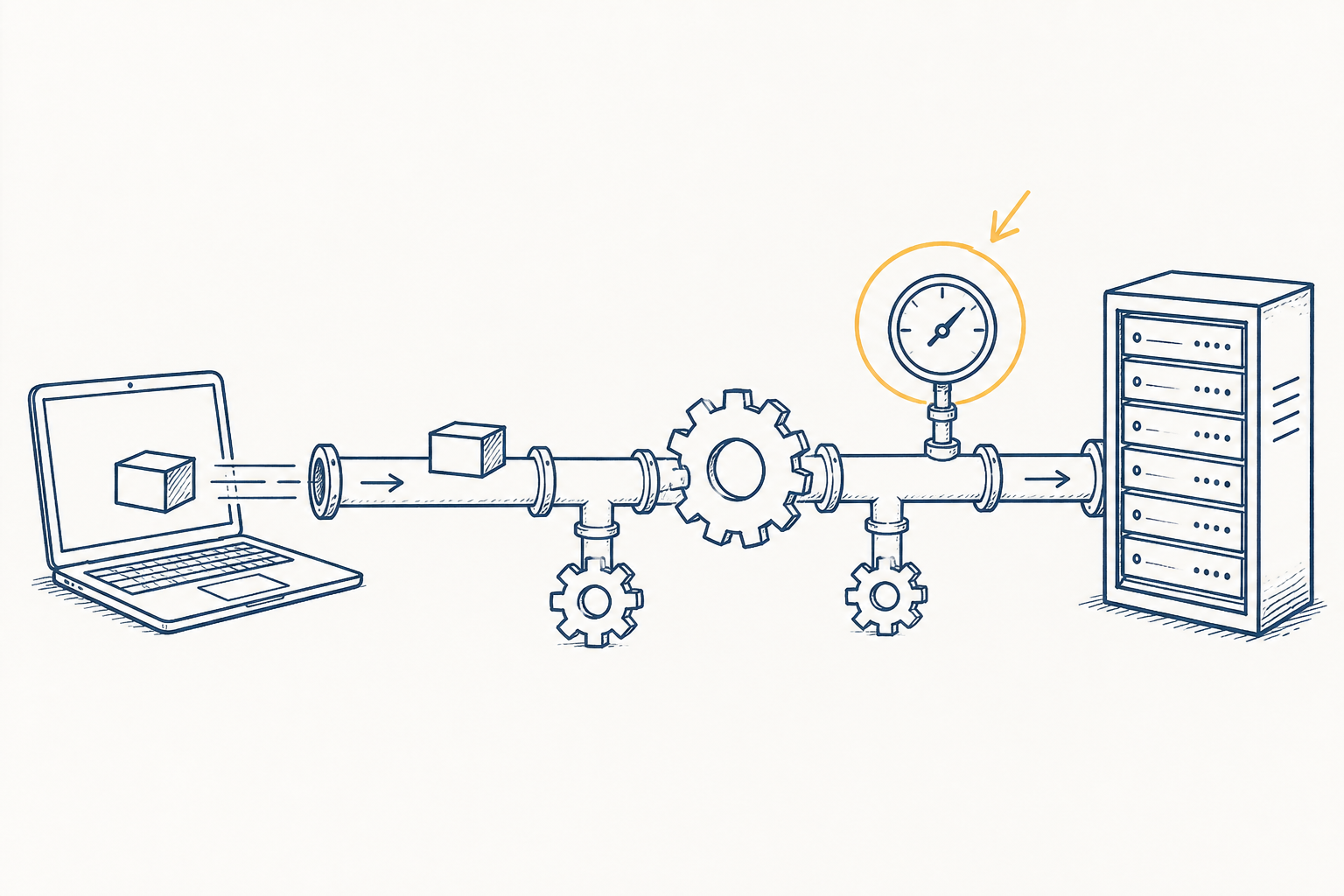
What is MLOps?
MLOps (Machine Learning Operations) is the engineering discipline that takes an AI model from a successful experiment and keeps it working in production: reliably, observably, and for years.
In one sentence: MLOps is the difference between a model that works in a demo and a model that works in your business.
If you have read about RAG or AI agents, you know what AI can do. MLOps is what makes it keep doing it.
The car analogy
Picture two cars.
The first car is a concept vehicle. It looks stunning in the showroom. The engine runs perfectly on a test track with ideal conditions. But it has no maintenance plan, no diagnostic system, no spare parts supply. Three months after you drive it off the lot, something breaks and nobody knows how to fix it. That is a model without MLOps.
The second car is a fleet vehicle. It has a maintenance schedule, a diagnostic dashboard that alerts you before parts fail, a team of mechanics who know the engine, and a supply chain for replacements. It runs 100,000 miles without unexpected downtime. That is a model with MLOps.
The whole magic is this: a model is not a product. A model in production with monitoring, retraining, and governance is a product. MLOps is the production part.
How MLOps works (step by step)
1. Deployment: shipping the model
Taking a model from a developer’s notebook to a production API involves:
- Containerization. The model is packaged with its dependencies (Python version, libraries, configurations) into a container (usually Docker) so it runs identically everywhere.
- API layer. The model is wrapped in an API endpoint that accepts requests and returns predictions. Other systems (apps, websites, agents) call this API.
- Scaling. The deployment handles concurrent requests, load balancing, and failover.
2. Monitoring: watching quality
Once deployed, the model needs continuous monitoring:
- Prediction quality. Is the model still accurate? Track metrics on live data and compare against the baseline.
- Data drift. Has the input data changed? If users are suddenly asking different types of questions, the model may not handle them well.
- Model drift. Is the model’s behavior changing? Track hallucination rates, confidence scores, and user feedback.
- System health. Latency, uptime, error rates: standard infrastructure monitoring applied to AI.
3. Retraining: fixing drift
When monitoring detects that quality is dropping, the model needs retraining:
- Collect new data from production (the edge cases the model is failing on)
- Retrain or fine-tune the model on the expanded dataset
- Validate the new model against the old one (is it actually better?)
- Deploy the new model with a rollback plan if it performs worse
4. Governance: auditing decisions
For regulated industries (banking, healthcare, legal), every AI decision must be auditable:
- Log every prediction with input, output, model version, and timestamp
- Maintain model lineage (which data trained which model version)
- Produce compliance reports on demand
This is not optional in the industries I work in at Cone Red. Our banking AML system processes $250M+ in transactions: every flag, every screening decision, every model update is logged and auditable.
Why MLOps matters for business
A model without MLOps is a ticking clock. It works on day one and degrades every day after. The degradation is silent: users do not report “the model seems 3% less accurate.” They just stop trusting it.
Here is what MLOps unlocks:
- Reliability. The AI system works when you need it, with predictable uptime and performance.
- Longevity. Models stay accurate for years, not weeks, because monitoring catches drift early.
- Trust. When every decision is logged and auditable, regulators and stakeholders trust the system.
- Cost control. Retraining is triggered by data, not by crisis. You retrain when monitoring says “accuracy dropped 2%,” not when a customer complains.
- Scale. A well-designed MLOps pipeline lets you deploy new models across departments without rebuilding infrastructure each time.
DevOps vs MLOps: what is different?
| DevOps | MLOps | |
|---|---|---|
| What it manages | Code | Code + models + data |
| Behavior over time | Static (code does not change) | Dynamic (models drift as data changes) |
| Key risk | Bugs, crashes | Drift, hallucination, bias |
| Core activity | Deploy + monitor uptime | Deploy + monitor quality + retrain |
| Rollback | Revert to previous code version | Revert to previous model version + data |
| Audit need | System logs | Decision logs + model lineage + data provenance |
The practical rule: if you are deploying AI in production, you need MLOps. There is no “we will add monitoring later.” By the time you realize you need it, the model has already drifted and users have already lost trust.
Key takeaways
- MLOps is the engineering discipline that keeps AI working in production: deployment, monitoring, retraining, and governance.
- Models degrade over time. Without monitoring, you will not know until users complain.
- The four pillars: deploy reliably, monitor continuously, retrain when needed, govern every decision.
- MLOps costs 20-40% of your total AI budget. Skipping it costs more in production failures.
- In regulated industries, MLOps is not optional. Every AI decision must be auditable.
Common Questions
- What is MLOps?
- MLOps (Machine Learning Operations) is the set of practices for deploying, monitoring, and maintaining machine learning models in production. It is the ML equivalent of DevOps: the engineering discipline that ensures AI systems work reliably, stay accurate over time, and can be updated without breaking.
- Why do I need MLOps?
- Because models degrade. A model that is 99% accurate on day one will drift as the data it sees in production changes: new transaction patterns, new language, new edge cases. Without monitoring and retraining, accuracy silently drops. MLOps catches this drift and triggers retraining before users notice.
- What is model drift?
- Model drift is when a model's accuracy degrades over time because the real-world data has changed from what the model was trained on. For example, a fraud detection model trained on 2023 data will miss new fraud patterns that emerge in 2026. MLOps monitoring detects drift by tracking prediction quality on live data.
- What tools are used for MLOps?
- Common MLOps tools include MLflow (experiment tracking), Weights & Biases (monitoring), Kubeflow (orchestration), Docker (containerization), and CI/CD pipelines adapted for ML. For LLM-specific systems, tools like LangSmith, Phoenix, and custom evaluation pipelines are used to monitor hallucination rates and retrieval quality.
- How is MLOps different from DevOps?
- DevOps manages code that does not change behavior once deployed. MLOps manages models whose behavior changes as data changes. A web application behaves identically on day 1 and day 100. An AI model may behave differently on day 100 because the input data has shifted. This makes monitoring and retraining core MLOps activities that have no DevOps equivalent.
- How much does MLOps cost?
- MLOps infrastructure typically costs 20-40% of the total AI system cost. For a mid-size deployment, this means 2,000-10,000 dollars per month in monitoring tools, compute for retraining, and engineering time. Skipping MLOps saves money upfront but guarantees production failures that cost more in damage.