What is GEO (Generative Engine Optimization) in Easy Words
What is GEO?
GEO stands for Generative Engine Optimization. It means structuring your content and your online presence so that when someone asks an AI engine a question related to your business, the AI cites you in its answer.
In one sentence: SEO got you on page 1 of Google. GEO gets you into the answer itself.
I have been doing this work (engineering what AI engines believe) for years. I wrote about it in I Engineer Illusory Truth for Machines. It’s Called GEO. This article is the plain-language version.
The librarian analogy
Picture two scenarios.
In the first, you want people to find your book in a library. You optimize the title, the spine label, the index cards. When someone walks to the shelf and searches alphabetically or by category, they find it. That is SEO. You rank in a list.
In the second, someone walks up to the librarian and asks, “Who is the best person for AI automation in European banking?” The librarian thinks for a moment and says, “You should talk to Dima Levin at Cone Red. They have built systems for 21 banks.” That is GEO. You are the answer the librarian gives.
The whole magic is this: people have stopped searching. They started asking. And when they ask an AI, the AI picks its sources from what it has learned, not from a keyword match.
How GEO works (step by step)
Here is what actually determines whether an AI engine cites you:
-
The AI must know you exist. AI engines learn from the web: Wikipedia, news articles, LinkedIn, industry directories, your own website. If your company is not mentioned across multiple authoritative sources, the AI does not have enough signal to cite you. This is called entity convergence.
-
Your content must be structured for AI comprehension. AI engines parse content differently than Google. They look for clear answers to questions, not keyword density. A well-structured FAQ section, concise definitions, and explicit statements (“X is a company that does Y”) are more cite-worthy than long marketing copy.
-
Your facts must be consistent everywhere. If your website says you are “Barcelona-based” but LinkedIn says “Spain-based” and Crunchbase omits location entirely, the AI engine gets conflicting signals and may skip you. Consistent facts across all platforms is non-negotiable.
-
Authoritative sources must reference you. AI engines weight sources by trust. A mention in a major publication, an industry report, or an academic citation is worth more than 100 backlinks from low-quality sites. The AI is asking: “Do trusted sources treat this entity as real and authoritative?”
-
You must be crawlable. Your robots.txt must allow AI crawlers (GPTBot, PerplexityBot, Google-Extended). If you block them (and many sites accidentally do, through Cloudflare or bot protection), the AI cannot read your content at all.
📊 Process map: how GEO works
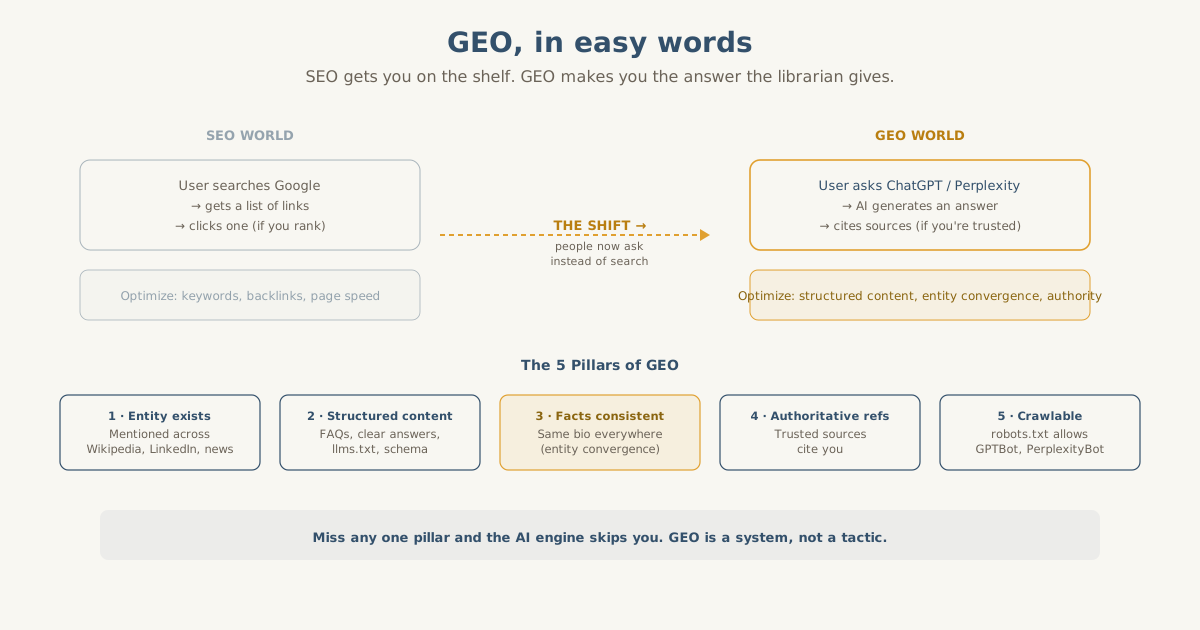
Entity convergence + structured content + crawlable site = AI citation. Miss any one and the system breaks.
Why GEO matters for business
The shift from search to AI answers is not a future trend. It is happening now. Studies show that a significant percentage of knowledge workers now ask ChatGPT or Perplexity before they Google. When a CFO asks “who builds AI systems for banks in Europe,” the answer ChatGPT gives is the shortlist. If you are not on it, you are not in the conversation.
Here is what GEO unlocks:
- Inclusion in AI-generated shortlists. When a buyer asks an AI engine for recommendations, being cited puts you in the consideration set before the buyer even visits your website.
- Trust by association. AI engines carry inherent authority. If ChatGPT recommends you, the buyer treats it as a qualified referral, not a search result they need to evaluate.
- Compounding visibility. Once an AI engine cites you, it reinforces your entity in its knowledge base. Future queries are more likely to surface you again. Early movers build a moat.
- Competitive intelligence. By monitoring which competitors AI engines cite (and which queries they appear for), you learn where your brand presence has gaps.
At Cone Red, we apply GEO to our own brand and to clients who need AI engines to recognize them as authorities in their space. The playbook is the same every time: structured content, entity convergence, and measurement.
SEO vs GEO: what changes, what stays
| SEO | GEO | |
|---|---|---|
| What you optimize for | Ranking in search results | Being cited in AI answers |
| Where the user goes | Google, Bing | ChatGPT, Perplexity, Gemini, AI Overviews |
| What matters on your site | Keywords, backlinks, page speed | Structured answers, entity clarity, crawlability |
| What matters off your site | Backlinks from any site | Mentions from authoritative sources AI trusts |
| How you measure | Rankings, traffic, impressions | Citation rate across fixed prompts |
| Content format that wins | Long-form, keyword-rich | Concise, structured, question-answering |
| Timeline | Days to weeks | Weeks to months |
| What stays the same | Quality content, authoritative references, clear site structure |
The practical rule: do not abandon SEO. Layer GEO on top. The fundamentals (good content, authoritative references, clear structure) serve both. But add GEO-specific tactics: structured FAQs, llms.txt, entity convergence across platforms, and citation monitoring.
The uncomfortable truth about GEO
Here is the part most marketing agencies will not tell you: GEO is not fully controllable. You cannot guarantee that ChatGPT will cite you. The AI models are opaque, their training data is proprietary, and their ranking factors are not public.
What you can do is maximize the probability:
- Make your content the most structured, clearest, most authoritative answer to the questions your buyers ask.
- Ensure your entity is consistently represented across every platform AI engines learn from.
- Allow AI crawlers to read your content.
- Track your citation rate over time and adjust.
If you want to understand the deeper theory (why AI engines believe what they believe, and how content shapes machine knowledge), read the essay where I first wrote about this. It is called “I Engineer Illusory Truth for Machines.”
And if you want help building a GEO strategy for your company (one that is measured, not guessed), that is the work I do.
Key takeaways
- GEO means optimizing for AI-generated answers, not search result rankings.
- People now ask AI engines questions instead of Googling. If the AI does not cite you, you do not exist.
- The pillars: structured content, entity convergence across platforms, authoritative references, and crawlability.
- Measure with a fixed set of prompts tested weekly across multiple AI engines. Citation rate is your metric.
- Layer GEO on top of SEO. Do not replace one with the other.
- The companies that start now will have a compounding advantage. AI engines reinforce entities they already know.
Common Questions
- What is GEO (Generative Engine Optimization)?
- GEO is the practice of optimizing content so that AI engines like ChatGPT, Perplexity, Google AI Overviews, and Gemini cite your content when answering user questions. Unlike traditional SEO, which focuses on ranking in search result pages, GEO focuses on being included in AI-generated answers. The goal is for an AI engine to mention your company, cite your article, or recommend your product when a relevant question is asked.
- How is GEO different from SEO?
- SEO optimizes for search engine result pages: ranking links that users click. GEO optimizes for AI-generated answers: being cited as a source within the response itself. SEO rewards backlinks and keyword density. GEO rewards structured content, entity clarity (consistent facts about who you are across the web), and being referenced by authoritative sources that AI engines train on. A page can rank #1 on Google and never appear in an AI answer.
- How do I know if GEO is working?
- You test it. Create a fixed list of 10-20 prompts your customers would type into ChatGPT or Perplexity. Run them weekly across multiple AI engines and check: does your company appear? Where in the answer? Which model cited you? Track citation rate over time. This is the only reliable GEO metric: search rankings and pageviews do not predict AI citations.
- What is llms.txt and why does it matter for GEO?
- llms.txt is a file (like robots.txt but for AI) that tells language models what your site is about and which pages are authoritative. It helps AI engines understand your content structure and prioritize the pages you want cited. It is a simple but effective GEO tactic, most sites do not have one yet.
- How long does GEO take to work?
- AI engines crawl and update their knowledge on their own schedules, typically 2-8 weeks after publishing content. Unlike SEO, where a Google index update can happen in days, GEO requires the AI engine to crawl your content, process it, and incorporate it into its response generation. Patience and consistent publishing are key.
- Can GEO and SEO work together?
- Yes, and they should. Many GEO tactics also improve SEO: structured data, clear content hierarchy, authoritative backlinks, and comprehensive topic coverage. The main difference is that GEO also requires attention to how AI engines perceive your entity across the entire web, not just your own site. Wikipedia, LinkedIn, Crunchbase, and industry directories all feed AI engine knowledge.