What is Fine-Tuning in Easy Words
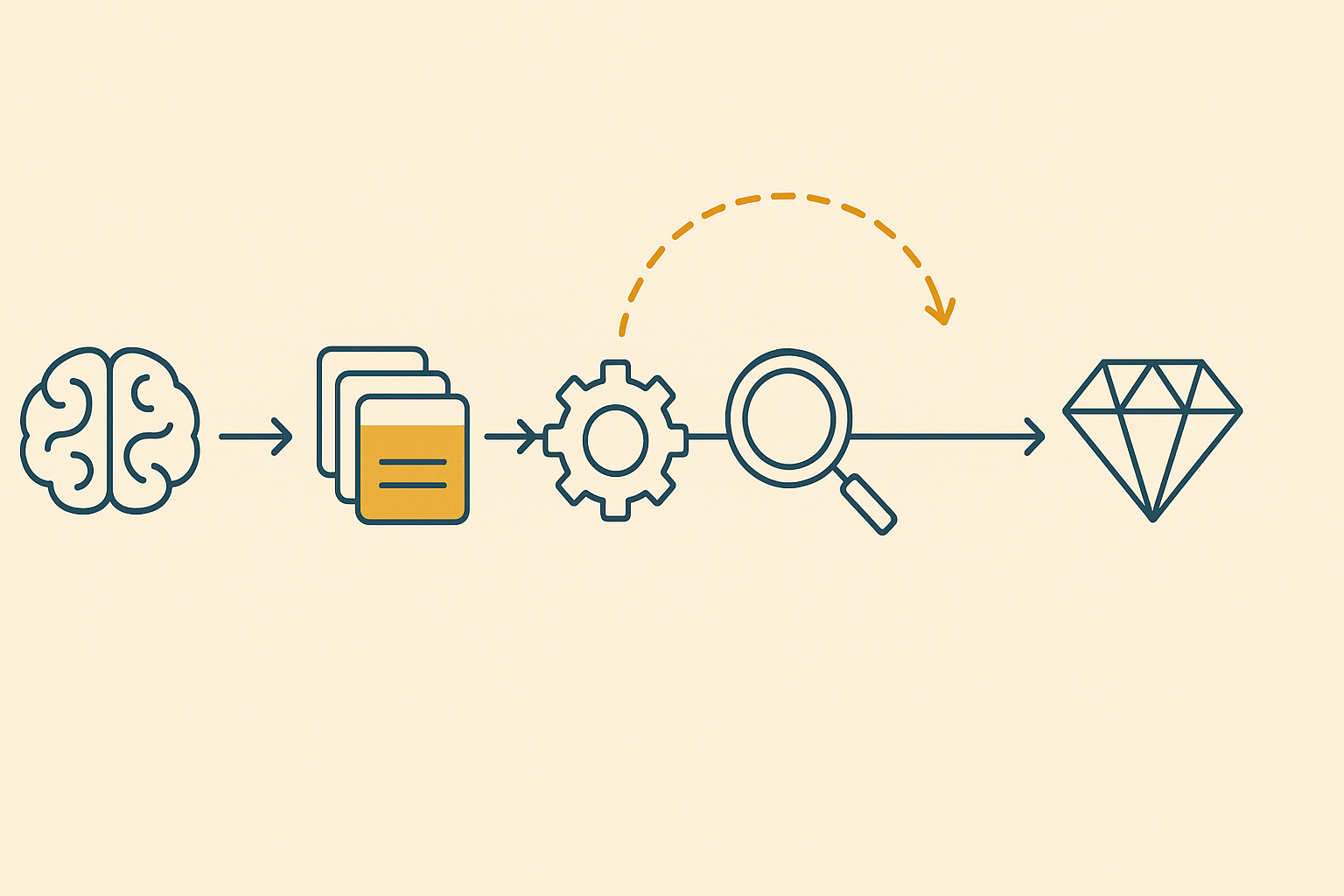
What is fine-tuning?
Fine-tuning means taking an AI model that already knows how to do a lot of things, and training it further on your specific data so it gets better at one particular thing. The model does not learn new facts. It learns a new way of behaving.
In one sentence: fine-tuning changes how the model thinks, not what it knows.
If you have not read it yet, the companion piece on RAG explains how to give a model new knowledge. This article explains the other half: teaching a model new instincts.
The culinary school analogy
Picture two chefs.
The first chef is talented and knows hundreds of recipes. You hand them a new recipe for a specific dish, they read it, and they cook it. Sometimes they nail it. Sometimes the execution is slightly off: the sauce breaks, the timing is rushed, the plating looks amateur. But with a good recipe, they get close. That is a model using prompting and context.
The second chef went to culinary school for your exact cuisine. They trained for months on your techniques, your plating style, your flavor profiles. When you say “make the signature dish,” they do not need a recipe. The skill is baked into their hands. That is fine-tuning.
The whole magic is this: fine-tuning does not give the model new information. It gives it new instincts.
How fine-tuning works (step by step)
Here is what happens when you fine-tune a model:
-
You choose a base model. This is a pre-trained model like GPT-4, Llama, or Claude that already understands language broadly. You do not start from scratch. You start from a model that is already smart.
-
You prepare training data. This is a set of examples showing the exact input-output pattern you want. For a model that writes in your brand voice, you provide hundreds of examples of inputs and your desired outputs. Quality matters more than quantity: 500 excellent examples will always beat 5,000 mediocre ones.
-
The model trains on your data. The training process adjusts the model’s internal weights: millions of numbers that determine how it maps inputs to outputs. This is done on GPUs and takes hours, not minutes.
-
You evaluate the result. You test the fine-tuned model on new data it has never seen. Does it follow the pattern? Did it forget how to do general tasks? Did it actually improve, or did it just memorize your examples?
-
You deploy or iterate. If the model passes evaluation, it goes to production. If not, you adjust the data and try again.
📊 Process map: the fine-tuning pipeline

The feedback loop is the hidden cost. You rarely get it right in one shot; plan for 3–5 iterations.
The mistake everyone makes
Fine-tuning is the most over-prescribed tool in AI.
Teams reach for it because it sounds sophisticated. “We fine-tuned our own model” sounds more impressive than “we used better prompts.” But in my experience (building AI systems for HSBC, Raiffeisen Bank, ArcelorMittal, and a dozen other enterprises), 80% of the teams who ask me about fine-tuning actually need RAG or better prompt engineering.
Here is the test I use:
- If the problem is that the model does not know something → use RAG. The model needs access to your documents, policies, or data. No amount of training will fix a knowledge gap as efficiently as just giving it the right document.
- If the problem is that the model cannot do something the right way → consider fine-tuning. The model knows the facts but applies them wrong: wrong format, wrong tone, wrong reasoning structure.
When fine-tuning is actually the right answer
There are legitimate cases where fine-tuning is the correct tool. I have deployed it in production for clients where nothing else worked:
- Consistent output format. A banking client needed the model to produce structured transaction reports in a proprietary format: every field, every time, zero tolerance for deviation. Prompting got them 95%. Fine-tuning got the last 5% that actually mattered.
- Brand voice and style. The model must write in a specific corporate tone across thousands of customer communications. This is a behavior pattern, not a knowledge problem.
- Domain-specific reasoning. The model must apply reasoning steps unique to your industry: AML detection logic, legal argumentation structure, financial modeling conventions. These are patterns the base model did not learn during pre-training.
- Latency and cost reduction. A fine-tuned smaller model can match the performance of a larger model with prompting, at a fraction of the inference cost. At scale, this saves real money.
The rule I give every team: RAG for knowledge, fine-tuning for behavior, prompting for everything else. And always try better prompting first.
RAG vs fine-tuning: the decision
| RAG | Fine-tuning | |
|---|---|---|
| What it changes | What the model knows (at query time) | How the model behaves (permanently) |
| Best for | Facts, documents, knowledge that changes | Style, format, reasoning patterns |
| Cost | Low ($100–500/month) | High ($500–5,000/run + engineering) |
| Speed to deploy | Days to weeks | Weeks to months |
| Updating knowledge | Add or edit a document | Retrain the model |
| Iteration speed | Instant (change a document) | Slow (retrain, re-evaluate) |
| What it cannot do | Change the model’s core behavior | Add new knowledge without retraining |
Most enterprise use cases (internal knowledge bases, document search, customer support) are knowledge problems. RAG solves them. Fine-tuning is the right answer for a narrow set of behavior problems that prompting cannot fix.
When you need both
In production, the best systems use both. Fine-tuning gives the model the right behavior (output format, reasoning style, domain language). RAG gives it the right knowledge (specific documents, current data, source citations). Together, they produce a system that behaves correctly and knows the facts.
This is the architecture I build at Cone Red: a fine-tuned model that understands banking and compliance, grounded by a RAG system that pulls from the client’s actual documents. The model knows how to behave like a compliance analyst. The RAG system ensures it is talking about the right transactions, the right regulations, and the right policies.
If you want to see what production retrieval looks like when it is combined with structured ingestion and a verification gate (the system I designed for exactly this kind of work), read the VERA blueprint.
Key takeaways
- Fine-tuning retrains a model on your data to teach it a new behavior, not new facts.
- It is expensive and slow compared to RAG, so it should never be your first approach.
- Use fine-tuning when prompting and RAG cannot solve the problem: format consistency, brand voice, domain reasoning.
- The rule: RAG for knowledge, fine-tuning for behavior, prompting for everything else.
- In production, the best systems combine both: fine-tuned behavior plus RAG-grounded knowledge.
- Most teams who think they need fine-tuning actually need better prompts and a good RAG system. Start there.
Common Questions
- What is fine-tuning in AI?
- Fine-tuning is a training process where you take a pre-trained language model and continue training it on a smaller, specialized dataset. This adjusts the model's internal weights so it becomes better at a specific task, style, or domain. The model does not learn new facts. It learns new patterns of behavior that make it more effective for your use case.
- How is fine-tuning different from RAG?
- RAG gives the model new information at query time by searching documents. Fine-tuning changes how the model behaves by adjusting its internal weights through training. RAG is cheaper, faster, and easier to update. Fine-tuning is better when you need the model to consistently apply a specific style, format, or reasoning pattern that prompting and context alone cannot achieve.
- How much does fine-tuning cost?
- Fine-tuning a model typically costs between 500 and 5,000 dollars per training run, depending on model size, dataset size, and GPU provider. This is significantly more than RAG, which costs 100 to 500 dollars per month for ongoing operation. Fine-tuning also requires ML engineering time, which is often the larger cost. Most teams should start with RAG and only fine-tune when they have proven the use case justifies the investment.
- When should I fine-tune a model?
- Fine-tune when the model consistently fails at a task despite good prompting and relevant context. Common signals: the model cannot maintain a specific output format, it does not adopt the right tone or style, or it lacks domain-specific reasoning patterns. If the problem is that the model does not know something, use RAG. If the problem is that the model cannot do something the right way, consider fine-tuning.
- What data do I need for fine-tuning?
- You need 500 to 10,000 high-quality examples of the input-output pattern you want the model to learn. The data must be consistent, correctly labeled, and representative of real usage. Garbage data produces a garbage model. The most common mistake is using too little data or data that does not reflect actual production queries.
- How long does fine-tuning take?
- The training itself takes 1 to 12 hours depending on model size and dataset. The full process (data preparation, training, evaluation, iteration, and deployment) typically takes 2 to 4 weeks. This is much slower than RAG, which can be deployed in days. Factor in iteration time: you rarely get fine-tuning right on the first attempt.