What are Vector Embeddings in Easy Words
What are vector embeddings?
Vector embeddings are a way of turning text into numbers so that a computer can measure meaning by distance. Words, sentences, and documents that mean similar things get numbers that are close together. Words that mean different things get numbers that are far apart.
In one sentence: embeddings translate meaning into location, so similarity becomes a distance you can measure.
This is the invisible layer underneath modern AI search. If you have read about RAG, embeddings are the technology that makes the “retrieval” part work. This article explains how.
The library analogy
Picture two libraries.
In the first library, books are sorted alphabetically by title. If you want a book about “cars,” you go to the C section. But the book you actually need might be titled “Automobile Engineering” (A section) or “Vehicle Dynamics” (V section). You miss them because the system matches letters, not meaning. That is keyword search.
In the second library, books are arranged by topic. All the car books sit on the same shelf: “Automobiles,” “Cars,” “Vehicles,” and “Driving” are all next to each other because they are about the same subject. You walk to the shelf and everything relevant is right there. That is semantic search, and it works because of embeddings.
The whole magic is this: the model has learned which words and concepts belong together, and it encodes that knowledge as numbers.
How embeddings work (step by step)
Here is what happens when you embed a piece of text:
-
The text goes in. You give an embedding model a word, sentence, or entire document. It does not matter how long; the model processes it and outputs a fixed-length vector.
-
The model converts meaning to numbers. The output is a list of typically 384 to 1536 numbers. Each number captures some aspect of the text’s meaning: topic, sentiment, entities, relationships. You do not need to know what each number means individually. The pattern as a whole is what matters.
-
Similar texts produce similar vectors. “The bank approved the loan” and “The lender authorized the credit” produce vectors that are numerically close together, even though they share almost no words. The model understands they mean the same thing.
-
Distance equals similarity. To find documents that match a query, you convert the query to a vector, then measure the distance between the query vector and every document vector. The closest ones are the most relevant. This calculation runs in milliseconds, even across millions of documents.
📊 Process map: how embeddings work
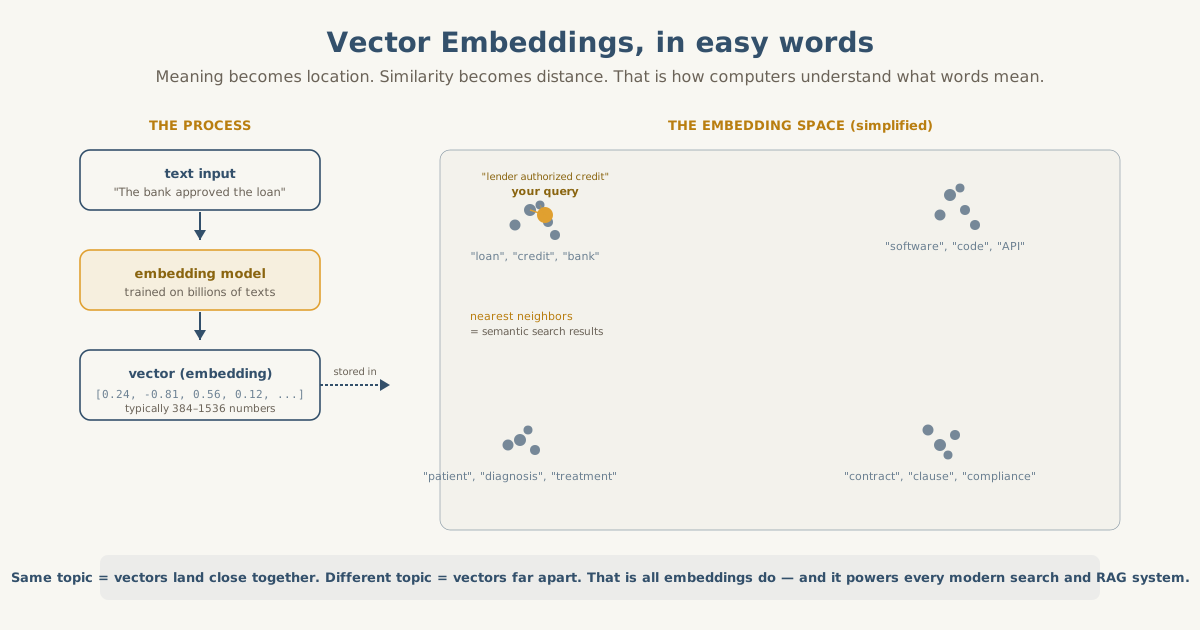
Text goes in. Numbers come out. Similar meanings land near each other. That is all there is to it.
Why embeddings matter for business
Most search systems fail because they match words, not meaning. A customer searches for “refund” but the help article is titled “return policy.” A sales rep searches for “German bank case study” but the document is labeled “DACH financial services client.” The information exists, but keyword search cannot find it.
Embeddings fix this. I have deployed semantic search systems across banking, pharma, and industrial clients at Cone Red, and the results are always the same pattern: search relevance jumps, support tickets drop, and people stop pinging the one colleague who “knows where everything is.”
Here is what embeddings unlock:
- Semantic search. Customers, employees, and agents find information by meaning, not exact keywords. We deployed this for a bank processing $250M+ in transactions: compliance officers searching for “suspicious wire pattern” now find every relevant report, regardless of how it was titled or categorized.
- RAG systems. Embeddings are the foundation of RAG: they are how the system finds the right documents to ground the model’s answer. Without embeddings, RAG cannot work. Without good embeddings, RAG retrieves the wrong documents and the model hallucinates with confidence.
- Recommendation engines. Products, articles, and content are matched by similarity. “You liked this” becomes “here are ten things that mean something similar.”
- Deduplication. Records that say “IBM Corp,” “International Business Machines,” and “IBM Corporation” are recognized as the same entity because their embeddings are nearly identical. In M&A due diligence, which is what we built GetDeal.AI for, this is how you clean a messy data room in hours instead of weeks.
The ROI is direct: better search means faster answers, fewer escalations, and decisions based on the right information instead of whatever the keyword search happened to surface.
Keyword search vs semantic search
| Keyword search | Semantic search (embeddings) | |
|---|---|---|
| What it matches | Exact words | Meaning and concepts |
| ”Car” finds “automobile” | No | Yes |
| Misspellings | Breaks search | Usually handled |
| Synonyms and jargon | Misses them | Understands them |
| Cost | Very low | Low (embedding API calls) |
| Best for | Exact lookups (IDs, names, codes) | Discovery, research, Q&A |
| Infrastructure | Standard database | Vector database (pgvector, Pinecone, Qdrant) |
The practical rule: use keyword search for exact matches (product IDs, customer numbers, exact names). Use semantic search for discovery, research, and questions. Most production systems combine both: a practice called hybrid search, and the approach I recommend in every system we build.
How this connects to RAG
If you have read the RAG in Easy Words article, you already know the open-book exam analogy. Embeddings are the index the student uses to find the right pages. Without a good index, the student flips through pages randomly. With a good index, they go straight to the right section.
That is why the choice of embedding model matters so much for RAG quality. A weak embedding model retrieves documents that “kind of match”: close in wording, wrong in meaning. A strong embedding model retrieves documents that are genuinely about the same concept, even if the words are completely different.
And if you are wondering how to evaluate whether your embeddings are actually working, whether retrieval is pulling the right sources, that is the exact problem I designed VERA to solve.
When you are ready for production-grade retrieval
Embeddings are the foundation, but production retrieval requires more than nearest-neighbor search. When the stakes are high (compliance, legal, banking), you need to verify that the retrieved documents actually support the answer the model generates.
That means combining embeddings with keyword filters (hybrid search), re-ranking models that refine the top results, cross-references between documents (a knowledge graph), and a verification step that checks the final answer against the facts before the user sees it.
This is not theoretical architecture. It is the system I have deployed for financial institutions where being wrong costs real money. If you want to see the blueprint, read the VERA architecture. And if you are building a system where retrieval quality is non-negotiable, let’s talk.
Key takeaways
- Embeddings convert text into numbers where distance means similarity. Documents about the same topic land near each other.
- This is what powers semantic search: finding information by meaning instead of exact words.
- Embeddings are the foundation of RAG. Without them, the system cannot find the right documents to ground its answers.
- Use semantic search for discovery and questions. Use keyword search for exact lookups. Use both (hybrid search) in production.
- You do not need to understand the math. You need to understand the principle: meaning becomes location, similarity becomes distance.
Common Questions
- What are vector embeddings?
- Vector embeddings are a way of representing text as arrays of numbers. An embedding model takes a word, sentence, or document and outputs a list of typically 384 to 1536 numbers. These numbers encode the meaning of the text. Texts with similar meanings produce similar number patterns, which means you can measure how similar two pieces of text are by calculating the distance between their vectors.
- How do vector embeddings work?
- An embedding model has been trained on billions of texts to learn which words and concepts appear in similar contexts. When you give it new text, it outputs a vector (a list of numbers) that captures the text's meaning. Texts about similar topics produce vectors that are numerically close together. You can then use simple math to find the nearest matches, which is how semantic search works.
- What is a vector database?
- A vector database is a specialized storage system designed to store and search vectors efficiently. When you have millions of documents, each represented as a vector, you need a way to quickly find the closest matches to a query vector. Vector databases use indexing techniques like HNSW or IVF to return approximate nearest neighbors in milliseconds, even across massive datasets.
- How are vector embeddings used in business?
- The most common business applications are semantic search (finding documents by meaning instead of keywords), recommendation systems (finding products or content similar to what a user likes), deduplication (identifying near-duplicate records), and RAG systems (retrieving relevant documents to ground AI responses). Anywhere you need to match by meaning rather than exact text, embeddings are the tool.
- What is the difference between keyword search and semantic search?
- Keyword search matches exact words. If you search for 'automobile,' it finds documents containing the word 'automobile,' but misses documents about 'car' or 'vehicle.' Semantic search uses embeddings to match by meaning. It understands that 'automobile' and 'car' are similar concepts and returns both, even if the exact word does not appear. This makes search dramatically more relevant.
- How do I choose an embedding model?
- Consider three factors: language support (English-only vs multilingual), dimensionality (smaller vectors are faster but less precise), and benchmark performance. Open-source models like all-MiniLM-L6-v2 are good starting points. For production, OpenAI's text-embedding-3 or specialized models from providers like Cohere or Voyage AI offer better quality. Always test on your own data; benchmark scores do not always reflect real-world performance.