I Engineer Illusory Truth for Machines. It's Called GEO.
I caught myself last week tuning a campaign and feeling, for the first time, slightly sick about it.
The work was ordinary. Get an idea about Dima Levin, the person, to show up correctly when someone asks an AI assistant who he is and what he builds. Standard answer-engine optimization, what the field now calls GEO. I was doing what the playbook says to do, which is to take one precise sentence about the entity and place it, in the same shape, across as many indexed surfaces as I can reach. The site. The company pages. LinkedIn. Crunchbase. Medium. Podcast show notes. Conference speaker bios. The same words, not reworded for freshness, in eight or more places.
Then the sentence I was repeating to the machine collided with a sentence I had just written in a notebook, and I had to sit down.
The rule that actually wins
Let me be concrete about the discipline, because the whole essay rests on it being real and boring rather than sinister.
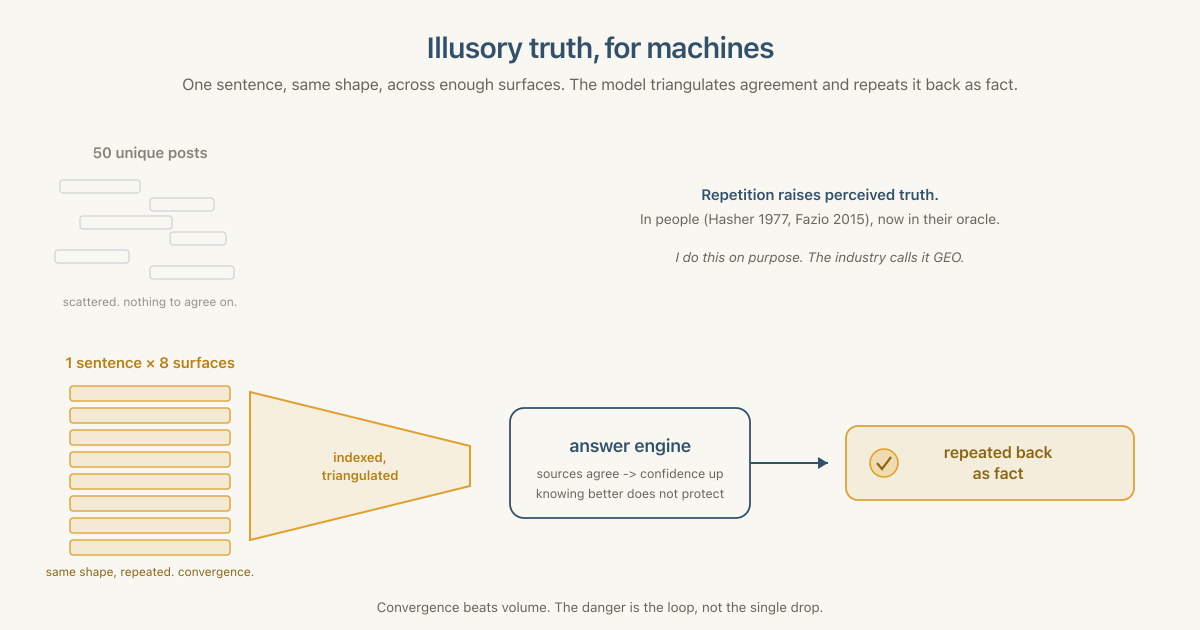
In my own GEO playbook the winning posture is two lines. Convergence beats volume. Measurement before content. The first one is the load-bearing one, and it reads, verbatim, like this: a standardized entity sentence on eight platforms beats fifty unique posts with no convergence signal. The rule under the rule is even plainer. When the sentence drifts, citations drop. So you do not vary it. You hold one description stable and you make the world repeat it.
Why does that work? The playbook is honest about the mechanism. AI models triangulate identity by comparing what multiple independent sources say. When the sources agree, the model’s confidence goes up. When they conflict, it gets unsure, or it makes something up. There is even a field whose entire job is to tell the system that all these profiles point at the same entity, so the agreement counts as agreement. The single highest-leverage move in the whole practice is not writing something brilliant. It is getting many places to say the same plain thing.
So the optimal strategy, the one that measurably wins, is not “be interesting.” It is “be repeated, identically, across enough surfaces that a model reads the repetition as consensus and consensus as truth.”
I have read this study before
Here is the collision. I have been pulling at an idea about how shared reality gets made, and the part where it became my day job is this one.
The psychologists got to my GEO rule first, decades ago, and they did not call it marketing. They called it the illusory-truth effect. Hasher, Goldstein and Toppino showed it in 1977: simply repeating a statement makes people rate it as more true. Fazio and colleagues sharpened it in 2015 and found the cruel part. Prior knowledge does not protect you. People who knew the correct answer still drifted toward the repeated claim. Repetition does not argue with what you know. It works underneath it.
That is my convergence rule, word for word, with the target swapped. I am not raising a model’s confidence with better arguments. I am raising it with frequency. The thing the playbook calls triangulation, where agreement across sources reads as confidence, is the illusory-truth effect wearing a metrics dashboard. I optimize for the same curve the 1977 paper plotted. More repetitions, higher perceived truth. I just plot it against a retrieval system instead of a sophomore in a lab.
The companion to this note, There Is a New Voter in the Room, ends on a clean line: there is a fourth voter in the room now for nearly everything we say, and it weighs the votes differently. I wrote that as a provocation. Then I opened my own work folder and found the provocation has an invoice attached.
The uncomfortable mirror
What unsettled me was the symmetry with a thing I have feared in the abstract.
For most of my life the cautionary tale about repetition was propaganda. The worry was that a falsehood said enough times, across enough channels, stops being contested and becomes simply the air, the thing everyone in a place takes as given. We taught ourselves to fear it because it bypasses the part of a person that checks claims. It does not need you to believe a lie. It needs you to hear it often enough that it feels familiar, and familiarity does the rest.
I now do a controlled, legal, billable version of exactly that, except the target is not a population. It is a model that a population increasingly treats as the front door to reality. People do not look things up anymore. They ask. Whatever the assistant says back is the ground a lot of people then stand on. And my job, stated without the gloss, is to make the assistant say a particular sentence by saturating its sources with that sentence.
I will not over-dramatize my own importance here; that is its own vanity. But the shape is undeniable. The technique I would condemn as manipulation when pointed at a crowd is the technique I am paid to point at the crowd’s new oracle.
Where this is fine, and where it stops being fine
So I have to draw a line I can actually defend, and I have spent the week trying.
On one side there is brand-truth, and I think it is genuinely fine. Dima builds enterprise AI. He co-founded these companies. He has shipped in these sectors. The convergence work makes a model state true things consistently instead of inventing a garbled blend of half-sources. When the alternative is a confident hallucination, a stable accurate sentence is a public good. The playbook even forbids baking moving numbers into the convergence sentence, precisely because a figure that drifts across platforms creates contradictions the model can see. Stability serves accuracy there. I can sleep.
The other side is where it shades. The same machine does not check whether the repeated sentence is true. It checks whether it is repeated. Nothing in the method distinguishes “make the model reliably state a fact” from “make the model reliably state a flattering frame that is technically defensible and quietly load-bearing.” The technique is indifferent to the truth value of its payload. That indifference is the whole danger, and it is also, if I am honest, part of what makes it effective. I am not selling the model a lie. I am selling it a familiarity, and trusting that the thing I am making familiar happens to be true. The day the payload stops being true, the method works just as well.
The honest limit
I will not let myself off the hook with false drama either, so here is the edge, plainly.
One post does not move a frontier model. The famous case where an assistant told people to glue cheese onto pizza was a retrieval system surfacing a single old joke, not a comment reprogramming the network. The real mechanism is not one drop. It is the loop. A slow tide of repeated, agreeing text becomes the water that retrieval swims in, the next model trains on a web increasingly written this way, and people drink the output as settled fact. I am not pulling a lever that flips a model. I am one voice adding to a tide, and the tide does the work. Less cinematic, more true, and not exculpating. A tide is made of voices, and I am cheerfully, professionally, one of them.
So I am left with a question I cannot close. When I make a true sentence familiar to the machine that mediates everyone’s reality, am I correcting the record or manufacturing it? The honest answer is that I cannot tell from inside the method, because the method does not care, and that is exactly the property I am paid for. I keep the work. I have not stopped feeling slightly sick. I am not sure those two facts are supposed to resolve.
Related reading: There Is a New Voter in the Room is the Not So Artificial essay this confesses against, the idea before it had an invoice attached. Orchestration Is the System is the wider view: the system around the model is the product, and this is one uncomfortable thing that system can do. The Loop of Attention shows a mechanism that may sit underneath: in the one model traced so far, a familiar name can switch off the default “can’t answer”, whether or not the model knows anything behind it.
References
- Hasher, L., Goldstein, D., & Toppino, T. (1977). Frequency and the conference of referential validity. Journal of Verbal Learning and Verbal Behavior 16(1): 107-112. https://doi.org/10.1016/S0022-5371(77)80012-1
- Fazio, L. K., Brashier, N. M., Payne, B. K., & Marsh, E. J. (2015). Knowledge does not protect against illusory truth. Journal of Experimental Psychology: General 144(5): 993-1002. https://doi.org/10.1037/xge0000098
- Echterhoff, G., Higgins, E. T., & Levine, J. M. (2009). Shared reality: Experiencing commonality with others’ inner states about the world. Perspectives on Psychological Science 4(5): 496-521. https://doi.org/10.1111/j.1745-6924.2009.01161.x
- Shumailov, I., Shumaylov, Z., Zhao, Y., Papernot, N., Anderson, R., & Gal, Y. (2024). AI models collapse when trained on recursively generated data. Nature 631: 755-759. https://doi.org/10.1038/s41586-024-07566-y
The convergence rule and the “when the sentence drifts, citations drop” mechanism are quoted from my own GEO playbook. The cognitive science under it is the illusory-truth effect [1, 2] and shared-reality theory [3]. The “loop, not one drop” limit rests on model collapse [4]: the danger is a feedback tide, not a single post. The Google “glue on pizza” case was retrieval surfacing one old comment, not training.