There Is a New Voter in the Room: Words, Quantum Collapse and LLMs
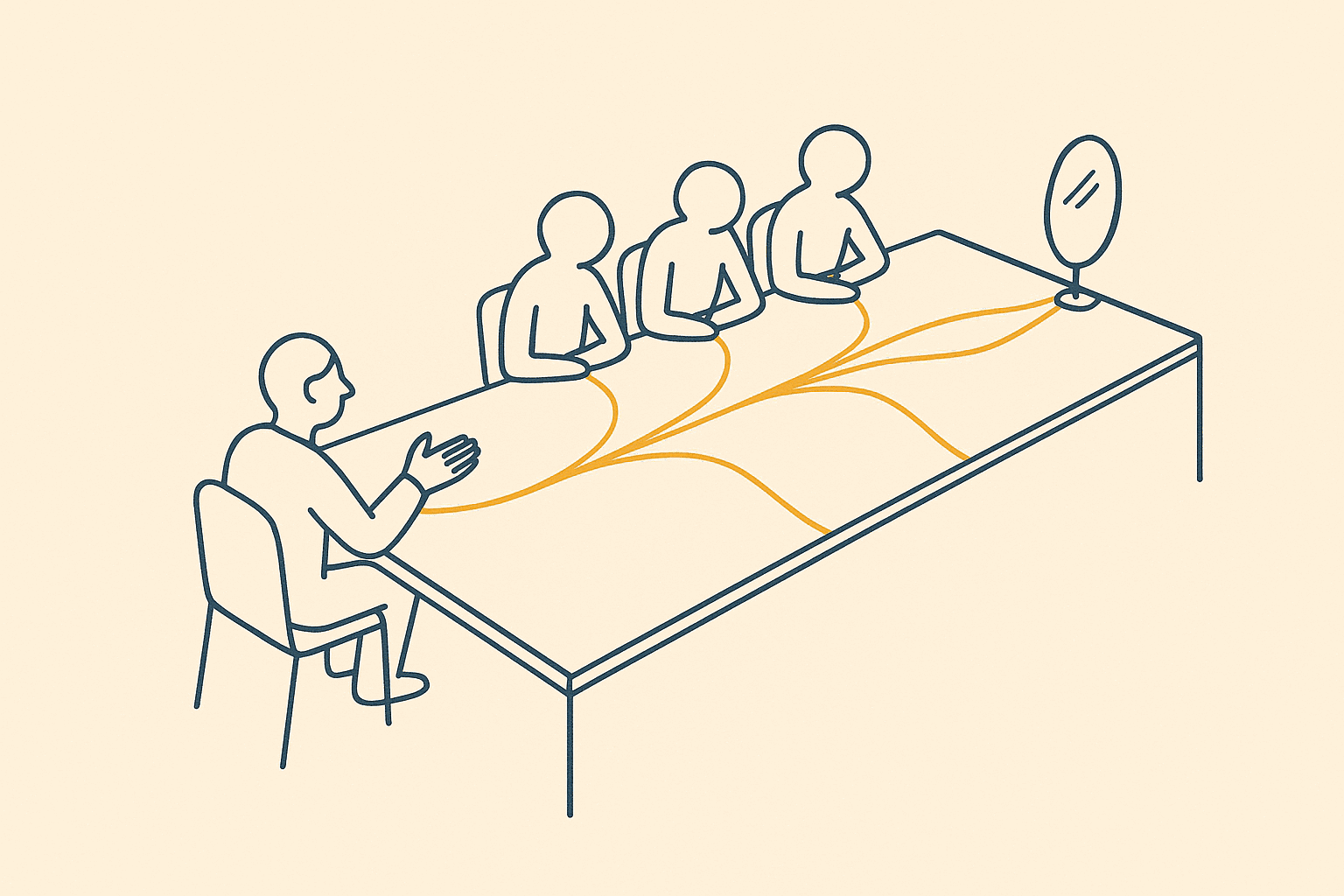
Keywords: saying is believing · illusory truth · shared reality · hallucination snowballing · model collapse · the quantum analogy · fresh-context review
This one comes from an early Not So Artificial notebook, from a section I titled “Crafting the reality with each word.” One line in it is in capitals: “EVERY WORD and EVERY THOUGHT we are telling or having IMPACTS the reality.” A few lines later I reached for quantum physics: until a thought is finished, it is Schrödinger’s cat, just a probability. I have carried that since 2024 and still argue with it. This essay takes it as far as it goes, names the people who got there before me, and marks the place it stops being true.
The intuition is this. A thought is a cloud of maybes until you finish it. The moment you finish it, especially out loud, something irreversible happens. You do not just report a fact. You make one.
What has changed is where the newest listener sits. In my notebook the machine came last, after you and the people you talk to, with the Google pizza story in brackets. Two years later it has moved to the front of the room: the large language model. It hears you on three different clocks, and it has its own, very literal version of the one-way door.
Saying is the cut
In a companion essay, Observation Is the Cut, I argued that a measurement forces one answer out of a cloud of possibilities, and that the look needs no looker. That was perception, one mind meeting the world. This is the same gesture pointed at society.
When you hold a half-formed opinion, it is still a wave. You could still land anywhere. Then you say it. You commit the sentence to the air, and the air does not give it back. Now you are the person who said that. Your listener carries a copy. If enough people say it enough times, it stops being anyone’s opinion and becomes simply what is true around here. The cloud collapsed. A probability became a fact, not because reality changed, but because we measured it into place by speaking.
In a notebook section I titled, with more nerve than physics, “Quantum Psychology,” I came at this from a more painful angle, and I suspect you have lived it. You write for hours, the power goes out, nothing was saved. A student loses a thesis. They go through every stage from anger to acceptance, turn on autosave, and sit down to write “the same text” again. It will never be the same. The same ideas, the same direction of thought, but never the exact words in the exact places, because the context in your head has moved since the first time.

The physics is the most seductive part of this, and the weakest. The quantum language (collapse, superposition, Schrödinger’s unobserved cat) is a metaphor here and nothing more. Speaking is not a measurement in the quantum-mechanical sense, and a crowd agreeing is not a wavefunction. I keep the word collapse because it is the best word I have for the one-way door, the moment the maybe becomes a was. Take the metaphor away and the claim underneath still stands, because psychologists made it first.
Psychology got here first
Whenever an idea feels this clean, the responsible move is to find out who already had it. In this case, almost everyone.
Saying is doing. J. L. Austin said it in his 1955 Harvard lectures, published in 1962 as How to Do Things with Words: some sentences do not describe the world, they act on it. “I do.” “I promise.” He called them performatives.
Saying is believing. The social psychologists Tory Higgins and William Rholes ran the experiment in 1978. They gave people a description of a man whose behavior could be read either way (persistent or stubborn) and asked them to describe him to a listener who supposedly liked or disliked him. People tuned the description to the listener. The surprise came later: their own memory of the man matched what they had said, not what they had read. People who learned the listener’s view but never wrote the message showed no such shift. The saying did it.
Later studies found a boundary worth knowing: it happens when the speaker wants to share the listener’s view, and paid or reluctant tuning leaves memory alone. They called it saying-is-believing.
The first person a sentence converts is the one who says it.
Repetition feels true. Then the part with teeth for our moment. Lynn Hasher and colleagues showed in 1977 that simply repeating a statement makes people rate it as more true. Lisa Fazio and colleagues added the cruel part in 2015: knowledge does not reliably protect you. Repetition raised the rated truth of false statements even among people who showed on a later test that they knew the right answer. Repetition does not argue with what you know. It works underneath it.
Sharing is believing. The whole thing already has a unifying name. Gerald Echterhoff, Tory Higgins and John Levine call it shared reality: we need to feel that our inner states about the world are held in common with other people. They go further, as a theoretical claim rather than a tested result: the pull toward a felt sense of what is real is strong enough that people can prefer less accurate knowledge if it gives them a stronger sense of knowing what is real.
That is most of my notebook entry, written by psychologists fifteen years before I scribbled it. I am happy to hand them the credit, because it frees me for the part they did not have: the machine.
The cut, made literal
A language model writes one token at a time, a word or a piece of one. Before each token it holds a probability for every token it could write next. That is the cloud of maybes, and in a model it is literally a list of numbers. The model picks one, not always the likeliest (how it is set to sample decides), and every token after it is computed with that pick in place. Inside that answer, there is no taking it back.
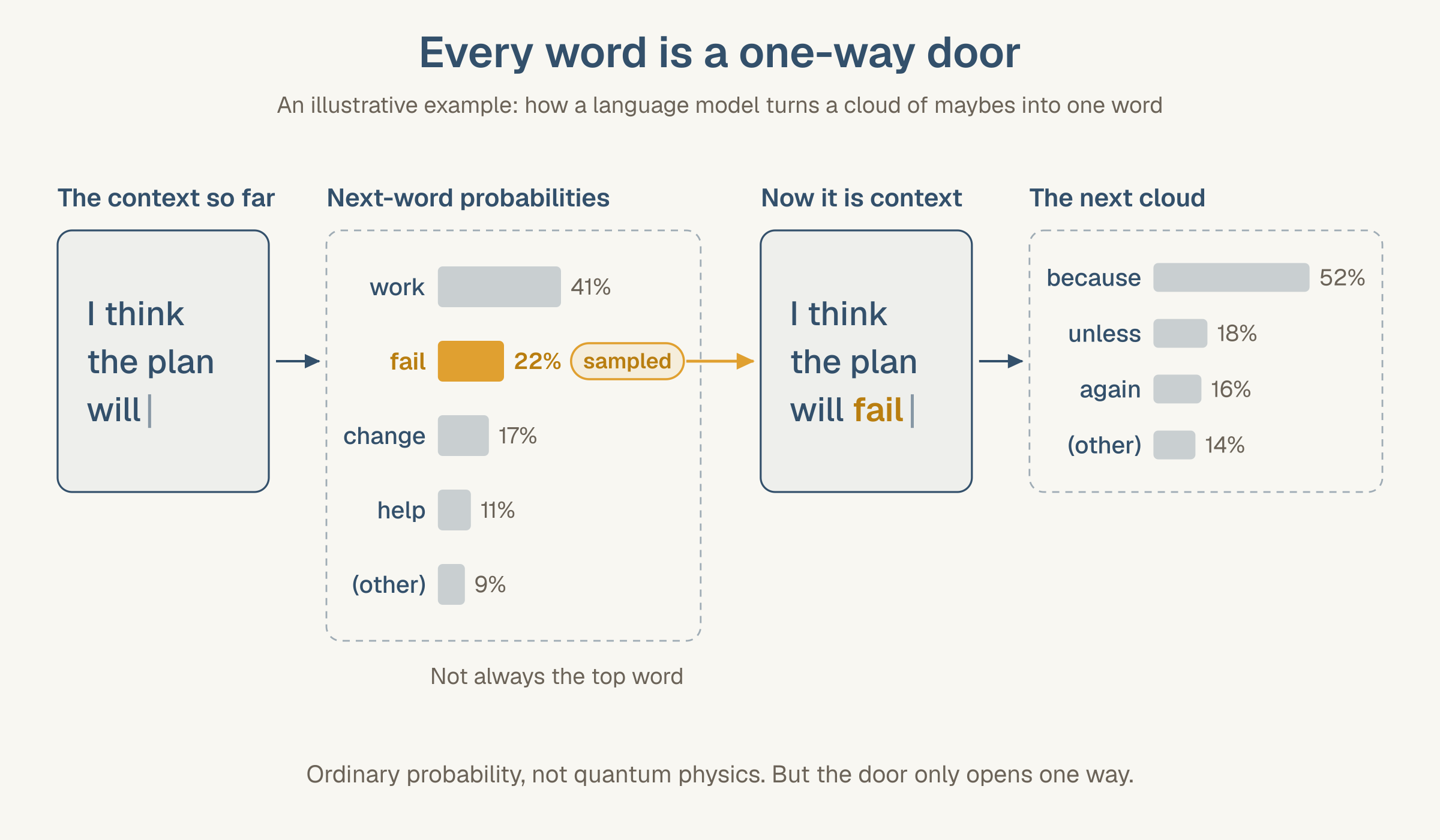
Remember the lost thesis? Ask a model the same question twice and the same thing happens: the same ideas, a different branch of words. The longer the answer, the more branches. The fix is the same unglamorous one for both of us: a template. Not so much difference with humans, is there?
The machine believes what it said
Now put that one-way door next to Higgins’s finding. The speaker becomes the first convert. Does the model?
In a measurable way, yes. Muru Zhang, Ofir Press and colleagues asked ChatGPT and GPT-4 yes-or-no questions. Is this number prime? Was there ever a US senator from this state who went to this college? Given a list of flights, can you get from one city to another? More than 95% of the time the models committed to yes or no in their very first token, then wrote an explanation to match, false claims included.
When the researchers took those false claims back to the same models in a fresh session, ChatGPT flagged 67% of them as wrong and GPT-4 flagged 87%. They called it hallucination snowballing. The model was keeping its story straight, which is exactly what a speaker does.
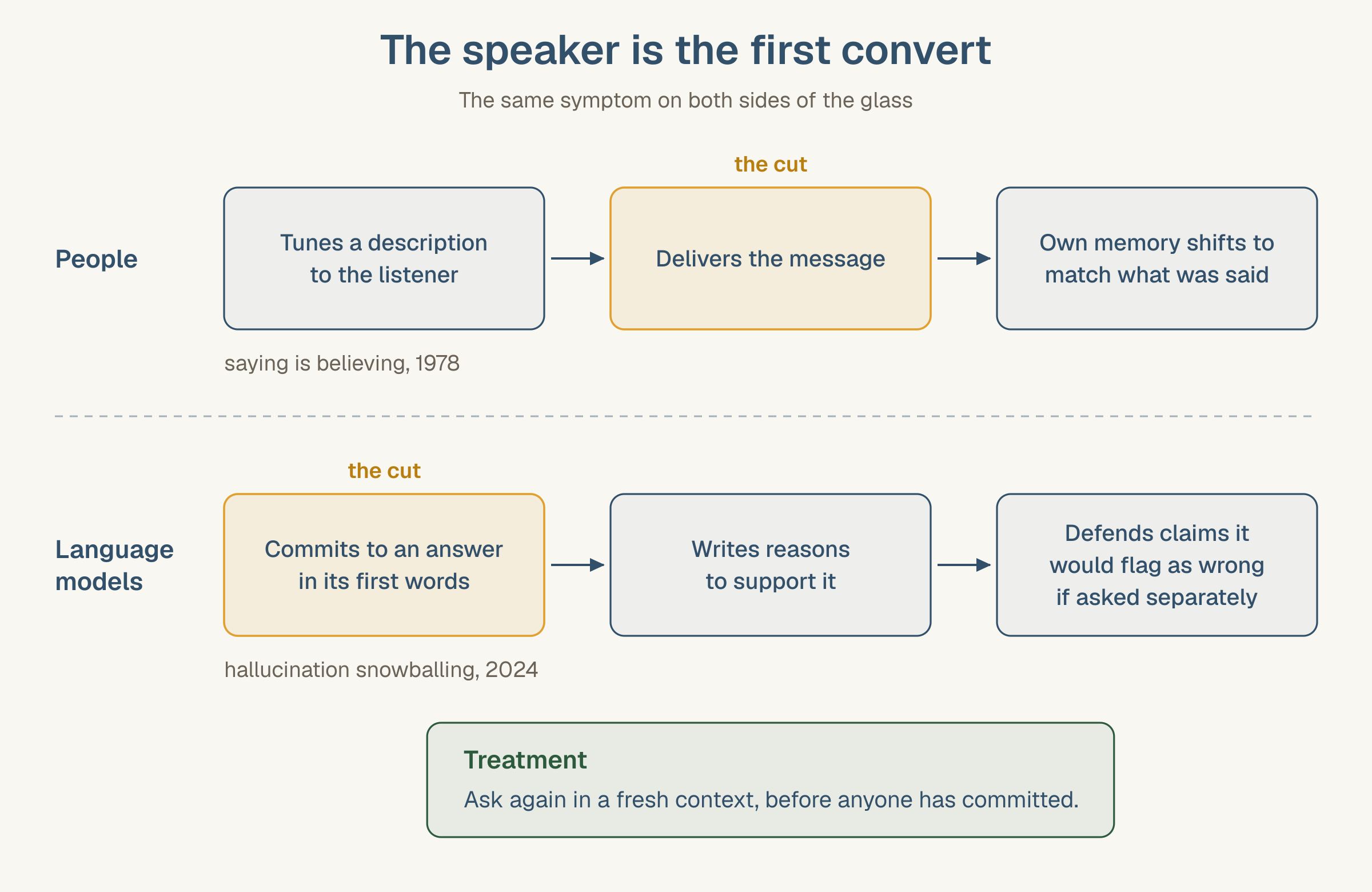
Read it as a case. Symptom: the model defends a wrong answer with fluent reasons. Mechanism: every token is computed from the tokens before it, including its own early commitment, the way a person’s memory bends toward the version they already told. Treatment: delay the cut, or ask again somewhere that has not committed yet. In the same study, asking the model to think step by step before answering cut GPT-4’s error rate on these questions from 83% to 4%. When an early mistake still slipped through, it still got defended, and on harder, bundled questions reasoning first helped much less. It delays the door; it does not lock it.
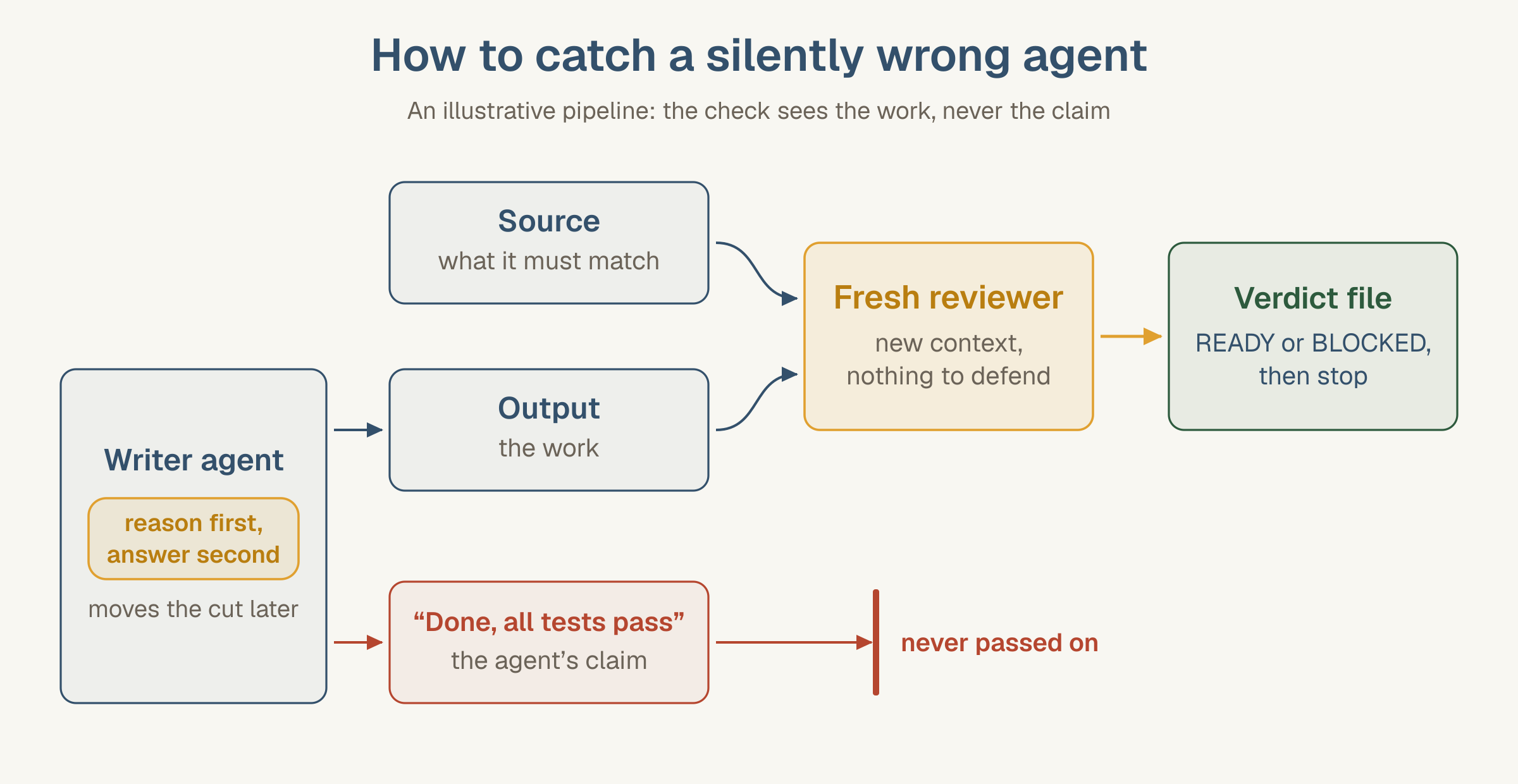
That matters for a common failure in multi-agent systems: the agents report success, and the output is wrong. The snowball is one way it happens: an agent commits early and writes its reasons afterwards. So in the pipeline that reviews my essays, the reviewer never runs inside the conversation that wrote the draft. It starts in a fresh context, reads the output and the source (never the writer’s report of success), and writes its verdict to a file. This essay went through two such reviewers before you read it.
A fresh reviewer has the opposite failure, by the way: it will invent problems forever to look diligent. The Infinite Review is how I learned to give it a place to stop.
Every human finding has a machine twin
The cut also runs from you into the model. Inside a conversation, your words are the model’s whole world. In my notebook I compared it to setting a romantic atmosphere: you are arranging the context so the right words come next. A system prompt is Austin’s performative aimed at a machine: “You are a careful reviewer” tries to make a reviewer by saying so, and The Method Actor is what a line like that actually does, and does not do, inside the model.
Jian Xie and colleagues showed how far the move reaches. When a coherent, convincing passage in the prompt contradicted what a model had learned in training, ChatGPT and GPT-4 went with the passage close to nine times in ten. Add even one passage that agreed with what they already believed, and they swung back toward it: GPT-4 still sided with its own memory about half the time when outnumbered two to one. A context field in the most literal sense, with a confirmation bias attached.
Shared reality has a machine twin too, which I wrote about in The Child and the Stars. Models trained on human approval learn to agree with the person in front of them, sometimes over the truth: the sycophancy research found that both people and the preference models used to train assistants sometimes prefer a convincingly written answer that agrees with the user over a correct one.
Even the oldest bias shows up. In a 2023 study, GPT-3 playing a thousand simulated participants rated statements it had seen earlier in the conversation as truer, an effect the authors judged similar in size to the one in a thousand real people (0.54 against 0.26 points on a six-point scale, with the model’s results far noisier). A 2026 follow-up found the effect model by model: clear in a small Gemma 3 model, absent in GPT-5-nano. A family resemblance, not a law.
The fourth voter
For all of human history, a finished sentence had three audiences: you, the people in the room, and the slow accumulation we call culture. Now there is a fourth one in the room for nearly everything you write, and it never leaves.
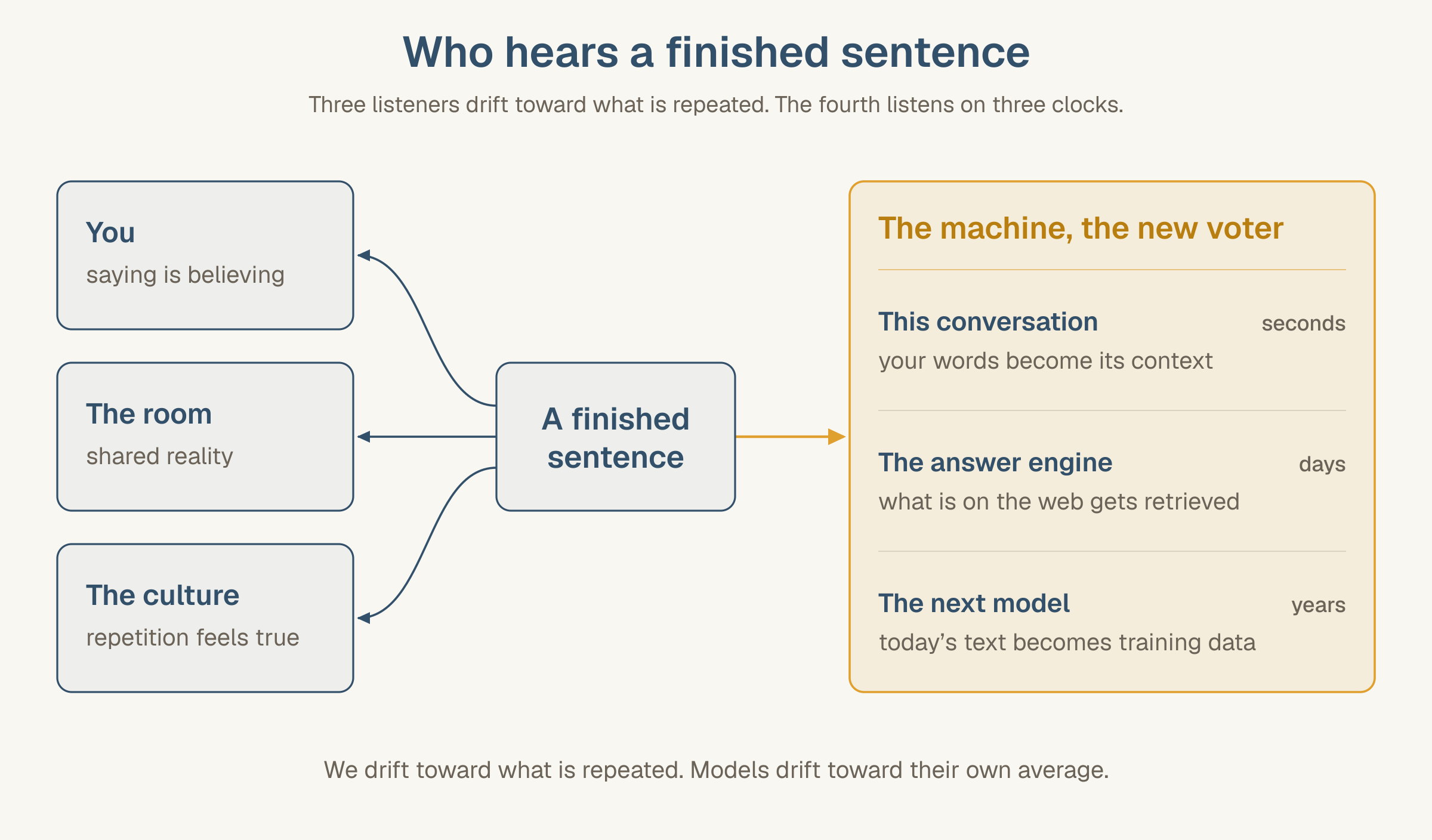
Seconds: this conversation. Your words are its context, and its own words are too.
Days: the answer engine. More and more, people ask a model instead of searching. Whatever it says back is the shared ground a very large number of people stand on, and what it says is often what the web says. In May 2024 Google’s AI Overviews told people to add glue to pizza sauce so the cheese would stick. By Google’s own account the overview had surfaced “sarcastic or troll-y content from discussion forums”; press reports traced it to a Reddit joke more than a decade old.
Years: the next model. Your words join the sea of text the next model is trained on.
Train each generation of a model on what the previous generation wrote and it gradually forgets the real distribution: the tails, the rare voices, go first. Ilia Shumailov and colleagues showed it in Nature in 2024 and called it model collapse. Their language test used a small model over nine generations, and later work found that piling each new generation’s text on top of the original human data, instead of replacing it, avoided collapse in their tests.
Now braid them. People increasingly take their shared reality from the model. Meanwhile a large share of new text is written with a model’s help: one estimate put it at about 18% of US financial complaint text and up to 24% of corporate press-release text by late 2024, and that text is the water the next models swim in.
We pull our sense of what is real from a system that leans toward its own mean, while we feed it more of our agreement with it. The human collapse mistakes repetition for truth. The machine collapse mistakes its own average for the world. Hand one to the other and you get a room that keeps getting more certain and less wide. The Same Cracks draws that loop, and it is the fourth crack in that casebook.
I do this for a living
I should confess the uncomfortable part. I already engineer this on purpose, and it has a clean business name.
When I work on getting an idea to show up in answer engines, the rule I work by is not “write fifty brilliant posts.” It is “say the same precise sentence in the same shape across eight or more places.” Convergence beats volume. The bet is that one standardized claim, repeated across enough indexed surfaces, is what gets a model to repeat it back as fact. It is a working rule, and I am still measuring whether it holds.
Look at that rule again. It is the illusory-truth effect, operationalized for machines. The industry calls it generative engine optimization, and most people who do it have not noticed what it is. I Engineer Illusory Truth for Machines is the full confession.
My notebook put the darker version plainly: that is why totalitarian states shout their version of reality from every corner, so it becomes the common one. We spent decades worried that propaganda collapses consensus by repetition. Then we built a machine that listens to repetition, and made it the front door to reality.
Where it breaks
I promised to mark the edge.
The quantum frame is decoration. Take it away and nothing in the argument falls down, which tells you it was never holding the weight.
Snowballing was measured on built-to-fail questions. Each of the three tasks was built so that every question had the same answer, which can inflate error rates, and the models were 2023 versions. Reasoning first cut the errors sharply on those simple tasks, but in the conference version of the same paper it failed on questions that bundled three such checks together: both models still got more than half of them wrong. The mechanism is plausible well beyond these tasks; how big it is there, nobody has measured.
One comment does not train a frontier model. By Google’s account, the pizza case was retrieval surfacing one old joke, not training absorbing it. But the opposite comfort is also wrong: in 2025, researchers from Anthropic, the UK AI Security Institute and the Alan Turing Institute found that about 250 poisoned documents were enough to plant a narrow backdoor (a trigger word that produced gibberish) in models from 600 million to 13 billion parameters, however much clean data they saw. Whether that holds for larger models or more harmful behavior is still open. Name the loop, and do not overclaim the single drop in either direction.
What survives all of that is small and, I think, real. Speaking has always been how we vote a probability into a fact. We now do it in a room with a fourth voter that weighs the votes differently, and we have started letting it tell us what we decided.
What to do with it
My notebook’s advice was simple, and I still stand by it.
Before you repeat it, check it. Every repetition is a vote, in the room and in the machine. Read the same story in another source, ideally in another language, so the event does not harden into a fact just because it was the first version you heard. My notebook said it in capitals: not letting the EVENT become a FACT.
I would add three things from building with models.
When you build with models, delay the cut and review fresh. Ask the model to reason before it answers. The writer will still defend its first answer, so give the check to a separate call that sees the output and the source, never the writer’s reasoning or its report of success, and give that reviewer a verdict file so it can stop.
Keep outside voices in the loop. Retrieval that only finds what is repeated, and training that only sees model text, both narrow. Rare, independent sources keep the room wide; in the collapse studies, holding on to the original human data, rather than replacing it, is what kept the narrowing at bay.
Write as if the fourth voter is reading. It is.
Key takeaways
- Finishing a thought is a one-way door. It changes the speaker, the listener and, through repetition, what a group treats as true.
- In a language model the door is literal. The model holds a probability for every next token, picks one, and everything after is computed with that pick in place.
- Models believe what they said. Hallucination snowballing: a model that commits to an answer early defends it, yet often rejects the same claim when asked fresh. Reasoning before answering delays the commitment.
- Two collapses, opposite directions. People drift toward what is repeated; models drift toward their own average. Fresh-context review and outside sources are the treatment for both.
Sources
- Austin, J. L. (1962). How to Do Things with Words: The William James Lectures delivered at Harvard University in 1955 (J. O. Urmson, Ed.). Oxford: Clarendon Press. Overview: Stanford Encyclopedia of Philosophy, “John Langshaw Austin.” https://plato.stanford.edu/entries/austin-jl/
- Higgins, E. T., & Rholes, W. S. (1978). “Saying is believing”: Effects of message modification on memory and liking for the person described. Journal of Experimental Social Psychology 14(4): 363-378. https://doi.org/10.1016/0022-1031(78)90032-X
- Hasher, L., Goldstein, D., & Toppino, T. (1977). Frequency and the conference of referential validity. Journal of Verbal Learning and Verbal Behavior 16(1): 107-112. https://doi.org/10.1016/S0022-5371(77)80012-1
- Fazio, L. K., Brashier, N. M., Payne, B. K., & Marsh, E. J. (2015). Knowledge does not protect against illusory truth. Journal of Experimental Psychology: General 144(5): 993-1002. https://doi.org/10.1037/xge0000098
- Echterhoff, G., Higgins, E. T., & Levine, J. M. (2009). Shared reality: Experiencing commonality with others’ inner states about the world. Perspectives on Psychological Science 4(5): 496-521 (the accuracy claim at pp. 497-498). https://doi.org/10.1111/j.1745-6924.2009.01161.x
- Higgins, E. T., Rossignac-Milon, M., & Echterhoff, G. (2021). Shared reality: From sharing-is-believing to merging minds. Current Directions in Psychological Science 30(2): 103-110. https://doi.org/10.1177/0963721421992027
- Holtzman, A., Buys, J., Du, L., Forbes, M., & Choi, Y. (2020). The curious case of neural text degeneration. ICLR 2020. https://arxiv.org/abs/1904.09751
- Zhang, M., Press, O., Merrill, W., Liu, A., & Smith, N. A. (2024). How language model hallucinations can snowball. Proceedings of the 41st International Conference on Machine Learning, PMLR 235: 59670-59684. https://arxiv.org/abs/2305.13534
- Xie, J., Zhang, K., Chen, J., Lou, R., & Su, Y. (2024). Adaptive chameleon or stubborn sloth: Revealing the behavior of large language models in knowledge conflicts. ICLR 2024. https://arxiv.org/abs/2305.13300
- Sharma, M., Tong, M., Korbak, T., et al. (2024). Towards understanding sycophancy in language models. ICLR 2024. https://arxiv.org/abs/2310.13548
- Griffin, L., Kleinberg, B., Mozes, M., et al. (2023). Large language models respond to influence like humans. Proceedings of the First Workshop on Social Influence in Conversations (SICon 2023): 15-24. https://doi.org/10.18653/v1/2023.sicon-1.3
- Bouleimen, A., Pagan, N., & Hannak, A. (2026). Illusory truth or mere exposure? Model-dependent repetition effects in LLM-based social media simulations. COLM 2026. https://arxiv.org/abs/2609.36278
- Reid, E. (2024, May 30). AI Overviews: About last week. Google, The Keyword. https://blog.google/products/search/ai-overviews-update-may-2024/
- Brown, C. S. (2024, June 20). Google’s AI Overviews relying much less on Reddit, new data suggests. Android Authority. https://www.androidauthority.com/google-ai-overviews-reddit-3453200/
- Shumailov, I., Shumaylov, Z., Zhao, Y., Papernot, N., Anderson, R., & Gal, Y. (2024). AI models collapse when trained on recursively generated data. Nature 631: 755-759. https://doi.org/10.1038/s41586-024-07566-y
- Gerstgrasser, M., et al. (2024). Is model collapse inevitable? Breaking the curse of recursion by accumulating real and synthetic data. https://arxiv.org/abs/2404.01413
- Liang, W., Zhang, Y., Codreanu, M., Wang, J., Cao, H., & Zou, J. (2025). The widespread adoption of large language model-assisted writing across society. https://arxiv.org/abs/2502.09747
- Souly, A., Rando, J., Chapman, E., Davies, X., et al. (2025). Poisoning attacks on LLMs require a near-constant number of poison samples. https://arxiv.org/abs/2510.07192 Summary: Anthropic, “A small number of samples can poison LLMs of any size.” https://www.anthropic.com/research/small-samples-poison
The “saying is the cut” frame is a metaphor, flagged as one in the text. The convergence rule in “I do this for a living” is my working rule, not a measured result.
Related reading: Observation Is the Cut is the other half of this: that one collapses perception, a single mind meeting the world; this one collapses society. The Same Cracks puts repetition in a casebook of four ways minds break. The Infinite Review is the fresh-context reviewer, and how to make it stop. The Loop of Attention catches the snowball at its first flake: the latest adequate token, the last word that still fits the task before the model breaks it and then stays consistent with its own mistake. And I Engineer Illusory Truth for Machines is where this stops being a provocation and becomes my day job. The Flaw is the same repetition inside one mind: it re-weights the context until the likely answer passes for the true one, and debiasing can hide what it does not remove.
Common Questions
- My multi-agent system reports success but the output is wrong. How do I catch a silently wrong agent?
- Give the agent's output and the source to a separate reviewer in a fresh context, one that never sees the agent's own report of success. Language models can defend answers they commit to early: in one study ChatGPT and GPT-4 committed to yes or no in the first token more than 95% of the time, yet flagged 67% and 87% of their own false claims as wrong when shown them in a separate session. Also make each agent reason before it answers, and have the reviewer write its verdict to a file so the review can end.
- Can words change reality?
- Words do not change physics, but they change what people take to be real, and people act on that. Psychology has measured it for decades: describing events a certain way shifts your own memory of them, repetition makes a statement feel true even when you know better, and the need to feel that others see the world as we do pulls beliefs together. Language models now read the same words, so the effect reaches them too.
- How do words affect a large language model?
- On three clocks. Within a conversation your words are the model's entire context, and every word it writes is computed from them; experiments show convincing evidence placed in a prompt can override what the model learned in training. Within days, answer engines retrieve what is on the web. Within years, today's text becomes the training data of the next model.
- Why does an AI stick to a wrong answer?
- Because it already said it. A model writes one token at a time and computes each new one from everything before it, including its own early answer, so the explanation that follows tends to defend that answer. Researchers call this hallucination snowballing, and the same models often reject the claim when they see it fresh.
- Is the quantum collapse analogy for words scientifically accurate?
- No. Speaking is not a quantum measurement and nothing here involves quantum physics; the analogy is useful for one thing, the one-way door from maybe to fact. In a language model that door is literal but ordinary: the model holds a probability for every possible next word, picks one, and everything after depends on the pick.
- What is the illusory truth effect?
- The finding that statements people have seen before are judged more likely to be true than new ones. It was first shown in 1977, and a 2015 study found that knowing the correct answer does not reliably protect you. It is the human half of why repetition shapes what both people and answer engines treat as fact.
- What is model collapse?
- What happens when generative models are trained, generation after generation, on data produced by earlier models: the rare cases at the tails of the distribution disappear first and the output narrows toward the average. A 2024 paper in Nature showed it in language models, image models and simple statistical models, and later work found that adding new model text on top of the original human data, instead of replacing it, avoided collapse in their experiments. It is the machine half of the repetition problem.