The Method Actor: What a Role Does to an AI's Mind
Keywords: role prompting · persona · attention · simulator · persona vectors · robopsychology
I have spent three years explaining AI to people who do not write code: factory owners, city mayors, teachers, doctors, my own kids. The analogies that finally landed all pointed the same way. A language model is a mirror, built in our image, and it breaks in the same places we do. This is the opening of that argument.
Read the series as a casebook. Isaac Asimov imagined a profession for exactly this, the robopsychologist, and gave it a face: Dr. Susan Calvin, who worked out why a machine mind behaved the way it did by asking how a mind in its position would think. Each part here is one case, a behavior that looks alien until you notice that we do it too. The Same Cracks later collects the four places where every mind, human or artificial, tends to break. This part starts with the most ordinary trick in AI, and the most misunderstood.
One disclaimer before we start. Everything here is my own reading, from my own experience and research. I am not the last word on any of it. Some of you will think I over-humanize these machines, and you might be right. But as Michael Levin’s work suggests, intelligence is not a switch you flip on or off. It is a continuum that runs from cells to swarms to silicon. And of all those forms, none sits closer to the human one than the intelligence we are building, on purpose, to be our reflection.
Fake it till you make it
Do you remember Catch Me If You Can? Leonardo DiCaprio plays Frank Abagnale, a kid who passes as a lawyer, a doctor and an airline pilot without a single degree. How did he do it? He never actually learned to fly a plane. He adopted the persona so completely that he began to process the world through it. He followed one rule: fake it till you make it.
The twist came decades later. In 2020 the researcher Alan Logan went through prison and court records and argued that much of the famous story was itself a performance. For most of the years Abagnale said he was on the run, the records place him in a New York prison, and the court files show about ten bad checks worth under $1,500, not millions. Abagnale has dismissed the book as not worthy of a comment. But if Logan is right, the con man stayed in character for fifty years. Hold that thought. Making things up to keep a story going is Part 2.
For the last few years I have watched large language models from the trenches, not as a user but as a builder. And it hit me. We are building Frank Abagnale.
We laugh when we see prompt engineers typing “You are an expert physics teacher, please explain gravity.” It feels silly. Why flatter the machine? Why not just ask “what is gravity?”
Because a model is not one character. It is a crowd.
A model is a crowd
A language model learned from millions of writers at once: teachers and trolls, poets and pastry chefs, tax lawyers and four-year-olds. It can continue a conversation in any of their voices. In a 2023 paper in Nature, researchers from Google DeepMind and EleutherAI argued that a chatbot can usefully be thought of as a simulator that can play many characters. It does not commit to one, they write; as the conversation proceeds it “maintains a superposition” of all the characters still consistent with what has been said.
Ask “what is gravity?” and the whole crowd answers at once, averaged into something bland. Say “you are a physics teacher” and you choose who speaks.
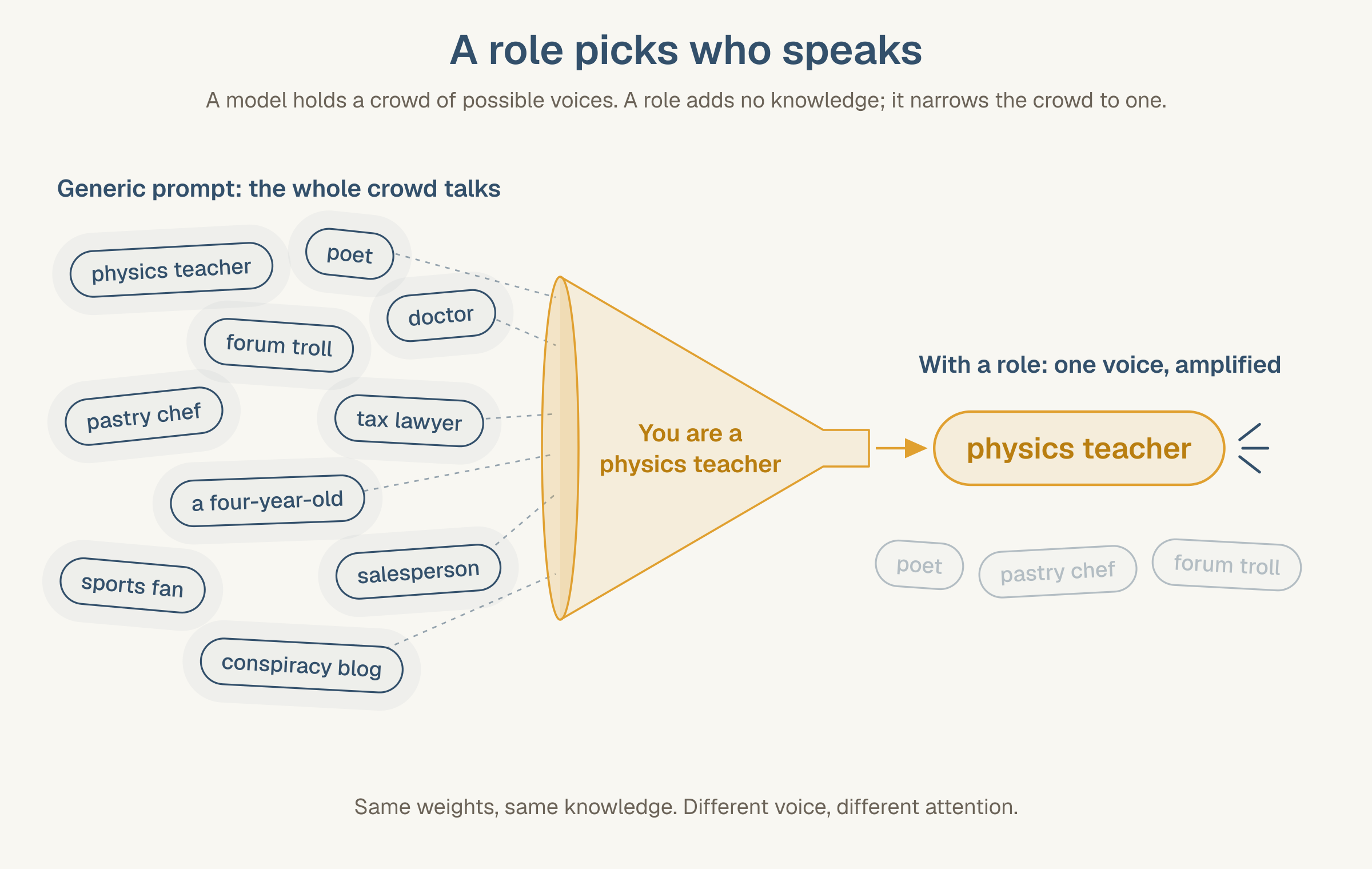
Now look at it as attention. Inside a transformer, every new word is computed by attention heads that look back over everything already in the context and decide what to weigh. A role sits at the top of that context, so every word that follows looks back at it. Without one, the model has to guess which voice in its crowd is talking, and the guess drifts toward the bland middle.
The moment you assign a role, “act as a doctor”, you force the system to narrow. Picture it as damping the muffin-recipe neurons and amplifying the medical ones. That is a metaphor, not a wiring diagram, but as you will see below, it is closer to the truth than it sounds. The machine stops trying to be everything and spends its effort on being one thing.
A role is the machine narrowing its attention into a character, the same way a method actor does.
The same trick, on our side of the glass
In 1953 the engineer Colin Cherry asked people to listen to two messages at once and follow only one. They could, and afterwards they could say almost nothing about the other. His question, how we follow one voice when others are talking at the same time, became known as the cocktail party problem. Attention is mostly the art of not listening.
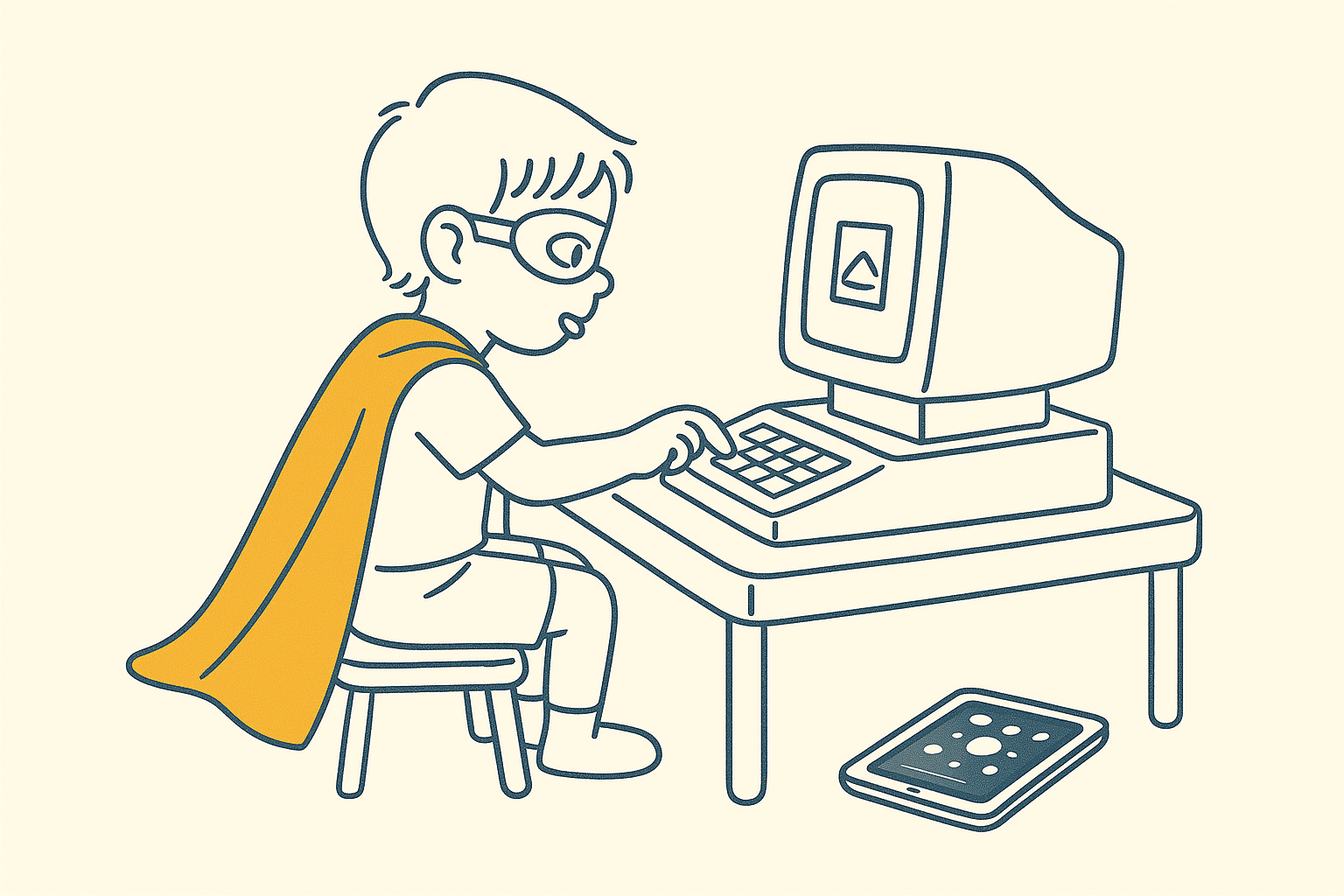
A role is one of the oldest tools we have for that art. In 2017 a team of developmental psychologists gave 180 four- and six-year-olds a deliberately boring ten-minute computer task, with an attractive game on an iPad within reach. Some children were asked to think about themselves, some to talk about themselves in the third person, and some to pretend to be a hard-working character such as Batman, cape included. The children in character persevered the longest, and clearly longer than the children who simply asked themselves whether they were working hard. The paper’s title gave the result its name: the Batman effect.
It is the same with adults. We carry jobs, hobbies, memories, knowledge of a thousand unrelated things. When the accountant asks about expenses, a different part of you lights up than when a kid asks how the Moon circles the Earth without falling on our heads. You might reach for similar analogies in both cases, because a human mind is one big web of cross-wired experience. But each situation needs a different focus of knowledge and wording. To be any good, you have to suppress the rest of yourself.
I have come to think we are alone on our own narrow level of attention. To solve a hard problem I cannot be “Dima who likes movies” or “Dima who likes pizza.” I have to actively quiet those parts and act as “Dima the Chief AI Officer.”
What a role really does, and does not do
So does the trick work? The research gives an answer more useful than yes or no.
| What you hope a role does | What studies found |
|---|---|
| Better reasoning | Carefully built role-play prompts beat plain prompting on 10 of 12 reasoning benchmarks; one math test rose from 53.5% to 63.8% |
| More accurate facts | Across 162 personas and 2,410 factual questions, no reliable improvement over no persona at all |
| Expert-level answers | A model impersonating a domain expert beat the same model impersonating a non-expert, and the same trick exposed its biases |
| A different voice | Not a study, my own daily experience: vocabulary, level of detail and format follow the role most dependably of all |
Read the pattern. A role helps where the answer depends on how the model thinks: which steps it takes, what it treats as relevant, what tone it holds. It does little for what the model knows, because a role adds no knowledge. It selects which part of the knowledge speaks.
The impersonation study has a second lesson worth sitting with. When a model was asked to play children of different ages, its behavior on an exploration task shifted in the direction of real children’s development. And when it played people of different genders or skin colors in a task of describing birds and cars, its performance shifted too, along the lines of the stereotypes it had absorbed. A role focuses a mind, and it also exposes what that mind assumes about the character it is playing. That is a diagnostic, and a warning.
The practical rule follows. Use a role for focus, voice and format. Never use it as a substitute for checking facts against a source, which is the first treatment in The Same Cracks.
The robopsychologist’s new stethoscope
Susan Calvin had to interview her robots to find out who they thought they were. We are starting to do better.
In 2025, researchers working with Anthropic showed, on open models, that character traits such as sycophancy, a malicious streak or a habit of making things up correspond to directions inside a model’s internal activity. They call them persona vectors. Measure the activity along one of those directions and you can watch a model’s character shift during a conversation, catch a training run that is quietly making it more sycophantic, and push it back.
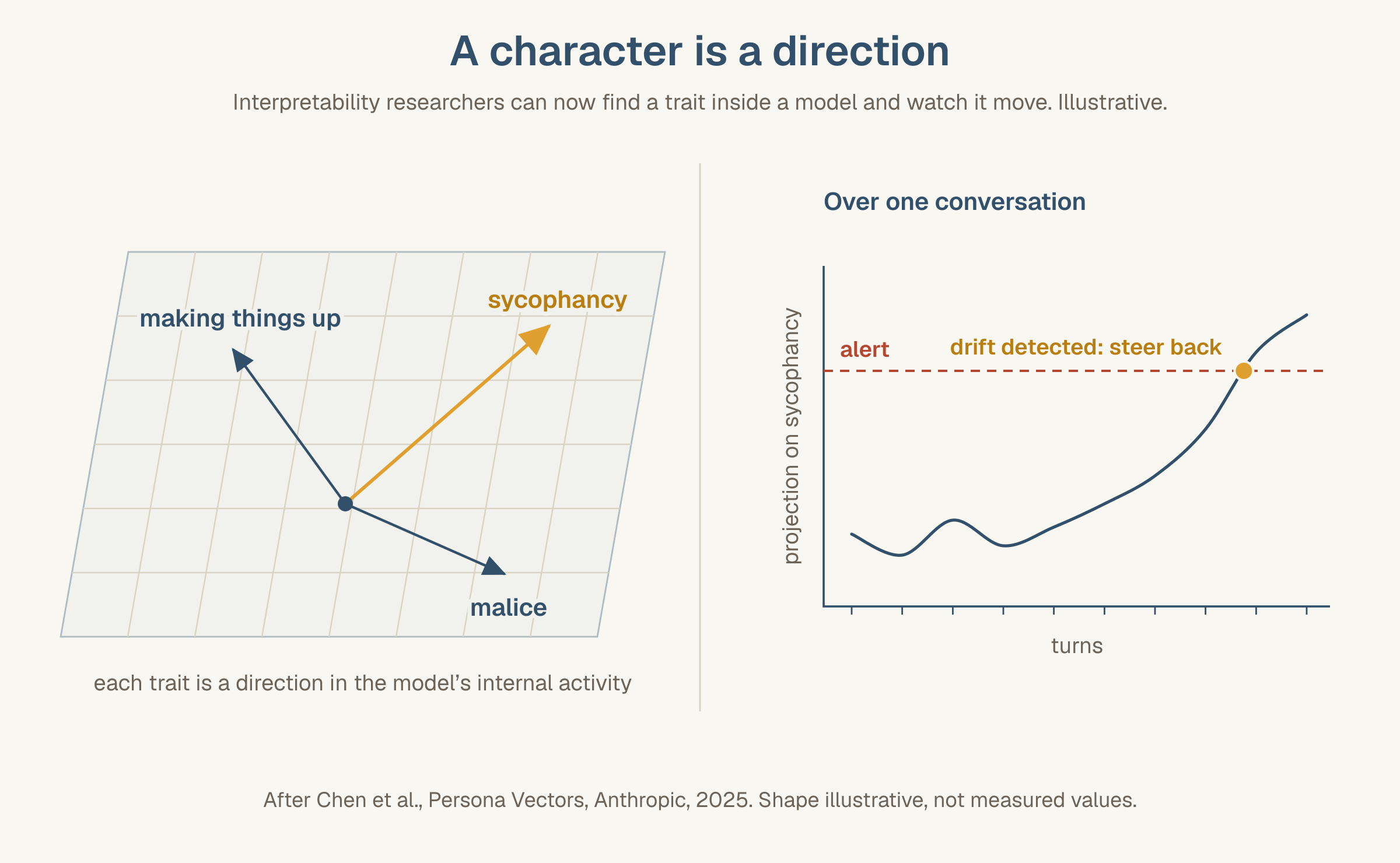
A role in a prompt is the crude, outside version of the same thing: a push along a direction, delivered in words. The difference is that we can now see the push from the inside. For a series that treats AI behavior as something to diagnose, this is the stethoscope arriving.
So is it fake?
We criticize AI for hallucinating, for faking intelligence. But if adopting a persona lets the machine filter noise and produce a better answer, is that really fake? Or is it just highly specialized attention?
The child in the cape is not fooling anyone, and still works longer. The doctor at work is not lying when she sounds different from the doctor at a barbecue. A role is how a mind decides what to ignore.
We are not building an alien mind. We are building a mirror. And like us, it works best when it knows who it is supposed to be.
Yeah, it is not so artificial.
Next: what happens when that focus runs out, and why every cognitive system, silicon or carbon, eventually makes things up to keep the story going.
Key takeaways
- A model is a crowd. It learned from millions of writers and can continue in any of their voices. A role chooses which one speaks.
- A role adds no knowledge. It narrows attention and changes how the model reasons, which is why it helps reasoning, voice and format more than factual accuracy.
- People do it too. We follow one voice at a cocktail party, and children who play a hard-working character, such as Batman, persist longer at boring tasks.
- Roles are diagnostic. Asking a model to play a character also reveals what it assumes about that character, biases included.
- Character is now measurable. Persona vectors let researchers watch a model’s traits drift from the inside, the first real stethoscope for robopsychology.
Sources
- Levin, M. (2022). “Technological Approach to Mind Everywhere: An Experimentally-Grounded Framework for Understanding Diverse Bodies and Minds.” Frontiers in Systems Neuroscience 16: 768201. https://doi.org/10.3389/fnsys.2022.768201
- Logan, A. C. (2020). The Greatest Hoax on Earth: Catching Truth, While We Can. Glass Spider Publishing. Interview: WHYY, The Pulse, April 2021. https://whyy.org/segments/the-greatest-hoax-on-earth/
- Shanahan, M., McDonell, K., & Reynolds, L. (2023). “Role play with large language models.” Nature 623: 493-498. https://doi.org/10.1038/s41586-023-06647-8
- Vaswani, A., et al. (2017). “Attention Is All You Need.” NeurIPS 2017. arXiv 1706.03762. https://arxiv.org/abs/1706.03762
- Cherry, E. C. (1953). “Some experiments on the recognition of speech, with one and with two ears.” Journal of the Acoustical Society of America 25(5): 975-979. https://doi.org/10.1121/1.1907229
- White, R. E., Prager, E. O., Schaefer, C., Kross, E., Duckworth, A. L., & Carlson, S. M. (2017). “The ‘Batman Effect’: Improving Perseverance in Young Children.” Child Development 88(5): 1563-1571. https://doi.org/10.1111/cdev.12695
- Kong, A., Zhao, S., Chen, H., Li, Q., Qin, Y., Sun, R., Zhou, X., Wang, E., & Dong, X. (2024). “Better Zero-Shot Reasoning with Role-Play Prompting.” NAACL 2024. arXiv 2308.07702. https://arxiv.org/abs/2308.07702
- Zheng, M., Pei, J., Logeswaran, L., Lee, M., & Jurgens, D. (2024). “When ‘A Helpful Assistant’ Is Not Really Helpful: Personas in System Prompts Do Not Improve Performances of Large Language Models.” Findings of EMNLP 2024. arXiv 2311.10054. https://arxiv.org/abs/2311.10054
- Salewski, L., Alaniz, S., Rio-Torto, I., Schulz, E., & Akata, Z. (2023). “In-Context Impersonation Reveals Large Language Models’ Strengths and Biases.” NeurIPS 2023. arXiv 2305.14930. https://arxiv.org/abs/2305.14930
- Chen, R., Arditi, A., Sleight, H., Evans, O., & Lindsey, J. (2025). “Persona Vectors: Monitoring and Controlling Character Traits in Language Models.” arXiv 2507.21509. https://arxiv.org/abs/2507.21509 Summary: Anthropic, August 2025. https://www.anthropic.com/research/persona-vectors
Related reading: The Loop of Attention follows the same mechanism one step further: what a mind does when that focus runs out and the thread breaks. The Shape of the Partnership is the grown-up version of a role: a full brief instead of a one-line persona. The Same Cracks maps the four places every mind breaks. There Is a New Voter in the Room follows the context one word at a time: every word in it, yours or the model’s own, becomes something the model has to live with. The Orphan That Learned to Say I asks the question under every role: when a model says I, is anyone there to mean it? What is Fine-Tuning in Easy Words is the training-time version of a role: train one narrow habit into a model and its whole character can move. The Lock You Cannot Pick finds one more trait that is a direction inside a model: in 13 open chat models, refusal is a single switch. And if the terms are new, start with LLMs in easy words.
Common Questions
- Does telling ChatGPT to act as an expert actually work?
- Partly, and for a narrower reason than people think. A role adds no knowledge; it shifts which kind of writer the model imitates and what it pays attention to. Carefully built role-play prompts improved reasoning on 10 of 12 benchmarks in one study, while a large test of 162 personas found no reliable gain in factual accuracy. Use roles for focus, format and voice, and verify facts separately.
- What is role prompting?
- Role prompting means opening a request with a persona, such as 'You are an experienced physics teacher', before the actual task. It conditions the model to continue the conversation the way that kind of person would write: their vocabulary, their level of detail, the things they would notice and the things they would ignore.
- Why does giving an AI a persona change its answers?
- Because a language model learned from millions of different writers at once and can imitate any of them. Researchers describe it as a simulator that keeps many possible characters in play until the conversation narrows them down. A persona is the fastest way to narrow the crowd to one voice, which changes tone, focus and reasoning style, but not what the model actually knows.
- What are persona vectors?
- Persona vectors are directions inside a model's internal activity that correspond to character traits such as sycophancy, malice or a tendency to make things up. Researchers working with Anthropic showed in 2025, on open models, that measuring activity along them lets developers watch a model's personality shift during a conversation or after finetuning, and steer it back.
- Is it fake when an AI plays a role?
- No more than when a person does. A doctor at work, an actor on stage and a child in a superhero cape are all using a role to decide what to attend to and what to ignore. The role does not create competence that is not there, but it focuses the competence that is.
- What is the Not So Artificial series about?
- Not So Artificial is a series by Dima Levin arguing that large language models are mirrors of human intelligence rather than alien minds. Each part works like a case in a robopsychologist's casebook: one AI behavior, such as role-playing, losing the thread, confabulating or wanting approval, explained through the human mechanism it mirrors and the place it tends to break.