The Measure of Misunderstanding
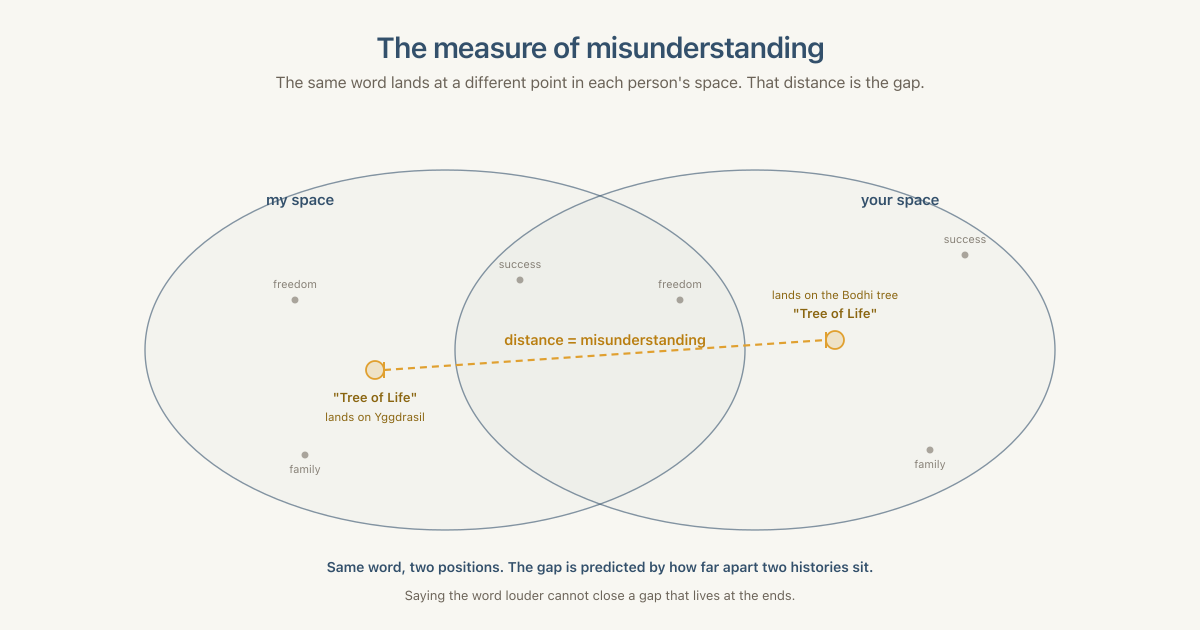
I have written before that a word is not a concept, and that when I say “dog” you rebuild a different dog on your side. That is the groundwork. Here I want the next turn, the one that makes it useful instead of just true.
If we each rebuild meaning privately, then the gap between my meaning and yours has a size. And a size can be measured.
Everyone runs a private embedding model
In a language model there is a step called embedding. A model takes a concept and places it at a point in a high-dimensional space. Where it lands, and how near it sits to every other concept, is the meaning. Two models trained on different data place the same word in different positions. “Apple” sits near “orchard” in one and near “iPhone” in another. Nobody moved it on purpose. The training data decided.
Every human runs the same step. You have your own embedding model, trained on your own life. When you hear a word, you place it. Where it lands, for you, is what it means, for you.
Say “Tree of Life” and watch where it goes. For me it lands on Yggdrasil, a Nordic tree holding up the world. For someone else it lands on the Kabbalistic tree, ten nodes and their paths. For someone else, the Bodhi tree the Buddha sat under. A baobab. Darwin’s branching diagram. The glowing tree in Avatar. Same three words. Six different positions in six different spaces, and each of us is certain we said something clear.
Misunderstanding is a distance
Here is the claim. The distance between where a word lands in my space and where it lands in yours is the measure of our misunderstanding.
Not whether we disagree on facts. Facts are downstream. The gap shows up earlier, in the words we both think are settled. When I say “freedom,” or “success,” or “family,” a whole constellation of associations lights up in me. A different constellation lights up in you. We never compare the constellations. We compare the word, see it matches, and assume the rest matched too.
So the error is not in the transmission. The word arrives intact. I say “A,” you hear “A.” The loss happens at the ends. I encode “A” from my space. You decode “A” from yours. The gap between what I meant and what you understood is the gap between our two spaces, nothing more and nothing less.
The useful part: the distance is predicted
This is where it stops being a nice metaphor and starts paying rent. The distance is not random. It is predicted by training data, the same way it is for the models.
Two people raised in the same place, in the same trade, in the same decade, sit close. Their spaces overlap, so most words land in nearly the same spot, so they understand each other cheaply. Two people from far-apart inputs sit far, and the same words land far apart, and they have to work to mean the same thing.
That single idea collapses a pile of separate problems into one:
- Cross-cultural communication is hard because the training data is different. Far inputs, far positions.
- Generational gaps are real because the same words were embedded in different decades.
- Couples argue about “obvious” things because shared vocabulary is not shared meaning. The words match, the spaces do not.
- Jargon fails because expert embeddings and lay embeddings place the same term in different neighborhoods. To the expert “model” sits near “weights.” To everyone else it sits near “runway.”
One mechanism under all four. An encoding and decoding mismatch, sized by how far apart two histories sit.
What you do with a measure
A measure is worth more than an insight, because you can act on it.
When a conversation feels insane, when the other person seems to be defending something obviously wrong, the reflex is to argue the fact harder. The measure says: stop, and check the distance first. You are probably not in a fact dispute. You are two embedding spaces putting one shared word in two different places, and louder transmission of the word cannot close a gap that lives at the ends.
So you do the thing that actually shrinks distance. You unpack the word. You name your constellation and ask for theirs. You reach for an analogy that lives in their space, not yours. This is the same lever I keep landing on for machines, funding the analogy instead of repeating the claim, and it turns out to be the lever for people too.
The distance never goes to zero. Nobody shares your training data. But you can stop mistaking a far word for a wrong person, and that alone is most of the fight.
Related reading: A Word Is Not a Concept is the groundwork this builds on. The Analogy Engine is the tool that actually shrinks the distance, by routing through experience the listener already has. And The Vector shows how the same kind of embedding space works inside the machine. The Flaw is what a private embedding model does when its sample is skewed: bias as context, and why the debiasing that only hides it is the dangerous kind. Perspective AI is the architecture side of that distance: a marketplace where communities tune and govern their own models instead of living inside one global default.
Sources
- Tomas Mikolov et al., “Efficient Estimation of Word Representations in Vector Space,” 2013.