The Vector
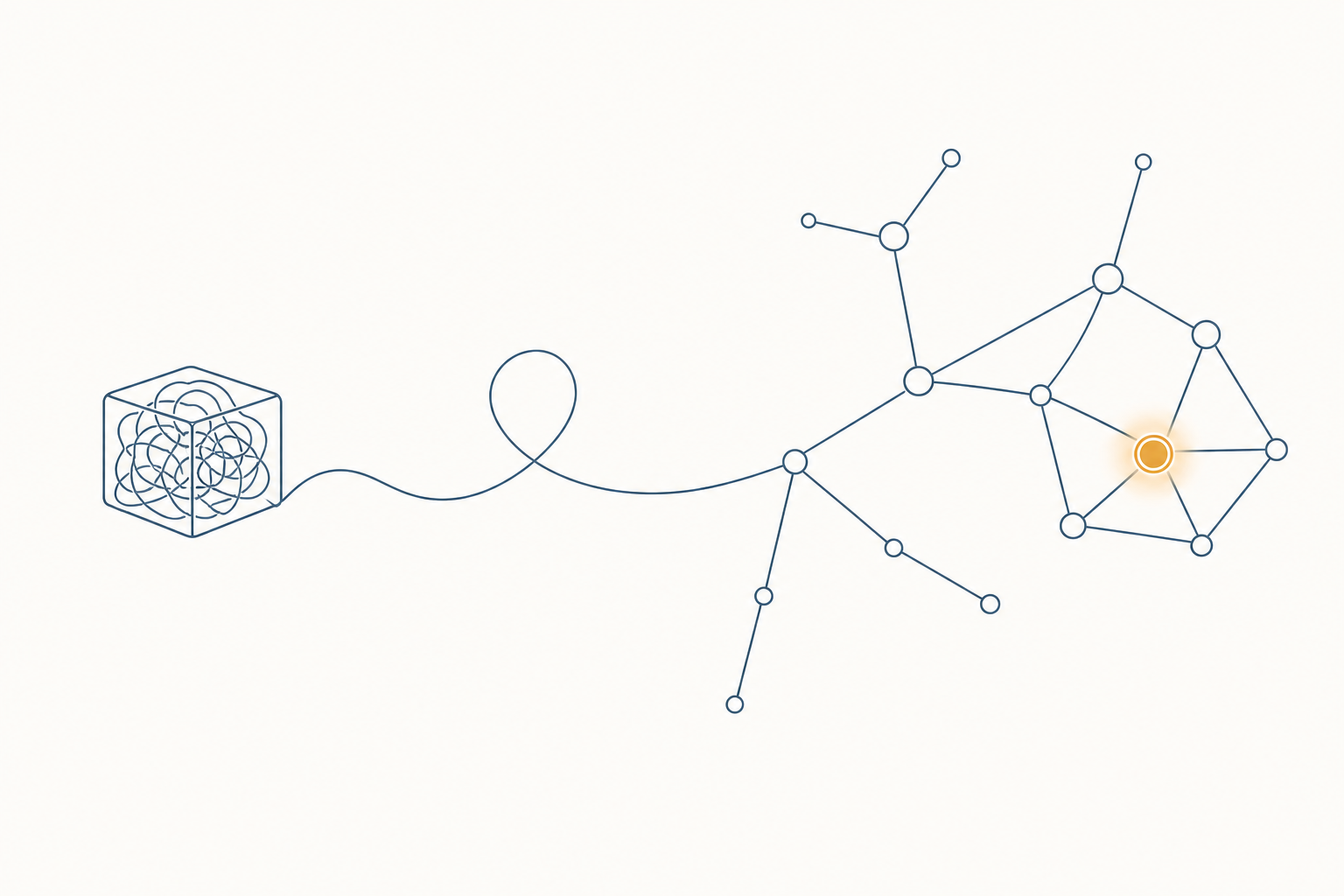
So AI acts, hallucinates, and carries bias. But the skeptic in the room still has the real question. Okay Dima, but does it actually understand what it is saying? Or is it just a calculator guessing the next word?
To answer, we have to look at how meaning is physically stored. And a recent turn in neuroscience explains why we get this so wrong.
We assume thinking and talking are the same act. But a major body of work from Fedorenko, Piantadosi, and Gibson points to a startling claim. Language is mainly a tool for communication, not for thought.
They find a double dissociation in the brain. You can have thought without language, solving a logic puzzle wordlessly. And you can have language without thought, perfect grammar carrying no meaning.
This changes how we should look at AI.
Think of a baby. The first time it sees a dog, it has no word “dog.” It builds a concept node, a vector: fur, four legs, barking, friend, the tail that wags. Later the parents attach a label, “dog.” Years later the child learns Spanish and meets “perro.” Crucially, they do not build a new node. They do not relearn what a tail is. They just attach a new tag to the existing dog vector.
Language is the zip file we use to move that heavy vector from my head into yours.
Which leads to a claim that annoys people. Text is deeper than video.
We assume video is the richest format, millions of pixels. But video is trapped in two or three dimensions. It shows one specific dog, from one specific angle, bound by physics. Video shows you an example. Text gives you room to build your own concept.
When I write “dog,” my brain unzips the vector of my own Lilu, a loko-dogo somewhere between a Chihuahua and a Papillon with the energy of an Arabian horse. The “dog” vector in your head fires something else entirely. A chubby pug, maybe, or a Husky.
Video shows you one dog. The word “dog” hands you the room to build your own.
Text is high-dimensional. It triggers the concept of loyalty, the smell of wet fur, a memory from your childhood. Language models work so well not because they read words, but because they ride these high-dimensional vectors. They surf the web of concepts, not the web of pixels.
(And this is exactly why you should read books and tell stories to your kids instead of parking them in front of a screen. You are forcing them to build their own high-dimensional vectors, not consume a pre-rendered one.)
But wait, how does text build a vector at all?
Here the skeptic raises a fair hand. Hold on. Humans build vectors through experience. We see the dog, touch the fur, hear the bark. A model only sees text. Those are not the same thing.
This is the embodiment problem, the one Stevan Harnad named in 1990 as the symbol grounding problem, and it is a real objection. When a baby builds the dog vector, it anchors the concept in sensory reality: the scratch of fur, the smell, the shock of a cold nose. When a model builds the same vector, it is doing something else: clustering the statistical pattern of how “dog” sits near “bark,” “loyal,” and “leash” across billions of fragments of text.
Different inputs. Different mechanism. But here is the surprising part. Similar output structure.
When researchers visualize a model’s embedding space, the map of how concepts relate, they find something remarkable. The model organizes concepts the way human intuition does. King minus man plus woman lands near queen. Doctor sits closer to hospital than to beach. Multilingual models learn that perro, hund, and chien all point at the same region, even though no one ever told them these words match.
So a model is not just memorizing word patterns. It is reconstructing conceptual structure from the statistical shadow that human language casts. Every time we write “the dog wagged its tail,” we leak information about what a dog is. Multiply that by billions of sentences and you get something that looks a lot like a vector space.
But let us be honest about what is missing.
A model has never felt fur. Never been startled by a cold nose. Its dog vector is built entirely from second-hand description, like someone who has read every book on swimming and never touched water. That creates systematic blind spots. Ask a model about the weight of holding your childhood dog as it is put to sleep, and it will produce grammatically perfect prose that feels strangely hollow. The words are right. The vector is incomplete.
The honest answer: models have functionally analogous vectors, not identical ones. They navigate concept space remarkably well, sometimes better than we do (try holding ten thousand concept relationships in your head). But they lack the sensory grounding that makes a human vector feel like experience instead of information.
That does not make them fake. It makes them different. A map drawn from satellite photos is not the same as a map drawn by walking the terrain. Both can still get you home.
So does it understand? If you mean “does it hold the vector,” then yes, a different kind. If you mean “does the talking part know truth,” then no. Just like in us, the communication module is only trying to be fluent and helpful. The thinking module, the vectors, is where reality lives. And like us, sometimes the mouth moves before the mind has finished checking.
Next: the part the lab keeps underestimating. Knowing is not enough. A mind also has to care, and caring runs on chemistry.
Related reading: A Word Is Not a Concept is the long-form version of this argument, with the receipts: why meaning is built by analogy, and why language is a compression of the world, not a description of it. For the newest branch of the same tree, Share the Answer, Not the Data shows meaning doing coordination work between machines: agents that must mean the same thing by “resident” or “income” without ever seeing the documents. The Analogy Engine puts the king and queen arithmetic next to a small test of what a model actually reaches for when you ask it for an analogy. The Flaw is the part before this one: word vectors learned from web text turned out to carry every implicit bias their authors tested, which is what it means for a fact and a belief to be the same kind of link.
Sources
- Evelina Fedorenko, Steven T. Piantadosi, and Edward A. F. Gibson, “Language is primarily a tool for communication rather than thought,” Nature 630: 575-586, 2024.
- Tomas Mikolov et al., “Efficient Estimation of Word Representations in Vector Space,” 2013.
- Stevan Harnad, “The Symbol Grounding Problem,” Physica D 42(1-3): 335-346, 1990.