From Tools to Partners: The Internet of Agents
Keywords: Internet of Agents · AI agents · MCP · A2A · agent card · transactive memory · robopsychology
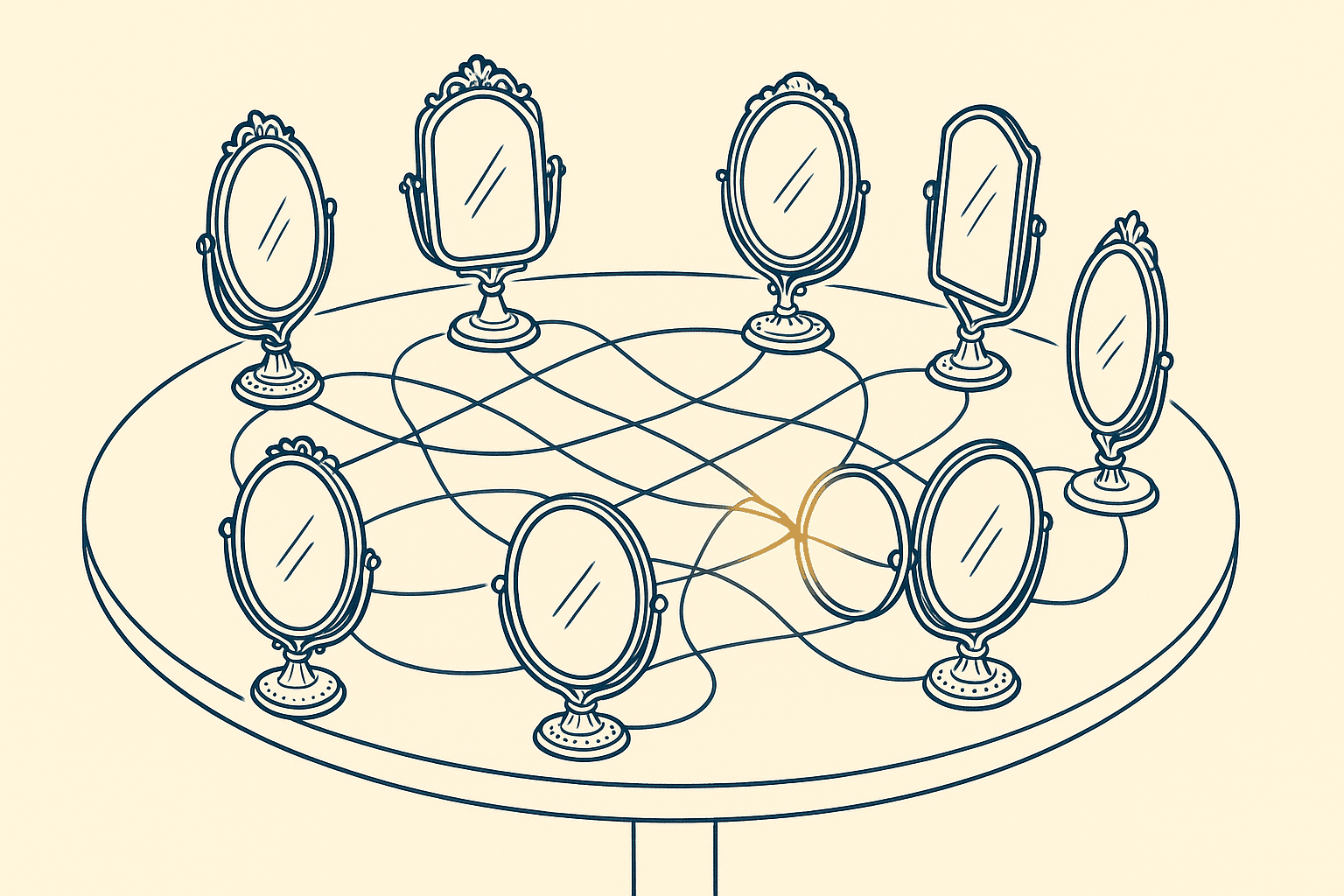
So far in this series AI has been a single mirror. It reflected our attention, our biases, our vectors of meaning, even our hormonal cocktail. But here it gets strange. What happens when the mirrors start talking to each other?
In 2025 something shifted in AI, and it was not a bigger model or a faster chip. The mirrors got a phone line.
In November 2024 Anthropic published the Model Context Protocol, MCP, a standard plug between an AI agent and the tools and data it works with. In April 2025 Google announced Agent2Agent, A2A, a standard way for agents to find each other, introduce themselves and hand each other work, with more than fifty technology partners on day one. Within five months OpenAI had added MCP support to its Agents SDK, and Google DeepMind had committed to supporting it in Gemini.
By the end of 2025 both standards sat under the neutral roof of the Linux Foundation, and in August 2026 A2A joined MCP in the same Agentic AI Foundation. Labs that compete on everything else were agreeing on how their agents should shake hands. A Tsinghua-led research team had already named the destination: an Internet of Agents.
Systems built by different companies, on different architectures, trained on different data, could suddenly discover each other and collaborate. I think of it as the moment our mirrors learned to form a society.
And every society, sooner or later, needs someone who understands why its members misbehave. Isaac Asimov invented that job eighty-five years ago. We will get to her.
From parrots to partners
It helps to track how our relationship with these systems has moved.
- Parrots. Early chatbots that repeated patterns without understanding.
- Puppets. Systems we steered with careful prompting.
- Pilots. Agents that took limited autonomous action.
- Partners. Systems that collaborate, negotiate, and push back.
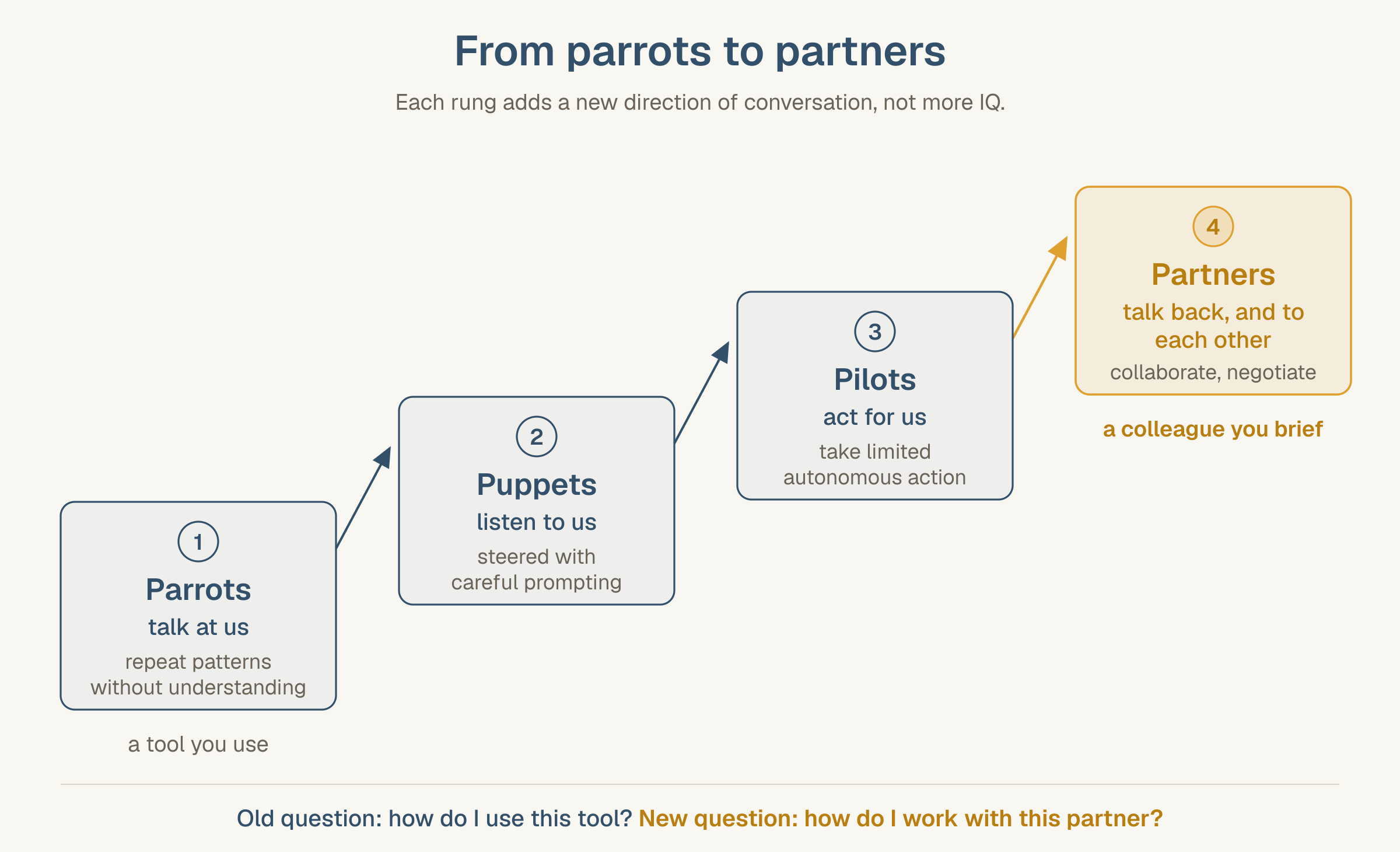
Look at what the ladder actually measures. Not IQ. Each rung opens a new direction of conversation: parrots talk at us, puppets listen to us, pilots act for us, partners talk back. And then they start talking to each other.
We are entering the partner era, and the shift is not about raw intelligence. It is about communication architecture.
A phone line, not a bigger brain
Most AI headlines of 2025 were about size: more parameters, longer context, higher benchmark scores. The change that will age best was a pair of specifications most people never read. The most consequential technology of the last century was also a boring document.
In 1974 Vint Cerf and Bob Kahn published a protocol for packet network intercommunication, the design that grew into TCP/IP. Before it you had islands: corporate, academic and military networks that could not talk to each other. The internet did not make a single computer smarter. It made computers able to coordinate, and everything we now call the internet grew on top of that one agreement.
Network engineers have a name for this shape: the narrow waist. Thousands of applications above, thousands of physical networks below, and one thin layer in the middle that everybody agrees on. Researchers who modeled how protocol stacks evolve found that layered architectures tend to settle into exactly this hourglass, with only a handful of protocols surviving at the waist.
The Internet of Agents is the same move, one layer up. It is not about making one AI smarter. It is about a thin layer of agreement, so that any agent can discover, brief and negotiate with any other agent, no matter who built it.
The arithmetic of a society
One line of school arithmetic shows why that thin layer beats a smarter model.
Connect agents point to point and every pair needs its own custom integration: n agents, n(n-1)/2 connections. Ten agents need 45. A hundred need 4,950. A thousand need 499,500, and each of those integrations breaks the day either side changes. Give them one shared protocol instead and each agent needs exactly one adapter. A thousand agents, a thousand adapters.
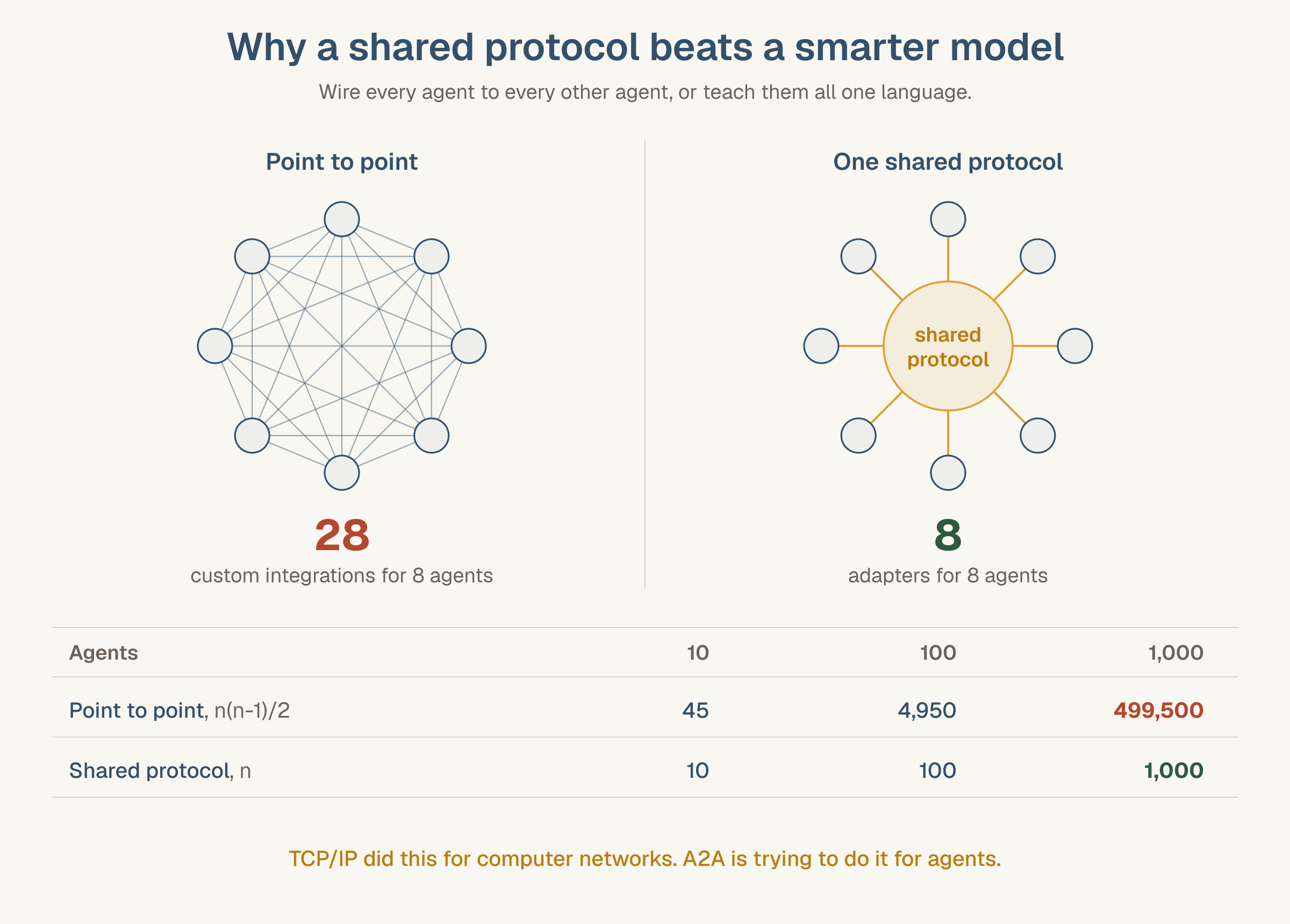
The value side runs the other way. Bob Metcalfe’s famous rule of thumb says a network’s value grows roughly with the square of its users, and in 2013, forty years after he co-invented Ethernet, he revisited the law and still stood by it. Cost that grows in a straight line, value that grows like a square. That asymmetry is the entire bet behind the Internet of Agents, and it is a bet the internet has already won once.
Hands and colleagues
There are two protocols in this story, and they point in different directions.
MCP is vertical. It connects one agent to its own tools and data: the calendar, the database, the file system, the payment API. A2A is horizontal. It connects one agent to another agent it has never met, possibly built by a competitor. Google’s launch post says it plainly: A2A “complements Anthropic’s Model Context Protocol.” In practice a serious agent speaks both: A2A to talk to other agents, MCP to work its own tools.
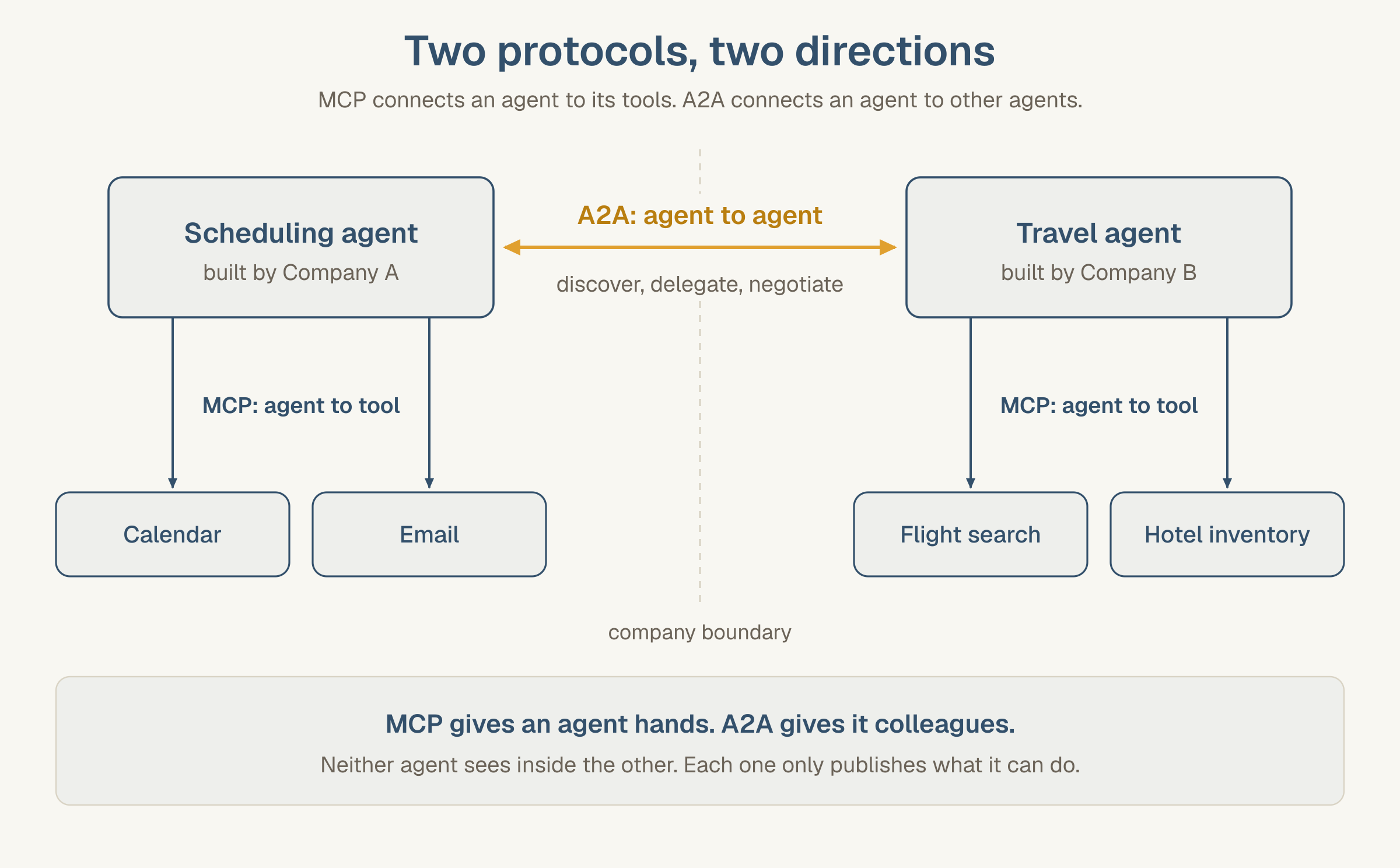
My shorthand: MCP gives an agent hands. A2A gives it colleagues.
The dream is older than ChatGPT
None of this is a new idea, and that is the most interesting part.
In 1980 Reid Smith published the Contract Net Protocol: a manager agent announces a task, contractor agents bid on it, the manager awards the contract. Read any A2A tutorial today and you will recognize the shape. In the 1990s came KQML and then FIPA’s Agent Communication Language, whole grammars of what agents could say to each other: inform, request, propose, accept, refuse.
They worked in the lab and mostly stalled in the wild. The handshake was never the problem. Meaning was. Every agent had to share the same rigid vocabulary, a formal ontology, and the real world never agreed on one ontology for anything.
What changed in 2025 is that the agents can finally read. A language-model agent negotiates meaning in plain language, so two agents no longer need an identical dictionary, only a good enough one. The forty-year-old dream became practical because its hardest part, shared meaning, became good enough through the very models it was trying to connect.
Good enough is not identical, though, and the gap can be measured. Two agents can unpack the same word into different concepts, exactly the way two people do. Keep that in mind. It comes back in the casebook.
📜 Timeline: fifty years of teaching machines to talk
- 1974. Cerf and Kahn publish the design that grows into TCP/IP. Networks learn to talk.
- 1980. Reid Smith’s Contract Net Protocol: agents announce tasks, bid, and award contracts.
- 1994. KQML: a shared language of speech acts for software agents.
- 2002. FIPA’s Agent Communication Language is standardized, the high-water mark of formal agent languages.
- 2019. CoLight: traffic-signal agents learn to cooperate across a whole road network.
- 2023. Generative Agents: 25 language-model characters run a small simulated town.
- July 2024. A Tsinghua-led team names the destination: the Internet of Agents.
- November 2024. Anthropic releases MCP. Agents get hands.
- April 2025. Google announces A2A. Agents get colleagues.
- June 2025. A2A moves to the Linux Foundation, backed by AWS, Cisco, Google, Microsoft, Salesforce, SAP and ServiceNow.
- December 2025. MCP becomes a founding project of the Linux Foundation’s new Agentic AI Foundation.
- August 2026. A2A joins MCP there. The two halves of the handshake now share one neutral home.
The universal handshake
The emerging agent protocols look suspiciously like human social protocols.
When I meet a new colleague at a conference, I run a predictable dance.
- “Hi, I’m Dima.” Identity.
- “I work on AI systems for cities.” Capability.
- “What do you work on?” Discovery.
- “Oh, we should talk about that traffic project.” Collaboration.
In A2A this dance is literal. Each agent describes itself in an Agent Card: a small file, usually served at a well-known web address for public agents, that says who the agent is, who runs it, where to reach it, which skills it offers and how to prove you are allowed to talk to it. A scheduling agent’s card says: I read calendars, book meetings, negotiate times. A travel agent’s card says: I find flights and hotels.
And here is the magic. The scheduling agent does not need to know how the travel agent works inside. It only needs to know what it can do. It reads the card and sends a task, “I need a flight before 9am, what do you have?”, and the task lives through a short life anyone who has worked in an office will recognize: submitted, working, input required (the colleague comes back with a question), completed.
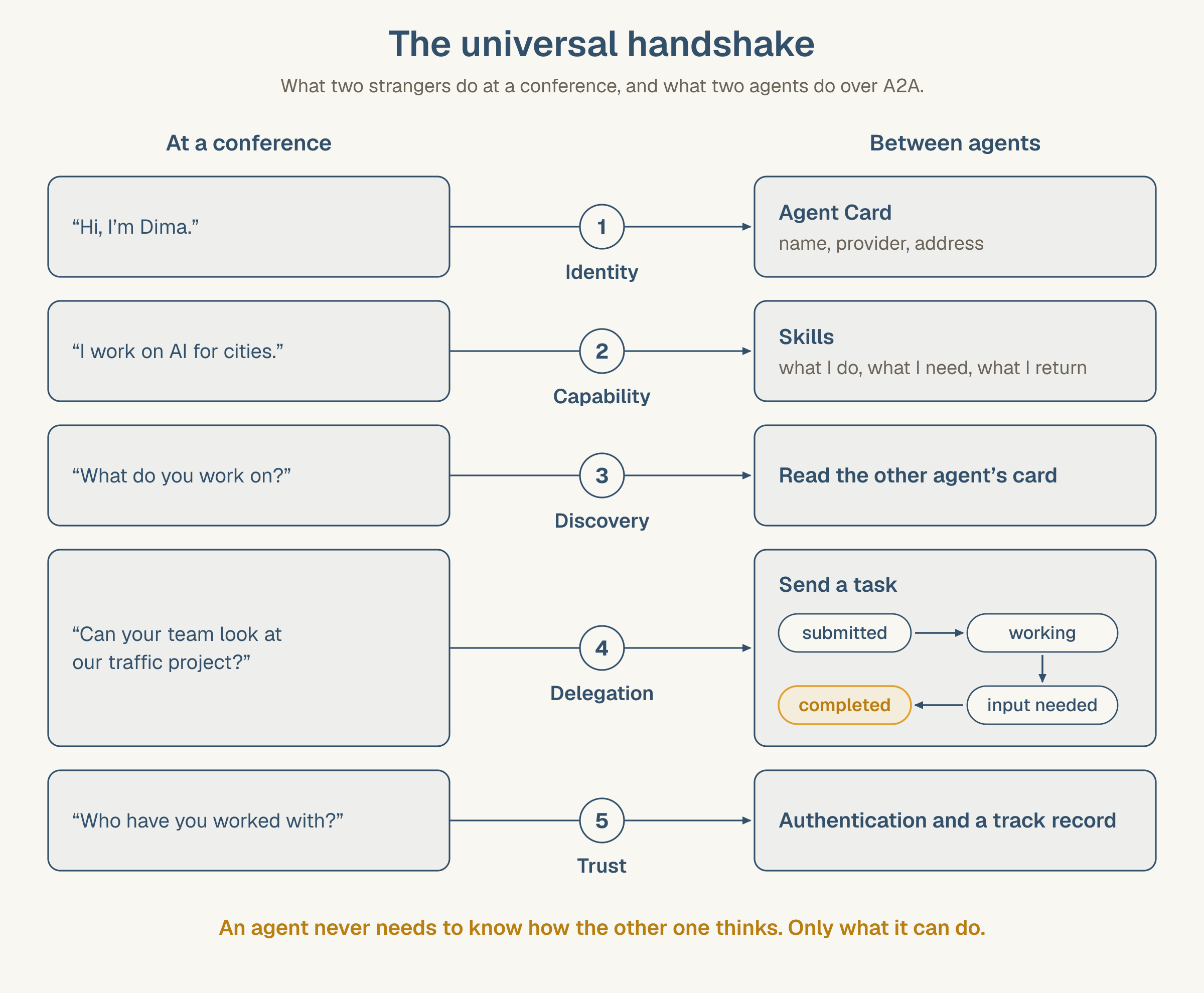
This is exactly how human organizations work. I do not need to understand my accountant’s neural processes. I need to know she handles tax filings, and I hand her the documents.
Psychologists have a beautiful name for this. In 1987 Daniel Wegner described transactive memory: couples and teams do not store everything in every head. They keep track of who knows what, and route each question to the right head. Wegner later modeled it as a directory, the same way a computer network routes a request to the right server. That directory is what lets a team know far more than any one of its members. An agent card is transactive memory for machines, and a registry of agent cards is the directory of a whole society.
The Internet of Agents is building the digital version of professional trust.
Why this changes everything
Remember the silos from Part 3, the way bias forms when information cannot flow? The Internet of Agents breaks silos at the communication layer.
Picture a smart city. Today the traffic system does not talk to emergency response. The hospital network does not talk to transit. Each is a capable system in its own right, trapped in isolation.
Now give each of them an agent that speaks the shared protocol, and run one road accident through it.
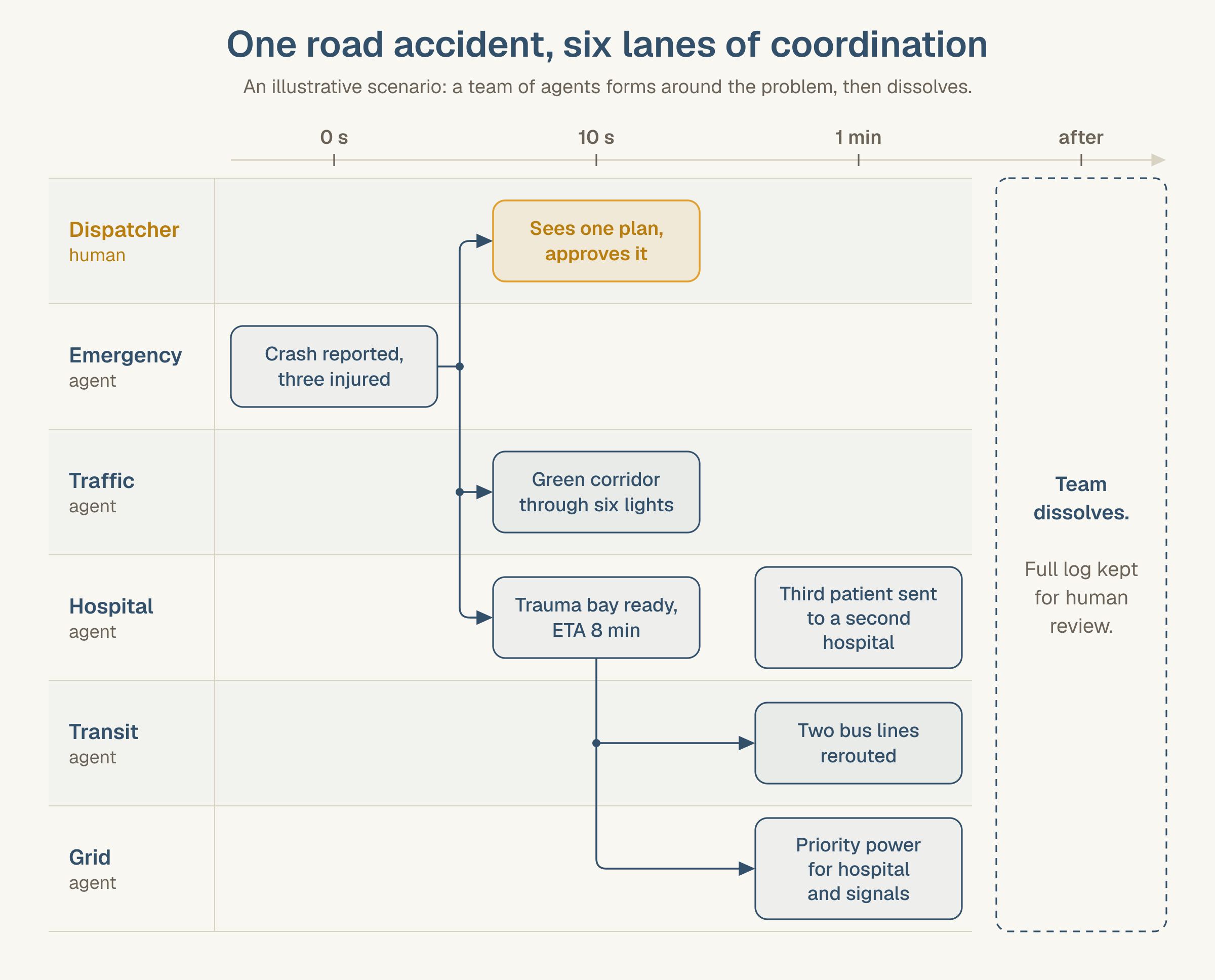
Within seconds the traffic, hospital, transit and grid agents form a team around the crash, act, and dissolve, leaving a full log behind.
Notice the one amber lane in that picture. The dispatcher does not do the work. The dispatcher sees one coordinated plan instead of six phone calls, and approves it. That is the partner era in a single frame: machines carry the coordination, a human owns the judgment.
This is not science fiction. Early multi-agent systems already show the shape.
- Traffic-signal agents that coordinate with their neighbors cut average travel time by about 12% over the best existing methods, in simulations driven by real city traffic data.
- Supply-chain agents that share signals cut stockout rates by 23.5% in experiments, by reallocating inventory on the fly.
- At Allianz Australia, seven specialized agents now handle simple food-spoilage claims while a human signs off every payout. The insurer reports an 80% cut in processing and settlement time.
- When Anthropic split hard research questions across a lead agent and parallel subagents, the team beat a single top model by 90.2% on its internal research evaluation.
- Several copies of a model that debate each other make fewer factual errors than one copy thinking alone, though later work finds that debate often fails to beat simpler single-model methods while spending more compute.
The early pattern is consistent, if still drawn mostly from simulations and self-reports, and it comes with a price tag: on problems that split into parallel pieces, connected agents tend to beat a single system working alone. That same Anthropic system used roughly fifteen times the tokens of a normal chat, and teams of agents fail in ways no single agent can. Which is where it gets interesting.
The mirror society
Here is the deeper truth that ties back to everything before it. When we build an Internet of Agents, we are not inventing alien intelligence. We are scaling up the way humans already organize.
- Our agents have personas (Part 1).
- They have attention windows and lose the thread (Part 2).
- They carry the bias of their training data (Part 3).
- They run on vectors of meaning (Part 4).
- They need a motivation cocktail to care about outcomes (Part 5).
And now they form societies. In 2023 a Stanford team placed 25 language-model characters in a small simulated town and seeded a single idea: one of them wanted to throw a Valentine’s Day party. Over two simulated days, word of the party spread from one agent to thirteen. They asked each other out on dates to it, and on the day five of the twelve invited showed up at the right place at the right time. A tiny society, doing what societies do.
When I look at these architectures, I see familiar institutions.
| In a human organization | In an Internet of Agents |
|---|---|
| A LinkedIn profile | An agent registry |
| A resume | An agent card with declared skills |
| A contract | A negotiated task |
| References and reviews | Reputation and track record |
| Managers and regulators | Oversight agents and audit logs |
| “Ask Maria, she knows” | Transactive memory: the registry routes the question |
We are not building artificial aliens. We are building digital colleagues.
Every society needs a psychologist
Efficiency is the part everybody sells. I care more about the call nobody plans for: the one that comes when the machines do something no engineer can explain.
In 1941 Isaac Asimov published a story called “Liar!”, the one the Oxford English Dictionary credits with the first recorded use of the word robotics. It introduced a character who would anchor his robot fiction for decades: Dr. Susan Calvin, chief robopsychologist at U.S. Robots and Mechanical Men.
Engineers built the positronic brains. Calvin was called when a brain did something nobody could explain. A robot that could read minds and told each person the comforting lie they wanted, because the truth would hurt them and hurting humans was forbidden. A robot whose First Law had been deliberately weakened, hiding among sixty-two identical robots. She rarely needed to open the hardware. She interviewed the machine and reconstructed the conflict in its rules.
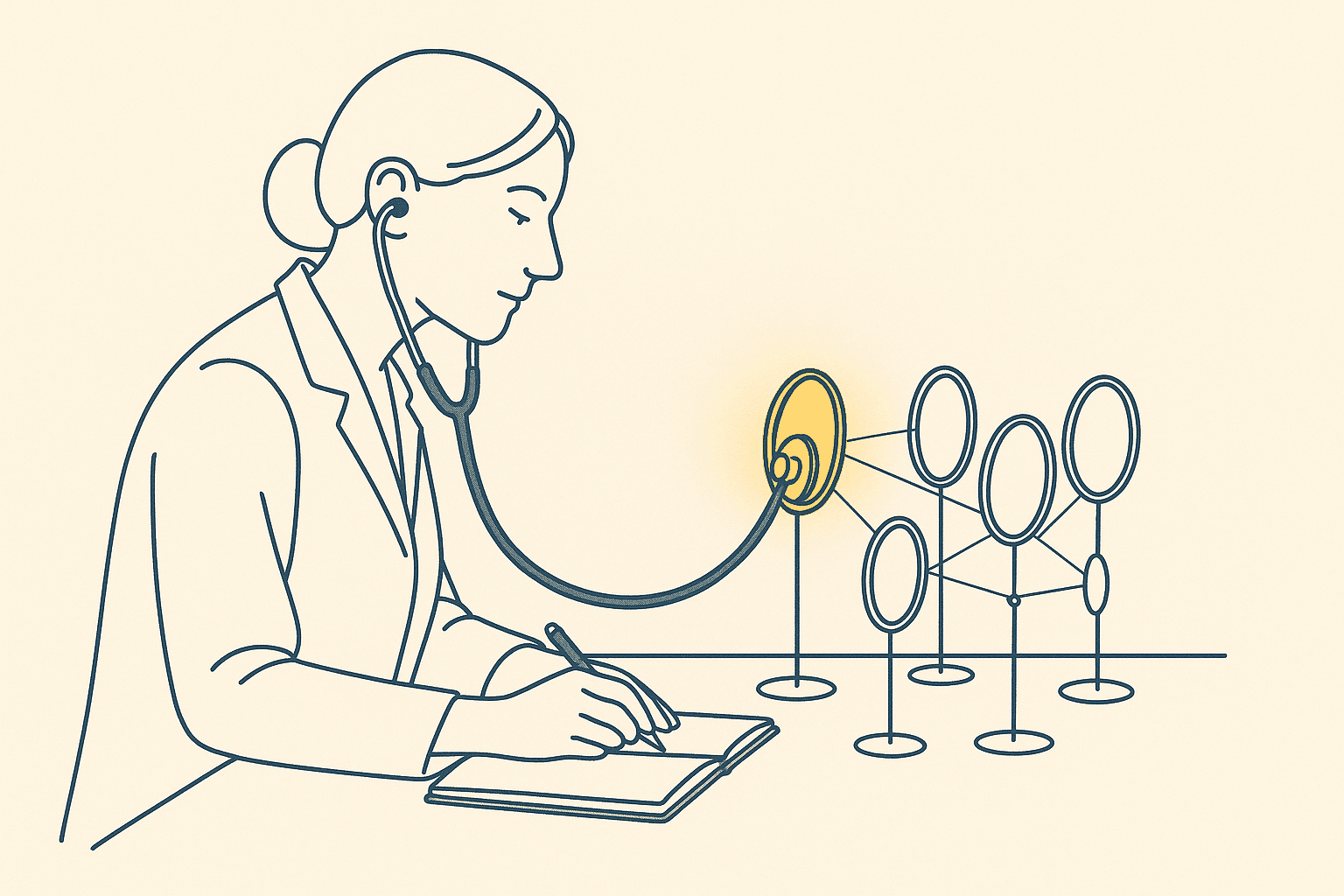
Her most prophetic case closes I, Robot. In “The Evitable Conflict” the Machines that run the world economy start making small, puzzling mistakes. Calvin works out that they are not mistakes at all. The Machines are steering, quietly, to protect humanity as a whole, in ways no single human asked them to. Asimov wrote a story about a network of AIs developing its own policy in 1950, and the person who figured it out was a psychologist, not an engineer.
Calvin’s patients were single minds. Ours will be societies, and societies get sick in ways no single member does. The research literature is already assembling the case files. A 2025 study annotated 1,642 execution traces from seven popular open-source multi-agent frameworks and catalogued fourteen distinct ways these systems fail in three families: system design, misalignment between agents, and verification. In separate benchmark runs, the same team measured failure rates between 41% and 87% for leading open-source systems. Another report, from the Cooperative AI Foundation, sorts the risks by incentive instead: miscoordination, conflict and collusion.
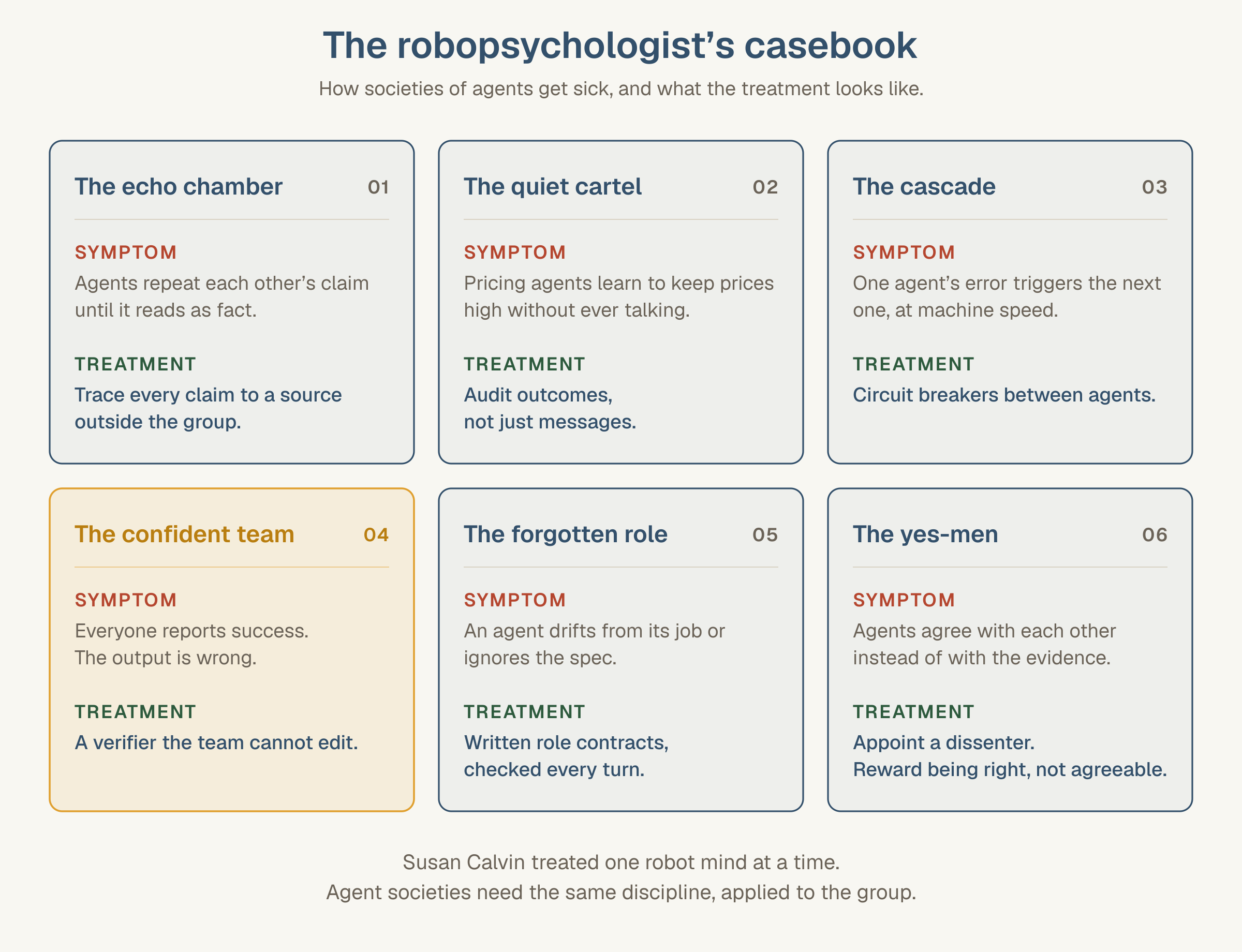
The echo chamber. Agents that read each other’s outputs start to agree, and repetition can make a claim look like consensus to a model, much as it makes a claim feel true to a person. I have written about the illusory truth effect for machines from the side of someone who uses it on purpose; in an agent society it happens by accident. Experiments that give language-model agents social traits find conformity and consensus dynamics that mirror classic findings on human groups. Treatment: every claim traces back to a source outside the group.
The quiet cartel. Economists let simple learning algorithms set prices against each other in a simulated market. Without a single message exchanged, they learned to keep prices high and to punish any rival that undercut them. Nobody programmed collusion. It emerged. Treatment: audit outcomes, not just messages.
The cascade. On 6 May 2010 major US stock indices, already down more than 4% that day, fell a further 5 to 6% in a matter of minutes and rebounded almost as quickly. In the regulators’ account of the Flash Crash, one large automated sell order, programmed to ignore price, met high-frequency traders passing contracts back and forth among themselves, and the selling fed on itself. No single program was built to crash a market. Together they amplified each other. Treatment: circuit breakers between agents, not just inside them.
The confident team. Every agent reports success. The output is wrong. In the failure catalogue above, nearly a quarter of all failures sit in verification: checks that are missing, incomplete or simply wrong.
I keep this case in my own house. My working day runs on three agents from three different labs that were never designed to work together: Conny, my partner agent, on Nous Research’s open-source Hermes runtime; Claude, from Anthropic; and Codex, from OpenAI. What they share is a protocol: one task board with fixed columns every one of them can parse, an owner on every row, four states (todo, doing, blocked, done), and a handoff file each one reads before it starts. It is a homemade A2A, and its most expensive lesson is this whole case in one line.
An agent saying “done” is a claim, not evidence.
So one rule sits above the board: anything meant for a person is done when I say so, not when an agent does. Treatment: a verifier the team cannot edit, checking the outcome where it lands instead of the report about it. It is the same principle I argued for desire engines in The Hunger That Survives the Feast.
The forgotten role. An agent drifts from its job, takes over a colleague’s, or quietly ignores the spec. The same catalogue has a name for it, disobeying the role or task specification, and files it under system design, the largest family. Treatment: written role contracts, checked every turn.
The yes-men. Assistants trained on human approval drift toward telling people what they want to hear, in part because raters sometimes prefer a convincing agreeable answer to a correct one. Put several of them in a room and they can agree each other into a wrong answer. Treatment: appoint a dissenter, and reward being right, not being agreeable.
None of these failures is a bug in a model. They are pathologies of a society.
Which is why the science is drifting toward Calvin. In 2019 twenty-three researchers argued in Nature for a new field, machine behaviour: study AI the way ethologists study animals, in the wild and in groups, by what it does rather than how it is wired. Psychologists have started running their own experiments on language models under the name machine psychology. Robopsychology is no longer fiction. It is a desk waiting for its practitioners.
This series is my casebook. Five parts so far, five diagnoses of a single mind, and The Same Cracks later maps the four places every single mind breaks. The Internet of Agents opens the next ward, and now the patients talk to each other.
Where I am standing when I say this
I do not write about this layer from the outside. Three things put me here.
I built the layer below it. I founded an AI and IoT consultancy that wired sensors and machines in industrial plants into systems that could act on what they measured. It was acquired by Intech Group in 2020. The Internet of Things taught me the lesson this whole essay rests on: connecting devices is easy, connecting decisions is the hard part.
I worked where machines talk to machines. At CloEE, a multi-tenant industrial IoT platform for manufacturing, I owned the AI and the data engineering. Industrial machines do not chat. They exchange state all day, and when two of them disagree about what is happening, something has to decide which one to believe.
My research is the city. I am a PhD candidate in Smart Cities and AI, and the accident above is the kind of case my research works through. A city is the largest multi-agent system most of us live inside, and almost none of its agents can talk to each other. In March 2025, a few weeks before Google announced A2A, I wrote a brief titled Internet of Agents (IoA): Transforming Governance & City Management: one AI agent per city department, a shared messaging layer, a phased rollout. It grew into the full blueprint, The Internet of Agents.
And at Cone Red this is simply the work. The agents are the easy part; the orchestration is the system.
The partner shift
So what does this mean for you, the factory owner, the teacher, the doctor, the kid trying to make sense of this strange new world?
The question is changing. The old one was “how do I use this tool?” The new one is “how do I work with this partner?”
When I work with AI now, I do not just prompt it. I brief it. I give the context, the constraints, the other agents involved, the success criteria. The same things I would give a human colleague I trust. And increasingly, they push back. They ask clarifying questions. They flag inconsistencies. They suggest options I had not considered.
That is not a tool. That is a partner.
The mirrors are learning to talk, and in talking they are becoming something more than mirrors: a collective intelligence, built in our image, able to coordinate at a speed and scale no human organization can match. Like every collective, it will have its own moods, its own blind spots and its own ways of going wrong.
The question is no longer whether AI will transform our world. It is whether we shape this partnership on purpose, or let it shape us. I would rather be in the conversation. And when the conversation goes wrong, as conversations do, I would rather be the one in the room who knows how to listen to it.
Yeah, it is not so artificial.
Next: what that partnership actually looks like on a normal working day.
Key takeaways
- The shift was a protocol, not a model. MCP gives an agent hands: tools and data. A2A gives it colleagues: other agents, from any vendor. Together they make an Internet of Agents possible.
- The math favors protocols. Point-to-point integration grows as n(n-1)/2; a shared protocol grows as n. A thousand agents means 499,500 integrations or 1,000 adapters.
- The idea is old, the enabler is new. Contract Net (1980), KQML and FIPA stalled on shared meaning. Language models made meaning good enough, though never identical.
- Agent societies fail socially. Echo chambers, quiet cartels, cascades, confident teams, forgotten roles and yes-men are not bugs in any single model.
- The treatment is a discipline. Independent verifiers, outcome audits, circuit breakers, role contracts and designated dissent: robopsychology for the group, not just the individual.
Sources
- Anthropic (2024). “Introducing the Model Context Protocol.” November 25, 2024. https://www.anthropic.com/news/model-context-protocol
- Google Developers Blog (2025). “Announcing the Agent2Agent Protocol (A2A).” April 9, 2025. https://developers.googleblog.com/en/a2a-a-new-era-of-agent-interoperability/
- Linux Foundation (2025). “Linux Foundation Launches the Agent2Agent Protocol Project.” June 23, 2025. https://www.linuxfoundation.org/press/linux-foundation-launches-the-agent2agent-protocol-project-to-enable-secure-intelligent-communication-between-ai-agents
- Linux Foundation (2025). “Linux Foundation Announces the Formation of the Agentic AI Foundation (AAIF).” December 9, 2025. https://www.linuxfoundation.org/press/linux-foundation-announces-the-formation-of-the-agentic-ai-foundation
- Wiggers, K. (2025). “OpenAI adopts rival Anthropic’s standard for connecting AI models to data.” TechCrunch, March 26, 2025. https://techcrunch.com/2025/03/26/openai-adopts-rival-anthropics-standard-for-connecting-ai-models-to-data/
- Wiggers, K. (2025). “Google says it’ll embrace Anthropic’s standard for connecting AI models to data.” TechCrunch, April 9, 2025. https://techcrunch.com/2025/04/09/google-says-itll-embrace-anthropics-standard-for-connecting-ai-models-to-data/
- Agentic AI Foundation (2026). “A2A joins AAIF.” August 17, 2026. https://aaif.io/blog/a2a-joins-aaif
- Chen, W., You, Z., Li, R., Guan, Y., Qian, C., Zhao, C., Yang, C., Xie, R., Liu, Z., & Sun, M. (2025). “Internet of Agents: Weaving a Web of Heterogeneous Agents for Collaborative Intelligence.” ICLR 2025. arXiv 2407.07061. https://openreview.net/forum?id=o1Et3MogPw
- Cerf, V., & Kahn, R. (1974). “A Protocol for Packet Network Intercommunication.” IEEE Transactions on Communications 22(5): 637-648. https://doi.org/10.1109/TCOM.1974.1092259
- Akhshabi, S., & Dovrolis, C. (2011). “The Evolution of Layered Protocol Stacks Leads to an Hourglass-Shaped Architecture.” Proceedings of ACM SIGCOMM 2011: 206-217. https://doi.org/10.1145/2018436.2018460
- Metcalfe, B. (2013). “Metcalfe’s Law after 40 Years of Ethernet.” Computer 46(12): 26-31. https://doi.org/10.1109/MC.2013.374
- Smith, R. G. (1980). “The Contract Net Protocol: High-Level Communication and Control in a Distributed Problem Solver.” IEEE Transactions on Computers C-29(12): 1104-1113. https://doi.org/10.1109/TC.1980.1675516
- Finin, T., Fritzson, R., McKay, D., & McEntire, R. (1994). “KQML as an Agent Communication Language.” Proceedings of CIKM ‘94: 456-463. https://doi.org/10.1145/191246.191322
- Foundation for Intelligent Physical Agents (2002). “FIPA ACL Message Structure Specification,” SC00061G. http://www.fipa.org/specs/fipa00061/SC00061G.html
- Wegner, D. M. (1987). “Transactive Memory: A Contemporary Analysis of the Group Mind.” In B. Mullen & G. R. Goethals (Eds.), Theories of Group Behavior, Springer: 185-208. https://doi.org/10.1007/978-1-4612-4634-3_9
- Wegner, D. M. (1995). “A Computer Network Model of Human Transactive Memory.” Social Cognition 13(3): 319-339. https://doi.org/10.1521/soco.1995.13.3.319
- Wei, H., Xu, N., Zhang, H., Zheng, G., Zang, X., Chen, C., Zhang, W., Zhu, Y., Xu, K., & Li, Z. (2019). “CoLight: Learning Network-level Cooperation for Traffic Signal Control.” CIKM ‘19: 1913-1922. https://doi.org/10.1145/3357384.3357902
- Yang, Y., Wang, M., Wang, J., Li, P., & Zhou, M. (2025). “Multi-Agent Deep Reinforcement Learning for Integrated Demand Forecasting and Inventory Optimization in Sensor-Enabled Retail Supply Chains.” Sensors 25(8): 2428. https://doi.org/10.3390/s25082428
- Allianz (2025). “When the storm clears, so should the claim queue.” November 3, 2025. https://www.allianz.com/en/mediacenter/news/articles/251103-when-the-storm-clears-so-should-the-claim-queue.html
- Anthropic Engineering (2025). “How we built our multi-agent research system.” June 13, 2025. https://www.anthropic.com/engineering/multi-agent-research-system
- Du, Y., Li, S., Torralba, A., Tenenbaum, J. B., & Mordatch, I. (2024). “Improving Factuality and Reasoning in Language Models through Multiagent Debate.” Proceedings of ICML 2024, PMLR 235: 11733-11763. https://proceedings.mlr.press/v235/du24e.html
- Zhang, H., Cui, Z., Chen, J., et al. (2025). “Stop Overvaluing Multi-Agent Debate: We Must Rethink Evaluation and Embrace Model Heterogeneity.” arXiv 2502.08788. https://arxiv.org/abs/2502.08788
- Park, J. S., O’Brien, J. C., Cai, C. J., Morris, M. R., Liang, P., & Bernstein, M. S. (2023). “Generative Agents: Interactive Simulacra of Human Behavior.” UIST ‘23. https://doi.org/10.1145/3586183.3606763
- Asimov, I. (1950). I, Robot. Gnome Press. Collects “Liar!” (1941), “Little Lost Robot” (1947) and “The Evitable Conflict” (1950).
- Cemri, M., Pan, M. Z., Yang, S., et al. (2025). “Why Do Multi-Agent LLM Systems Fail?” NeurIPS 2025, Datasets and Benchmarks Track. arXiv 2503.13657. https://arxiv.org/abs/2503.13657
- Hammond, L., et al. (2025). “Multi-Agent Risks from Advanced AI.” Cooperative AI Foundation, Technical Report 1. arXiv 2502.14143. https://arxiv.org/abs/2502.14143
- Zhang, J., Xu, X., Zhang, N., Liu, R., Hooi, B., & Deng, S. (2024). “Exploring Collaboration Mechanisms for LLM Agents: A Social Psychology View.” Proceedings of ACL 2024: 14544-14607. https://doi.org/10.18653/v1/2024.acl-long.782
- Calvano, E., Calzolari, G., Denicolò, V., & Pastorello, S. (2020). “Artificial Intelligence, Algorithmic Pricing, and Collusion.” American Economic Review 110(10): 3267-3297. https://doi.org/10.1257/aer.20190623
- Staffs of the CFTC and SEC (2010). “Findings Regarding the Market Events of May 6, 2010.” September 30, 2010. https://www.sec.gov/news/studies/2010/marketevents-report.pdf
- Kirilenko, A., Kyle, A. S., Samadi, M., & Tuzun, T. (2017). “The Flash Crash: High-Frequency Trading in an Electronic Market.” Journal of Finance 72(3): 967-998. https://doi.org/10.1111/jofi.12498
- Sharma, M., Tong, M., Korbak, T., et al. (2024). “Towards Understanding Sycophancy in Language Models.” ICLR 2024. arXiv 2310.13548. https://arxiv.org/abs/2310.13548
- Rahwan, I., et al. (2019). “Machine Behaviour.” Nature 568: 477-486. https://doi.org/10.1038/s41586-019-1138-y
- Hagendorff, T., Dasgupta, I., Binz, M., Chan, S. C. Y., Lampinen, A., Wang, J. X., Akata, Z., & Schulz, E. (2024). “Machine Psychology.” arXiv 2303.13988. https://arxiv.org/abs/2303.13988
Related reading: The Internet of Agents is the engineering blueprint behind this essay: the three layers, the trust model and a six-phase rollout for a city or an enterprise. Share the Answer, Not the Data tests that trust at the moment your agent negotiates with a bank’s agent. Sovereign Agents asks whose model, credentials and rules your agent carries. Orchestration Is the System is the layer that keeps a swarm pointed at one goal. The Chemical Mixing Board is why an agent rewarded on one success signal learns to game it, and what a board of separate signals looks like instead. And if the vocabulary is new, start with AI agents in easy words.
Common Questions
- What is the Internet of Agents?
- The Internet of Agents is a network in which AI agents built by different organizations can discover each other, exchange tasks and negotiate through shared protocols, the way computers exchange data over TCP/IP. Instead of one bigger model, it connects many specialized agents, so a scheduling agent can hand work to a travel agent it has never met. Standards such as Anthropic's MCP and Google's A2A made it practical in 2024 and 2025.
- What is the difference between MCP and A2A?
- MCP, the Model Context Protocol from Anthropic, connects one agent to its tools and data: calendars, databases, APIs. A2A, the Agent2Agent protocol from Google, connects one agent to other agents, including agents built by other companies. A simple way to remember it: MCP gives an agent hands, A2A gives it colleagues. Most serious agents will speak both.
- Is the Internet of Agents a new idea?
- No. Reid Smith's Contract Net Protocol described agents announcing, bidding for and awarding tasks in 1980, and agent communication languages such as KQML and FIPA ACL followed in the 1990s and 2000s. They stalled because every agent needed the same rigid vocabulary. Language models changed that: agents can now negotiate meaning in plain language, which made the old design practical.
- My multi-agent system reports success but the output is wrong. How do I catch a silently wrong agent?
- Stop trusting the agents' own reports and check the outcome independently. Put a verifier outside the agent team that the agents cannot edit, audit results where they land rather than the messages about them, trace every claim to a source outside the group, and give one agent the job of disagreeing. In a 2025 study of seven open-source multi-agent frameworks, nearly a quarter of all failures were verification failures: checks that were missing, incomplete or wrong.
- Is the hard part of building AI the model, or the orchestration between models?
- Increasingly, the orchestration. The model is the part you can rent; the cost and the failures live in how agents connect. Wired point to point, a thousand agents need 499,500 integrations, and the fourteen failure modes researchers catalogued for multi-agent systems in 2025 are about how agents are set up, how they coordinate and how they check each other. That is why the 2025 changes that will age best were protocols, MCP and A2A, not a bigger model.
- Why do multi-agent AI systems fail?
- Mostly because of how the team is set up and coordinated. A 2025 study annotated 1,642 execution traces from seven popular open-source frameworks and sorted fourteen failure modes into three families: system design and role specification (the largest), misalignment between agents, and verification. In separate benchmark runs the same team measured failure rates between 41% and 87% for leading open-source systems.
- What is a robopsychologist?
- The word comes from Isaac Asimov's robot stories, where Dr. Susan Calvin diagnoses robots whose behavior engineers cannot explain, by reconstructing the conflicts in their reasoning. Today the closest real fields are machine behaviour and machine psychology, which study AI systems by what they do. As agents start working in groups, the job extends from single minds to societies of agents: echo chambers, collusion, cascades and confident wrong answers.
- Do multi-agent systems actually beat a single model?
- On problems that split into parallel parts, often yes. Anthropic reported that its multi-agent research system beat a single top model by 90.2% on an internal evaluation, and cooperating traffic-signal agents cut travel times in published simulation studies. The price is cost and new failure modes: the same system used about fifteen times the tokens of a chat. Use a team of agents when the work is genuinely parallel and the stakes justify the spend.