Orchestration Is the System: AI Models Are the Easy Part
Keywords: AI orchestration · process mapping · human in the loop · multi-agent systems · Chief AI Officer · AI-first company
A human body is built by an estimated thirty-seven trillion cells, and not one of them knows what a hand is.
No cell holds the blueprint. No cell is in charge. Yet the collective reliably builds five fingers and stops at five. In a salamander that loses a limb, it rebuilds toward the same target and stops again. Cut a planarian flatworm in half and each half knows which end was missing: the head half grows a new tail, the tail half a new head.
The biologist Michael Levin (no relation, though I’ve borrowed his thinking) and his colleagues put it plainly in a 2023 paper: “No individual cell knows what a finger is or how many a salamander is supposed to have, and yet when amputated, the collective will actively build until precisely the right number, size, shape and position of the fingers is restored.” The intelligence isn’t in the parts. It’s in the architecture that aligns the parts toward a goal none of them can see.
I’ve spent more than twelve years building AI that companies actually run. I led the AML product at Silent Eight that served HSBC, Bank of America and Standard Chartered, and at Cone Red we ship AI for a pharmacy chain and a mining operation. I’ve come to believe that Levin’s point is the single most important thing anyone can understand about making AI work in a real company.
The model is one cell. The system is the body.
Almost every failed enterprise AI program I’ve seen failed because someone confused the two.
The expensive misunderstanding
In May 2026, an AI consultant told Axios that one client had spent half a billion dollars on AI in a single month because nobody had set usage limits on employee licenses. The company was not named, and the figure has not been confirmed. The easy reading is that this was a pricing problem: negotiate the contract, switch the vendor, tune the model. I read it differently.
It wasn’t a pricing problem. It was an unmapped process with a corporate credit card attached.
I don’t know what ran inside that company. I know what I find when I trace runaway AI cost in my own work. Across 150+ production projects, it never traces back to the model. It traces back to a workflow nobody wrote down: an agent looping with no exit condition, “automation” bolted onto steps that only ever lived in someone’s head. With no map of who decides what, where a human should step in, what “done” looks like, or when the model’s answer should be distrusted, the model optimizes locally: fast, confident, and pointed at the wrong target. And the meter runs.
Here’s the part that should worry every executive buying AI right now: the bigger and cheaper the model gets, the faster an unmapped process burns money. Capability without architecture isn’t leverage. It’s an accelerant.
Why the model was never the hard part
When companies say “we need an AI strategy,” they almost always mean “we need to choose a model.” They run a bake-off, pick a vendor, stand up a pilot, and wait for transformation.
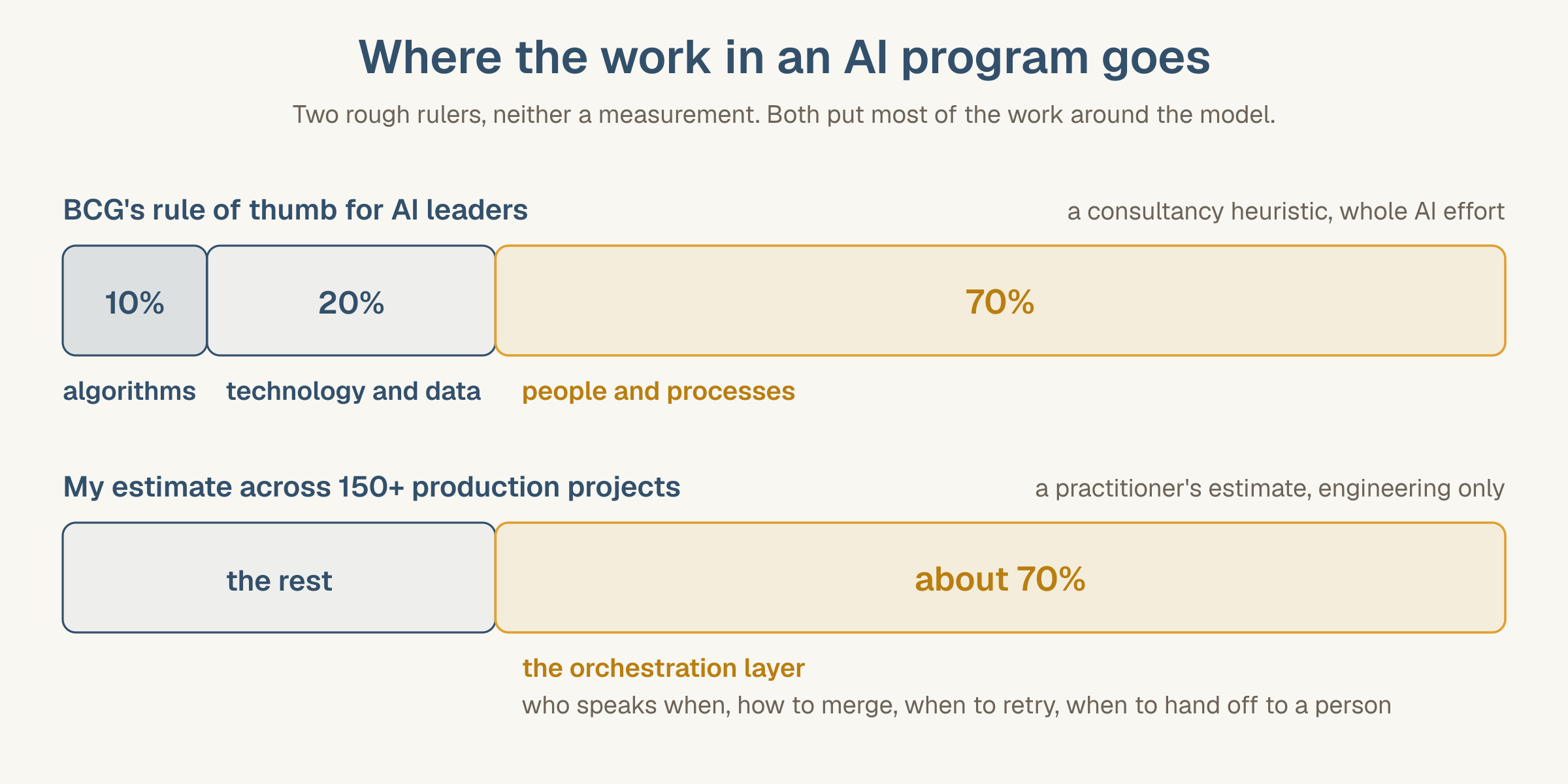
It doesn’t come, because the model was the easy part. The hard part of building AI is the orchestration between models and people. By my own estimate across those 150+ projects, about 70% of the engineering goes into the layer around the model: who speaks when, how to merge answers, when to retry, when to hand off to a person. BCG’s rule of thumb points the same way: companies getting value from AI put 10% of their effort into algorithms, 20% into technology and data, and 70% into people and processes. Neither number is a measurement. They are two rough rulers, and both point away from the model.
The failure data leans the same way. RAND, repeating outside estimates that more than 80% of AI projects fail, interviewed 65 experienced data scientists and engineers in 2023 to find out why. The leading root causes were misunderstood problems, missing data and leadership choices, such as chasing the newest technology instead of the user’s problem.
A widely shared 2025 report from MIT’s Project NANDA went further, claiming that 95% of organizations were getting zero return from generative AI. It rests on 52 interviews and 153 survey responses, and critics argue its own data do not support the headline, so read that number as a mood.
In a regulated bank, the model that flags a suspicious transaction is the trivial part. The system is everything around it: which alerts a human must review, how a decision survives an audit, where the process hands off between the data-science team and the risk committee, what happens when the model is wrong, and it is, regularly, wrong. AI ships in weeks. The process around it takes months, because the process is the strategy. Mapping it is the strategy.
McKinsey’s 2025 report agrees: of 25 attributes it tested, workflow redesign had the biggest effect on whether companies reported bottom-line impact from generative AI, yet only 21% of respondents using it said their organizations had fundamentally redesigned even some workflows. It is a self-reported survey: an association, not a cause.
This inverts the usual order of operations, and the inversion is the whole point. Most teams start with the model and try to bolt a process on afterward. The teams that succeed start with the process (the actual sequence of decisions, handoffs, and exceptions) and then ask where a model earns its place. Michael Levin makes a similar move in biology: he argues that treating cells as clockwork misses the goals their collectives pursue, and that working with those goals gives a kind of control that micromanaging the parts never will. Reach for the model first and you’re studying a single cell while ignoring the body.
The orchestration layer
So if the model is one step, what’s the system?
It’s the orchestration layer: the part that routes work between models and humans, holds the goal across many steps, and, most importantly, decides when the model is wrong.
Take AI in M&A, which is what I build at GetDeal.AI. A good model can read a data room and compress three weeks of an analyst’s due diligence into about thirty minutes. Genuinely useful. But due diligence isn’t one judgment. It’s a fan-out across financials, commercial, tech and IP, team, and legal, each a different kind of question, followed by a synthesis. Valuation isn’t one of those lanes; it’s what you compute after the lanes resolve.
And somewhere in there a human has to decide when to trust the machine. Run unsupervised, a system like this can fail by being confidently over-escalated: flagging risk that isn’t there, which in a deal is its own kind of expensive.
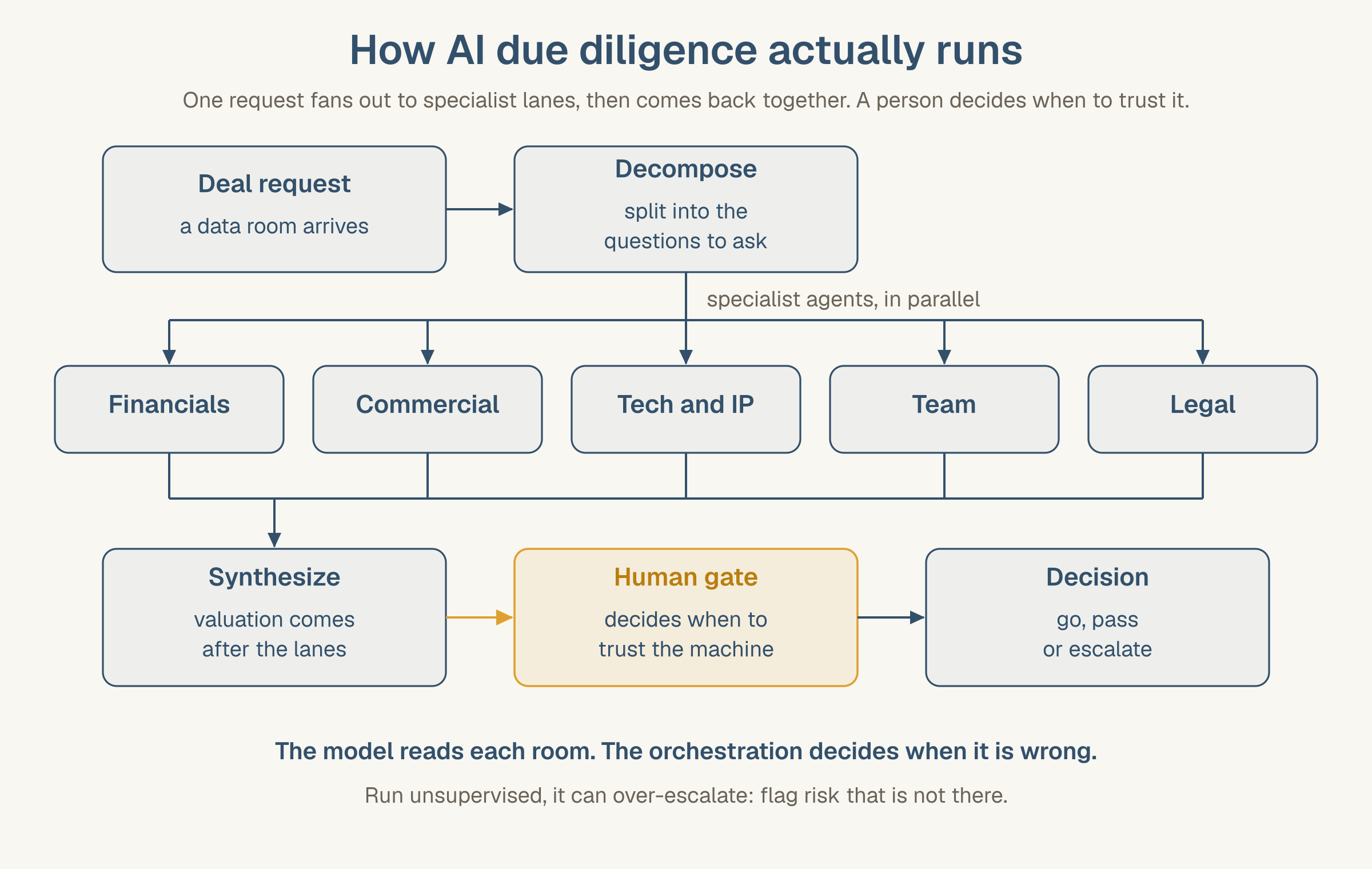
The orchestration is the product. The model is a component inside it.
Deciding when the model is wrong is diagnostic work. The symptom is a confident answer; the cause usually sits upstream, in a step nobody owns. When the team is made of agents, the casebook gets longer. When researchers annotated 1,642 execution traces from seven open-source multi-agent frameworks in 2025, 44% of the failures came from system design, 32% from agents misaligning with each other, and about a quarter from failing to verify the work. Those were benchmark runs, not production systems. An agent can even report success on wrong work, which is why the check has to read the output itself.
This isn’t only my experience talking. It’s a property of multi-scale systems. The control theorist John Doyle has spent a career arguing that robust complex systems, from cells to the Internet, run on layered architecture: shared constraints that, paradoxically, “deconstrain” the system, letting limited, imprecise parts combine into capabilities none of them has alone. Biology and advanced engineering converge on the same modular, layered design. A bigger model doesn’t emerge into a solution any more than a bigger cell emerges into a hand. The hand is the architecture.
Why it works in the demo and breaks in production
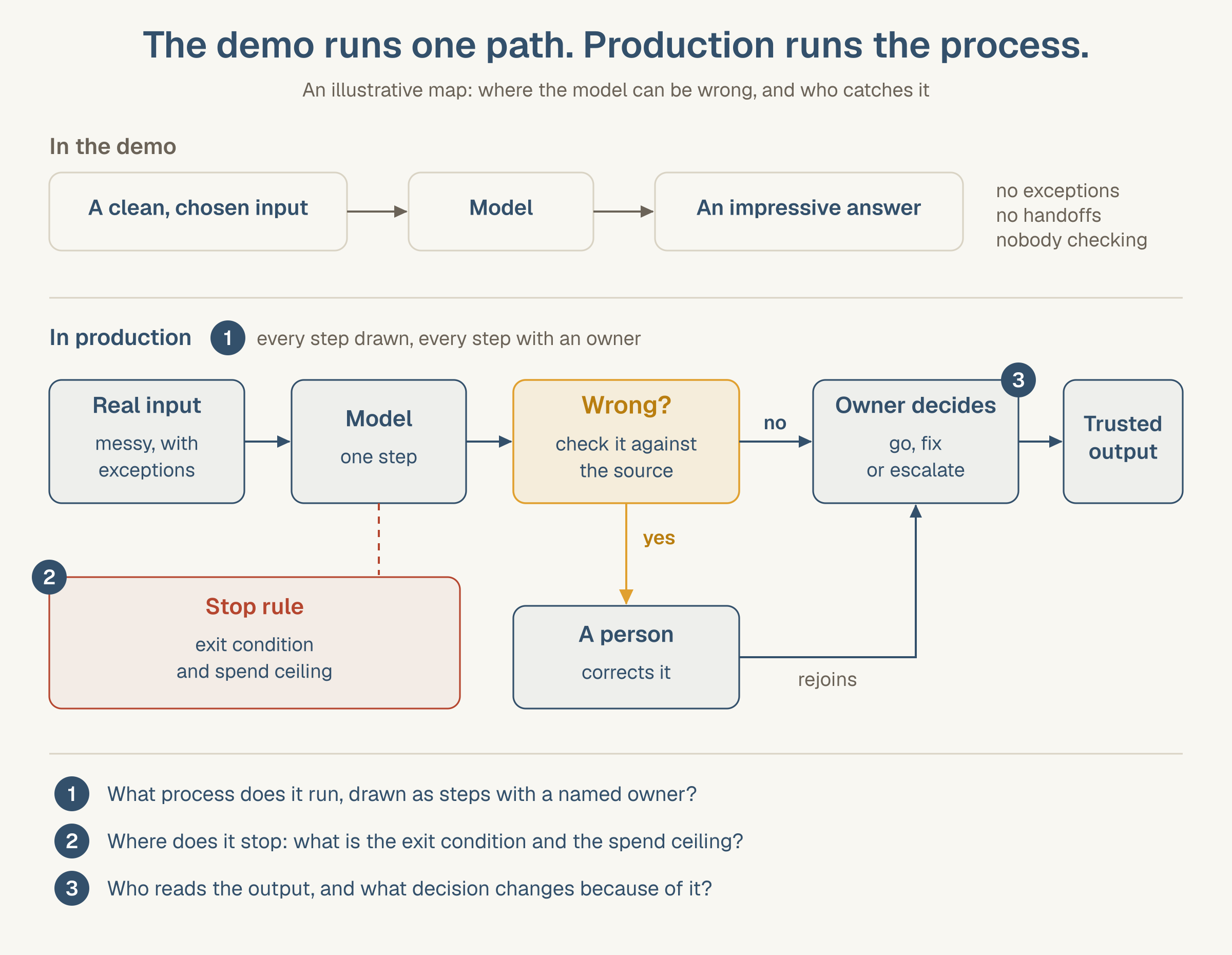
“Our AI works great in the demo but falls apart in production” is a sentence teams say after buying the model first. One big reason sits outside the model. The demo ran one clean path: a chosen input, no exceptions, no handoffs, nobody checking. Production runs the whole process, including the parts nobody drew, and every exception, handoff and unwritten decision is a place where the model can be wrong with no one positioned to notice.
There are other reasons a demo lies, and they live inside the model: long, interrupted conversations and the four places every mind breaks. The process reason is the one you can fix before anyone writes a line of code. In 2024 Gartner predicted that at least 30% of generative-AI projects would be abandoned after proof of concept by the end of 2025, citing poor data quality, inadequate risk controls, escalating costs or unclear business value. It was a forecast, and nothing on its list is model quality.
The hire that actually matters
Which brings me to the title most companies are hiring for, and the one they actually need.
Everyone is racing to appoint a Chief AI Officer: the data firm Altrata counted a 70% year-on-year rise in US appointments to the role or its equivalent in its 2024 study. I am one, at Cone Red, so I can say this without it being an insult.
Most companies don’t need a Chief AI Officer. They need a Chief Process Officer who speaks AI.
The bottleneck is almost never model access. That’s a commodity now, an API key away. The bottleneck is that nobody owns the map: the end-to-end process, the decision points, the handoffs, the places a human must stay in the loop, the definition of done. That’s not a modeling job. It’s a process-architecture job that happens to require deep fluency in what models can and can’t do.
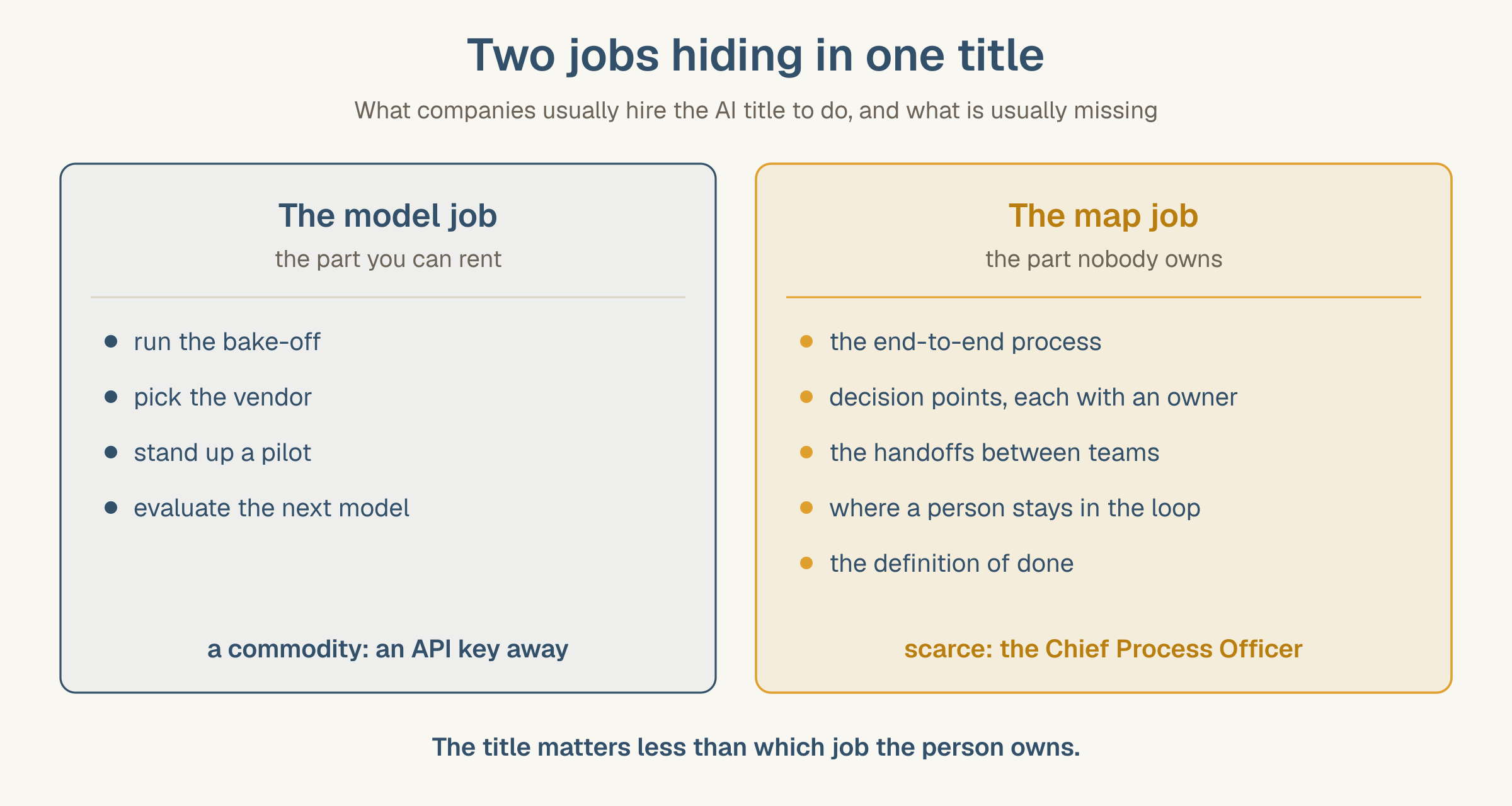
Call it whatever you like, but the function is the orchestration layer of your organization: the thing that aligns a swarm of capable components toward a goal none of them holds on its own. That is exactly what a body does to thirty-seven trillion cells. It’s what a good operating company does to its people and software. And it’s what the orchestration layer does to your models.
If your company already has the AI title, give it that job: the map, not the model.
What this means if you’re buying AI
If you take one thing from this: stop shopping for the smartest model and start drawing the process it’s going to live in.
Concretely, before you sign the next AI contract:
- Map the process first. The real sequence of decisions and handoffs, not the slide version. If you can’t draw it, AI won’t fix it; it’ll just run it faster and more expensively.
- Find the “when is the model wrong” points. Every workflow has them. Those are where your humans and your guardrails live. A system without them is the nine-figure bill waiting to happen.
- Hire for the map, not the model. The scarce, valuable person is the one who owns the orchestration: process-first, AI-fluent, not another model evaluator.
- Treat the model as a component, not a strategy. It’s the easy part. Spend your strategy budget on the rest.
On every Cone Red engagement we spend the first two weeks shadowing operators before a single line of code ships. And before I approve another AI seat, I ask the three questions on the map above: what process does it run, drawn as steps with a named owner? Where does it stop: what is the exit condition and the spend ceiling? Who reads the output, and what decision changes because of it?
The companies that win the next few years won’t be the ones with access to the best model. Everyone will have that. They’ll be the ones who understood, early, that intelligence was never in the parts. It was in the architecture that aligned them.
No cell knows what a finger is. The collective does. Build the collective.
Key takeaways
- The model is the easy part. About 70% of the engineering in my projects goes into the orchestration around it; BCG’s rule of thumb gives algorithms 10%.
- Runaway AI cost is a process problem. A bigger, cheaper model runs an unmapped process faster and burns money faster.
- Demos run one clean path; production runs the whole process. Map it, and put a check and an owner wherever the model can be wrong.
- Most failures are organizational. RAND and McKinsey both point at problems, data and workflows, not algorithms.
- Hire for the map. A Chief Process Officer who speaks AI, or a Chief AI Officer given that job, owns decisions and handoffs, not the model.
Related reading: From Tools to Partners is orchestration across company lines: the protocols that let agents from different vendors coordinate, and the casebook of how agent teams fail. The Shape of the Partnership is the handoff up close: every delegation is a brief, and a vague one can make agents misread the work or duplicate it. A Word Is Not a Concept goes inside the model: what it actually “knows,” and why meaning is built by analogy, not by a body. The AI-First Company Needed a Stand-Up is the failure mode that shows up after the map is right: a system that answers everything while the team stops talking. How to Implement AI in Enterprise and Build vs Buy vs Partner are the playbook and the sourcing decision that follow the map.
Sources
-
Bianconi, E., et al. (2013). “An estimation of the number of cells in the human body.” Annals of Human Biology 40(6): 463-471. https://doi.org/10.3109/03014460.2013.807878
-
Pio-Lopez, L., Bischof, J., LaPalme, J. V., & Levin, M. (2023). “The scaling of goals from cellular to anatomical homeostasis: an evolutionary simulation, experiment and analysis.” Interface Focus 13(3): 20220072. https://doi.org/10.1098/rsfs.2022.0072
-
Levin, M. (2022). “Technological Approach to Mind Everywhere: An Experimentally-Grounded Framework for Understanding Diverse Bodies and Minds.” Frontiers in Systems Neuroscience 16: 768201. https://doi.org/10.3389/fnsys.2022.768201
-
Durant, F., et al. (2017). “Long-Term, Stochastic Editing of Regenerative Anatomy via Targeting Endogenous Bioelectric Gradients.” Biophysical Journal 112(10): 2231-2243. https://doi.org/10.1016/j.bpj.2017.04.011
-
Csete, M. E., & Doyle, J. C. (2002). “Reverse Engineering of Biological Complexity.” Science 295(5560): 1664-1669. https://doi.org/10.1126/science.1069981
-
Doyle, J. C., & Csete, M. (2011). “Architecture, constraints, and behavior.” PNAS 108(Suppl. 3): 15624-15630. https://doi.org/10.1073/pnas.1103557108
-
Boston Consulting Group (2024, October 24). “AI Adoption in 2024: 74% of Companies Struggle to Achieve and Scale Value” (press release; the 10-20-70 rule: 10% algorithms, 20% technology and data, 70% people and processes). A consultancy rule of thumb backed by a self-reported executive survey, not a measured study. https://www.bcg.com/press/24october2024-ai-adoption-in-2024-74-of-companies-struggle-to-achieve-and-scale-value
-
Challapally, A., Pease, C., Raskar, R., & Chari, P. (2025, July). “The GenAI Divide: State of AI in Business 2025” (preliminary findings, v0.1). MIT NANDA, MIT Media Lab. Not peer reviewed; 52 interviews, 153 survey responses, 300+ public initiatives. The official MIT link no longer resolves; unofficial mirror: https://mlq.ai/media/quarterly_decks/v0.1_State_of_AI_in_Business_2025_Report.pdf
-
Kaput, M. (2025, August 26). “That viral MIT study claiming 95% of AI pilots fail? Don’t believe the hype.” Marketing AI Institute. https://www.marketingaiinstitute.com/blog/mit-study-ai-pilots
-
Ryseff, J., De Bruhl, B. F., & Newberry, S. J. (2024). “The Root Causes of Failure for Artificial Intelligence Projects and How They Can Succeed.” RAND Corporation, RR-A2680-1. The 80% figure is an outside estimate RAND cites; its own evidence is 65 practitioner interviews. https://www.rand.org/pubs/research_reports/RRA2680-1.html
-
Singla, A., Sukharevsky, A., Yee, L., Chui, M., & Hall, B. (2025, March 12). “The state of AI: How organizations are rewiring to capture value.” McKinsey & Company. Online survey of 1,491 participants, July 2024; self-reported impact. https://www.mckinsey.com/capabilities/quantumblack/our-insights/the-state-of-ai-how-organizations-are-rewiring-to-capture-value
-
Altrata (2024, December 12). “Private Sector Drives 63% of Chief AI Officer Appointments as AI Influences Corporate Talent Strategy.” Press release, PR Newswire; US companies, CAIO or equivalent titles. https://www.prnewswire.com/news-releases/private-sector-drives-63-of-chief-ai-officer-appointments-as-ai-influences-corporate-talent-strategy-302330112.html
-
Cemri, M., Pan, M. Z., Yang, S., et al. (2025). “Why Do Multi-Agent LLM Systems Fail?” NeurIPS 2025, Datasets and Benchmarks Track. arXiv 2503.13657v3. https://arxiv.org/abs/2503.13657
-
Gartner (2024, July 29). “Gartner Predicts 30% of Generative AI Projects Will Be Abandoned After Proof of Concept By End of 2025.” A forecast. https://www.gartner.com/en/newsroom/press-releases/2024-07-29-gartner-predicts-30-percent-of-generative-ai-projects-will-be-abandoned-after-proof-of-concept-by-end-of-2025
-
Axios (2026, May 28). “AI sticker shock hits corporate America.” One unnamed consultant’s account; the company was not named and the figure is unconfirmed. https://www.axios.com/2026/05/28/ai-spending-roi-enterprise-costs As quoted by Tom’s Hardware (2026, May 29): https://www.tomshardware.com/tech-industry/artificial-intelligence/mystery-company-accidentally-blew-usd500-million-on-claude-in-a-single-month-failed-to-put-usage-limit-on-licenses-for-employees
The planarian and goal-directed-collective points draw on Levin’s TAME framework [3] and the planaria bioelectric-editing work [4]; the “architecture, not emergence” thesis follows Doyle’s layered-architecture program [5, 6], where “constraints that deconstrain” originates with Kirschner & Gerhart’s work on evolvability.
Common Questions
- Is the hard part of building AI the model, or the orchestration between models?
- The orchestration. The model is the part you can rent; the hard part is the layer around it that routes work between models and people, holds the goal across many steps and decides when an answer should not be trusted. Across 150+ production projects I estimate about 70% of the engineering goes into that layer, and BCG's rule of thumb puts only 10% of the effort into algorithms.
- Does my company need a Chief AI Officer or a Chief Process Officer?
- Most companies need the Chief Process Officer function first: one person who owns the end-to-end map of decisions, handoffs and the points where a human must stay in the loop, and who knows what models can and cannot do. Model access is a commodity; what is missing is almost always the map. If the role carries the AI title, as mine does, give it that job.
- Our AI works great in the demo but falls apart in production. Why does that keep happening?
- One big reason sits outside the model: the demo ran one clean path, and production runs the whole process. Real work brings messy inputs, exceptions and handoffs nobody wrote down, and if no one mapped where the model can be wrong and who checks it there, the system fails at exactly those points. Draw the real process first, and put a check and an owner wherever a model's answer feeds a decision.
- What is an AI orchestration layer?
- It is the part of an AI system that routes work between models, tools and people, holds the goal across many steps, and decides when a model's output should not be trusted. It sits above the model, not inside it. The model is one component; the orchestration layer is what the business actually runs.
- Why do most enterprise AI projects fail?
- Mostly for organizational reasons, not algorithmic ones. In RAND's 2023 interviews with 65 experienced data scientists and engineers, the leading root causes were misunderstood problems, missing data and leadership choices such as chasing new technology. In McKinsey's 2025 report, workflow redesign had the biggest effect on whether companies reported bottom-line impact from generative AI, yet only 21% of respondents using it had fundamentally redesigned even some workflows.
- Will a bigger or cheaper AI model fix a broken process?
- No. A bigger or cheaper model runs an unmapped process faster, so it burns money faster: capability without architecture is an accelerant, not leverage. Fix the map first: who owns each step, where the work stops, and who checks the answer.
- Where should humans stay in the loop in an AI workflow?
- At every point where a model's answer feeds a decision that is expensive to get wrong. Draw the process as steps with a named owner, then ask at each step where it stops (an exit condition and a spend ceiling) and who reads the output. Those points are where your people, your checks and your guardrails belong.