How to Implement AI in Enterprise: A Practical Guide
The mistake everyone makes
Companies approach enterprise AI the same way they approached digital transformation in 2015: they hire a consultant, buy a platform, and hope transformation happens.
It does not. Here is what actually happens: they pick a use case based on what sounds impressive rather than what creates value. They deploy a model before their data is ready. They skip the measurement framework. Six months later, they have a demo that works in a controlled environment and fails in production.
I have built AI systems for HSBC, Bank of America, Hyundai, Raiffeisen Bank, ArcelorMittal, and a dozen other enterprises. The pattern is always the same: the companies that succeed follow a sequence. The companies that fail skip steps.
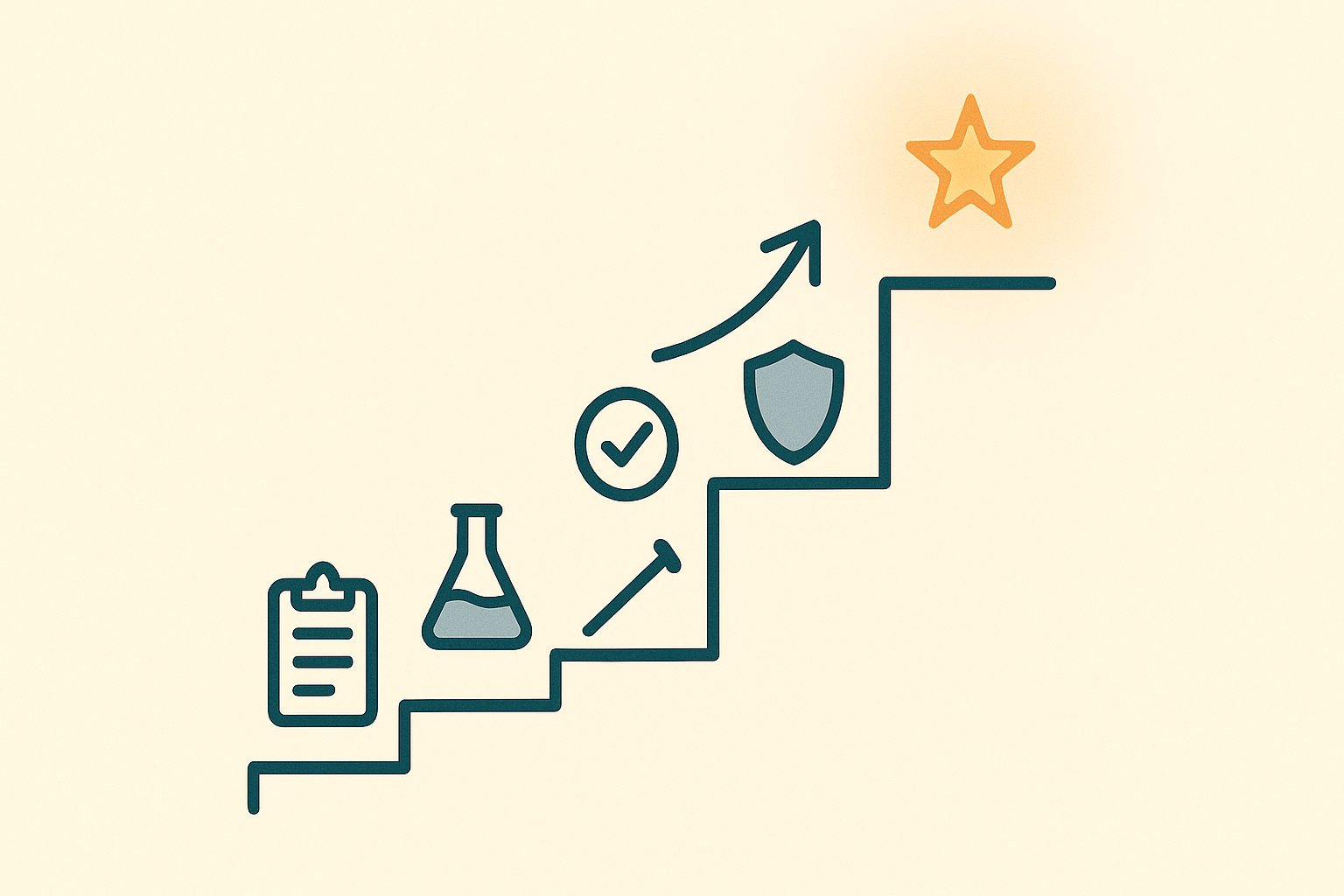
The five-phase playbook
Phase 1: Assess (weeks 1-3)
Before touching a model, answer three questions:
Where does your company spend the most human hours on repetitive, structured work? Not “what is cool to automate,” but what is expensive and boring. Compliance reviews, document processing, customer support triage, data entry. These are your AI candidates.
Is your data ready? AI needs data: clean, structured, accessible data. If your documents are scattered across SharePoint, email, and paper, the first investment is data infrastructure, not AI. I have seen companies spend six figures on AI models and zero on data pipelines. The models failed.
What is the measurable target? “Improve efficiency” is not a target. “Reduce compliance review time by 60%” is. Define the number before you start.
Phase 2: Pilot (weeks 4-8)
Pick one use case. One team. One process. Build the smallest version of the AI system that can produce a measurable result.
This is not a proof of concept that runs in a lab. It is a real system that real people use on real work for 30 days. The pilot must answer:
- Does the AI actually improve the metric? (accuracy, speed, cost)
- Do people use it? (adoption rate)
- What breaks? (edge cases, integration failures, data gaps)
At Cone Red, our pilots typically use RAG: the AI reads the company’s own documents and answers questions or drafts work. RAG is fast to deploy (days, not months), grounded in real data, and produces results that are immediately measurable.
Phase 3: Validate (weeks 9-12)
The pilot produced numbers. Now validate them:
- Was the improvement real or circumstantial? (Run for 60 days, not 30)
- Does it hold up under load? (More users, more data, more edge cases)
- What is the total cost of ownership? (API calls, infrastructure, maintenance, training)
- Does it meet regulatory requirements? (Audit trails, explainability, data privacy)
This is where most pilots die, and that is fine. A pilot that fails at validation saves you from a production failure. The goal of validation is to decide: scale, iterate, or kill.
Phase 4: Scale (months 4-9)
If the pilot validates, scale:
- Expand to more teams, departments, or locations
- Integrate with production systems (CRM, ERP, core banking, EHR)
- Build monitoring and alerting (drift detection, quality gates, usage analytics)
- Train users at scale
Scaling is where the architecture decisions from Phase 2 pay off or bite you. If you built on a fragile foundation, scaling breaks it. If you built on solid data pipelines and well-structured retrieval, scaling is straightforward.
Phase 5: Govern (ongoing)
AI in production needs governance:
- Quality monitoring. Is the model still accurate? Has the data drifted? Are edge cases increasing?
- Compliance. Can every AI decision be audited? Does the system meet regulatory requirements?
- Cost management. Are API costs scaling linearly with value? Is there a cheaper model that works?
- Security. Are AI APIs handling sensitive data correctly? Are access controls in place?
The technology stack
For most enterprise AI systems, the stack looks like this:
| Layer | What it does | Options |
|---|---|---|
| Data | Stores documents, transactions, records | PostgreSQL, MongoDB, S3 |
| Embeddings | Converts text to vectors for semantic search | OpenAI, Cohere, open-source models |
| Vector store | Stores and searches embeddings | pgvector, Pinecone, Qdrant |
| LLM | Generates answers, drafts work, classifies | GPT-4, Claude, GLM, Llama |
| RAG layer | Retrieves relevant documents before generation | Custom or frameworks (LangChain, LlamaIndex) |
| Agent layer | Takes actions beyond text generation | Custom or frameworks (CrewAI, Hermes) |
| Orchestration | Manages the pipeline end-to-end | Custom or platforms |
| Monitoring | Tracks quality, cost, usage | Custom or platforms (Weights & Biases, LangSmith) |
You do not need all of these for a pilot. You need data, embeddings, a vector store, an LLM, and a RAG layer. Add agent orchestration and monitoring as you scale.
Real-world examples
Banking AML (21 banks): We replaced rule-based compliance screening with AI that understands name variants and semantic matching. Accuracy went from 80% to 99.6%. Read the full case study.
Pharmacy chain (100+ locations): An agent system that processes operational documents, extracts data, and routes for approval. 20 minutes per document → 90 seconds. (Full case study coming soon.)
Industrial mining (€133M operation): AI for document intelligence and process automation across a complex industrial operation. (Full case study coming soon.)
The decision: build, buy, or partner?
| Build | Buy | Partner | |
|---|---|---|---|
| When to choose | Your use case is unique and creates competitive advantage | The problem is generic (OCR, chatbots, standard workflows) | You need custom AI but lack the internal team |
| Investment | High (team, infrastructure, time) | Low (subscription, setup) | Medium (engagement fee, faster time-to-value) |
| Risk | Execution risk (can your team ship?) | Vendor lock-in, limited customization | Finding the right partner |
| Best for | Companies with AI as core competency | Companies with standard needs | Most enterprises |
Most companies should do all three. Buy the generic, partner on the complex, and build only the capability that differentiates you from competitors. At Cone Red, we are the partner for companies that need custom AI systems shipped by operators who have done it before.
Key takeaways
- Start with the problem, not the model. Identify where humans spend hours on repetitive work.
- Follow the sequence: assess → pilot → validate → scale → govern. Skipping steps guarantees rework.
- Your first AI system should produce measurable ROI within 90 days. If it does not, the use case was wrong.
- Data readiness is the biggest predictor of success. Invest in data infrastructure before AI.
- Measure before you deploy so you have a baseline. Measure after so you can prove ROI.
- Build, buy, and partner: do not try to do everything in-house, and do not outsource everything.
If you are starting this journey and want an operator who has done it before (across banking, pharma, industrial, and fintech), let’s talk.
Common Questions
- How do I start implementing AI in my company?
- Start with a use case that has clear ROI: a process where humans spend significant time on repetitive, document-heavy work. Assess whether AI can handle 80% of that work. Build a small pilot with one team, measure results for 30 days, and scale only if the numbers justify it. Never start with the model. Start with the problem.
- How much does enterprise AI implementation cost?
- A pilot AI system typically costs between 20,000 and 80,000 dollars depending on complexity, data readiness, and integration requirements. A full production deployment ranges from 100,000 to 500,000 dollars. The key variable is not the model cost. It is the data engineering and integration work that connects the AI to your existing systems.
- How long does it take to implement AI in enterprise?
- A focused pilot takes 4-8 weeks. Production deployment takes 8-16 weeks. Full enterprise rollout (multiple departments, governance framework, monitoring) takes 6-12 months. Companies that promise faster timelines are cutting corners on data quality, testing, or governance.
- What are the biggest risks of enterprise AI?
- The top risks are: (1) Hallucination: the AI generates confident but wrong answers. Mitigated by RAG systems with source verification. (2) Data privacy: sensitive information exposed through AI APIs. Mitigated by on-prem deployment or strict data handling. (3) Regulatory non-compliance: AI decisions that cannot be explained. Mitigated by audit trails and explainable AI design. (4) Adoption failure: the system works but nobody uses it. Mitigated by training and change management.
- Should we build or buy AI systems?
- Build when your use case is unique to your industry and creates competitive advantage. Buy when the problem is generic (customer support chatbots, document OCR). Partner when you need custom AI but do not have the internal team to build and maintain it. Most enterprises should do all three: buy the generic, partner on the complex, and build only the differentiating.
- How do I measure the ROI of enterprise AI?
- Measure three things: (1) Time saved: hours per employee per week that AI eliminates. (2) Accuracy improved: percentage reduction in errors or increase in detection rates. (3) Revenue enabled: new capabilities that were not possible before (faster onboarding, better recommendations, 24/7 coverage). Start measuring before the AI is deployed so you have a baseline.