The AI-First Company
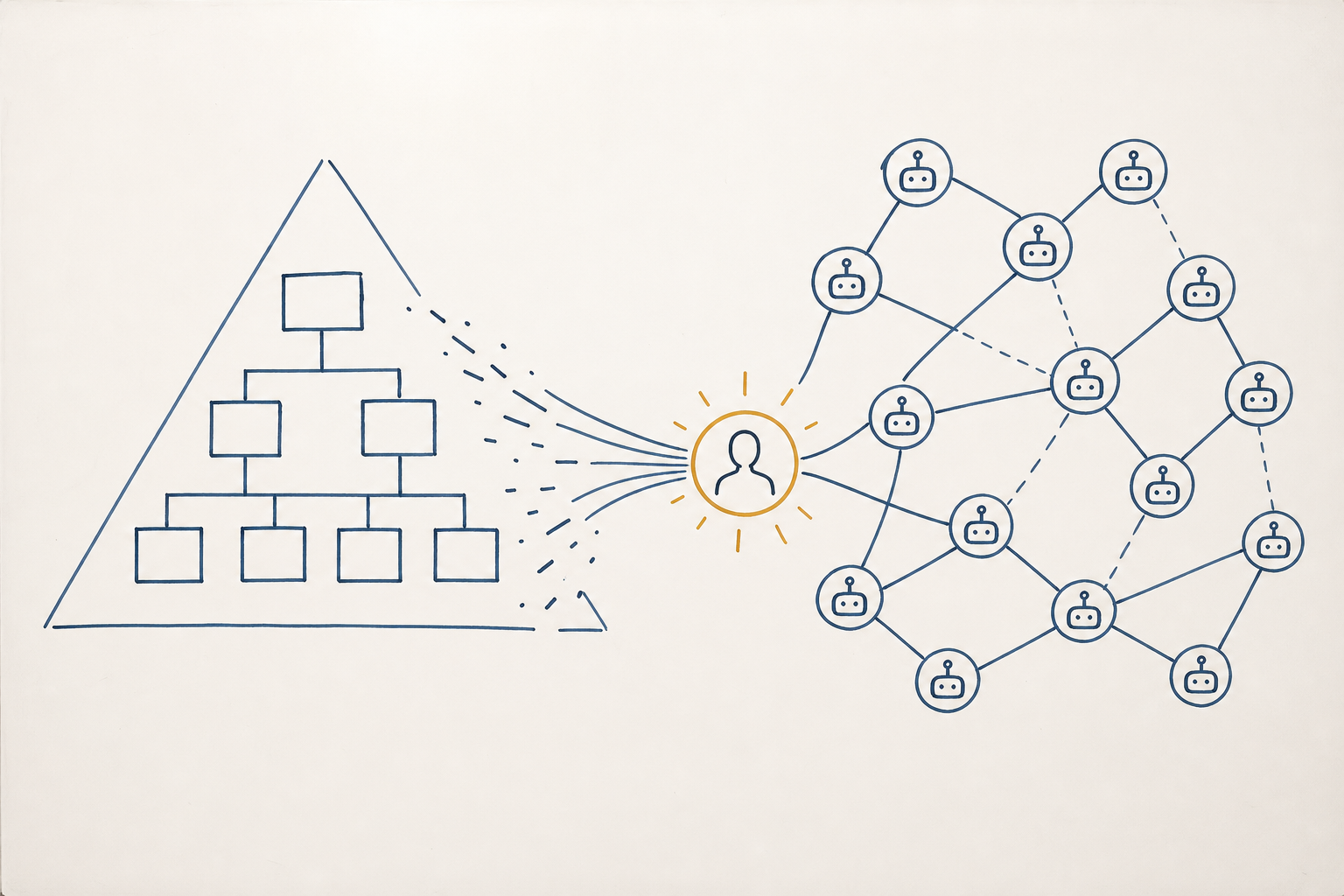
An AI-first company is not one that bought AI tools. It is one whose operating model has been rebuilt so an agent is the default operator of a repeatable process, and a human’s job is judgment: deciding when the agent is wrong, not doing the work the agent already does. Only about 1% of companies believe they’ve reached what McKinsey calls mature AI adoption, despite near-universal access to the same models. The gap is not the technology. It is the org chart.
I rebuilt my own company’s operating model this way before I sold anyone else on doing it. This is what actually changed, and why most companies that “use AI now” still haven’t.
The thing everyone gets backwards
Ask most executives what “AI-first” means and they describe tool adoption: everyone has Copilot, the support team has a chatbot, marketing uses an image generator. That is not AI-first. That is the old process, typed faster.
Here is the tell. A 2023 field study of consultants at a major firm found that AI assistance lifted output quality by 40% and task completion speed by 25%, but only on tasks inside what the researchers called the “jagged frontier”: the uneven boundary of what the model is actually good at. On tasks just outside that frontier, consultants using AI did worse than those without it, because they trusted an answer the model wasn’t equipped to give. The lift is real. It is also conditional on someone knowing where the frontier is and building a process around that boundary, not around the tool.
A separate study of 5,179 customer support agents found the same shape from a different angle: access to an AI assistant lifted productivity by 34% for novice and low-skilled workers, with almost no effect on the most experienced ones. The AI wasn’t making anyone smarter. It was distributing the expertise that used to live in a few people’s heads. That is an organizational fact wearing a productivity statistic’s clothes.
Adding AI to an unchanged workflow gets you a faster version of the old bottleneck.
What actually changes when you rebuild around it
Three things move, in this order, when a company genuinely rebuilds instead of bolts on.
Institutional memory stops living in people’s heads. In most companies, what was learned last quarter is scattered across Slack threads, one senior person’s memory, and a wiki nobody updates. The AI-first move is making memory a system: every fix, every decision, every lesson captured once, in a place an agent and the next person can both read, so the tenth time a problem shows up it takes minutes instead of a phone call to the one person who remembers.
A process gets an agent as its default operator, and a human as its exception handler. This is the inversion that actually matters. In the old model, a person does the work and escalates when they’re stuck. In the rebuilt model, an agent does the routine 80% of a process and a human’s attention goes entirely to the 20% that needs judgment: is this output right, should this deal move forward, does this number look real. PwC found AI-exposed industries are seeing revenue per employee grow three times faster than less-exposed sectors, which is what you’d expect if the win is reallocating human attention to the highest-judgment steps, not just working faster at the same steps.
Visibility replaces status meetings. If the process runs through a system instead of a person’s memory, the state of any piece of work is a query away, not a Monday stand-up away. Nobody should have to ask “where are we on this” if the system already knows.
What breaks first, and it’s not the technology
The honest part, because I’d rather tell you this than have you find out the hard way: rebuilding the operating model does not automatically produce a healthy company. The most common failure I’ve watched, including in my own company, is that the person who designs the system becomes the only one who can operate it. You fix the bottleneck of “nobody remembers how we did this” and quietly create a new one: “only the founder knows how the system that remembers things works.” A company that automates itself into a bus factor of one didn’t get more resilient. It got a single point of failure with better tooling.
The fix isn’t more automation. It’s making sure the humans around the system still talk to each other about what it’s telling them, on a cadence, out loud, not just trusting that the dashboard is enough. A system that compounds knowledge is only as good as the humans who still argue about what it means.
What this looks like from the outside
None of this is theoretical for me. I built this system inside my own operation before productizing the method for other companies: a knowledge graph that fixes and decisions get fed into as the team ships, an agent that watches open work and surfaces what’s stalled instead of waiting to be asked, process maps instead of tribal knowledge, and dashboards that update on every push instead of a status call. The scars from getting that wrong the first few times, memory that didn’t get captured, a process that only one person understood, became the actual product: the method is what we now install for other companies, on their own systems, because we ran it on ourselves first.
If you want the productized, install-it-on-your-repos version of this, that’s what the AI-First Transformation Practice is, and the method behind it is written up in full in the AI-First Company Handbook. This essay is the shorter, personal version of the same thesis: the model was never the hard part. The org chart is.
Related reading: Orchestration Is the System covers the layer-design principle behind this: the model is one step, and the system that decides when it’s wrong is the actual product. This essay is the org-chart-level view of the same idea.
References
- Dell’Acqua, F., McFowland, E. III, Mollick, E. R., Lifshitz-Assaf, H., Kellogg, K., Rajendran, S., Krayer, L., Candelon, F., & Lakhani, K. R. (2023). “Navigating the Jagged Technological Frontier: Field Experimental Evidence of the Effects of AI on Knowledge Worker Productivity and Quality.” Harvard Business School Working Paper 24-013. https://www.hbs.edu/ris/Publication%20Files/24-013_d9b45b68-9e74-42d6-a1c6-c72fb70c7282.pdf
- Brynjolfsson, E., Li, D., & Raymond, L. R. (2023). “Generative AI at Work.” NBER Working Paper 31161. https://www.nber.org/papers/w31161
- PwC (2025). “2025 Global AI Jobs Barometer.” https://www.pwc.com/gx/en/issues/artificial-intelligence/job-barometer/2025/report.pdf
- McKinsey & Company (2025). “Superagency in the Workplace: Empowering People to Unlock AI’s Full Potential at Work.” https://www.mckinsey.com/capabilities/tech-and-ai/our-insights/superagency-in-the-workplace-empowering-people-to-unlock-ais-full-potential-at-work
Common Questions
- What does "AI-first" actually mean?
- It means the operating model is rebuilt so an AI agent is the default operator of a repeatable process, not a tool someone reaches for occasionally. The human's job moves to judgment: deciding when the agent's output should be trusted, corrected, or escalated. A company that added a chatbot to an unchanged workflow is not AI-first. A company that redesigned the workflow around an agent is.
- Isn't using ChatGPT or Copilot every day already AI-first?
- No, and this is the most common confusion. Using an AI tool inside an unchanged process is still the old process, just typed faster. AI-first means the process itself was redesigned: who owns a step, where the handoff happens, what gets checked before it ships. McKinsey's 2025 research found only 1 percent of leaders believe their company has reached mature AI adoption despite near-universal tool access, which tells you the constraint was never the model.
- What's the first thing that should actually change?
- Institutional memory. Most companies store what was learned in people's heads and in chat threads that vanish. The first real AI-first move is making memory a system: every fix, decision, and lesson captured once and inherited by whoever touches that work next, instead of re-learned by each new person who joins.
- What's the difference between AI-first and AI-native?
- In practice, the two terms describe the same shift and are used close to interchangeably: an organization where AI is the substrate of daily work, not a bolt-on. AI-native tends to describe companies built this way from day one; AI-first tends to describe the deliberate act of rebuilding an existing company this way. I use AI-first because it is honest about the fact that most of us are doing a rebuild, not a fresh start.