Your Notes Are Not the Deal
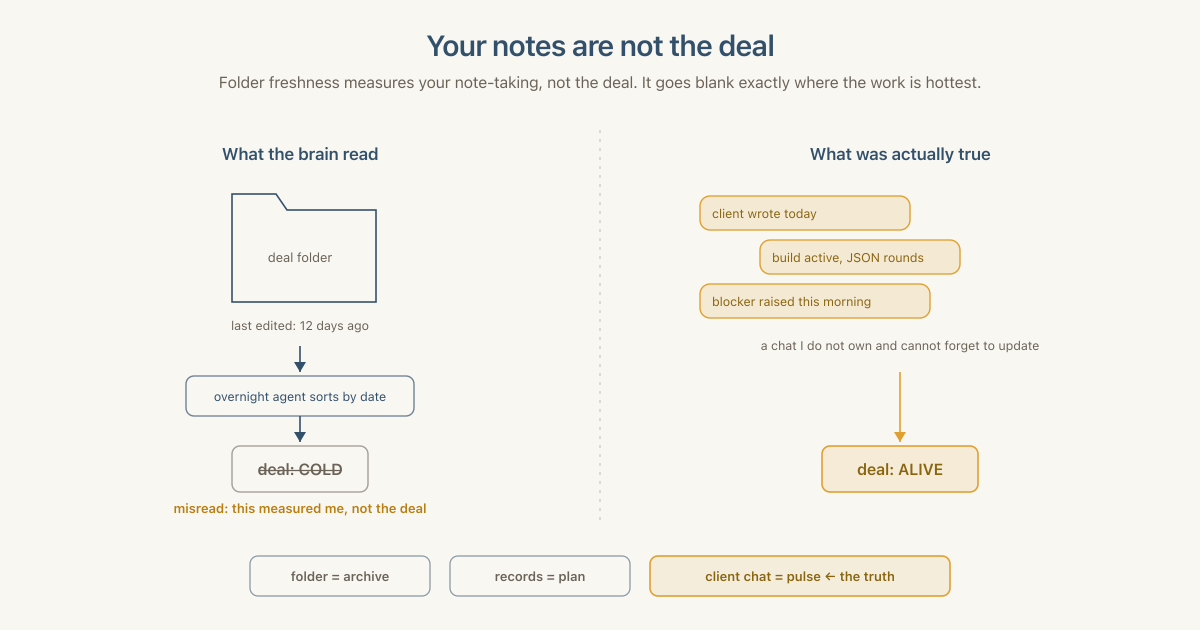
One night my company’s brain told me two of my best deals were dead.
It said it calmly, in a clean morning report it had written for me while I slept. Two names I had been working for weeks, ranked at the bottom, flagged cold. I felt the small drop in the stomach you get before you have even finished reading, the one that arrives before the thought does. Then I opened the actual client chats and found both deals not just alive but loud. Daily messages. Active builds. One of them had been the busiest thread I had all week.
The brain was not broken. It was doing exactly what I built it to do, and that is the part worth writing down.
What it actually measured
I run my entire company on a brain made of plain text. Not a SaaS tool, not a dashboard. A living set of documents. Every project and every deal has a folder. Every decision goes into a log the moment it is made. Every lesson goes into a playbook. There is a constitution that tells every agent how we work, an append-only journal of what happened each day, a shared board, and a memory that carries context from one session to the next. Most companies keep this knowledge in people’s heads and scatter the rest across Slack threads and a wiki nobody opens. I keep it in one place, in a plain format that both my team and my agents can read.
And the agents do read it. Every night, while I sleep, they walk the whole brain and leave me a state of the world before my coffee is cold: what moved, what stalled, what needs a human. It is the single highest-leverage thing I have built, and the honest reason an eleven-person team can operate like one several times its size. I have written, more than once and with some pride, that the documents are the runtime and the agents are the processes that move across them. I still believe it. What follows is the footnote that belief needed, the one place the system bit me, because that is the part you only learn by running it for real.
The agent ranked deal health by how recently each deal’s folder had changed. Reasonable on its face. A folder nobody has touched in two weeks looks like a deal nobody is working. So it sorted by last-modified date, found two folders gone quiet, and concluded the deals had gone quiet too.
But a folder’s freshness does not measure the deal. It measures my note-taking. And here is the cruel geometry of it: I update the folders for deals I have time to think about. The deals that are actually on fire, the ones eating every hour, are the ones I never stop to document, because I am too busy doing them. So the system was not just noisy. It was inverted. The quietest folders were the hottest deals. The instrument was pointed at my paperwork and reading it as if it were the world.
The law under the mistake
Say it as a general thing, because it is one. A self-maintained knowledge base measures how diligently you maintain it, not the reality it points at. And it decays fastest exactly where reality moves fastest, because that is where you have the least time to write.
This is the map-and-territory problem with a nasty twist. The usual warning is that a map is not the territory. The twist for any system you keep by hand is that the map rots unevenly. It stays crisp in the calm regions, where nothing is happening and updating is cheap, and it goes stale in the storms, where everything is happening and you cannot stop to redraw. A self-drawn map is least accurate precisely where you most need it to be right.
Which means the more I trust the brain uniformly, the more confidently it will mislead me in the one place that matters. A knowledge base is most dangerous not when it is empty, but when it is detailed everywhere except the part that is on fire, because the detail everywhere else makes the silence look like data.
The fix was a different instrument, not better notes
My first instinct was the wrong one: be more disciplined, update the folders faster. That is a treadmill, and it loses to my own calendar every time. The discipline that fixes this is not “write more.” It is “stop measuring the wrong surface.”
The live state of a deal does not live in my folder. It lives in the client’s chat, in the thread where the work and the blockers and the mood actually are. That is a system I do not own and cannot forget to update, because the client updates it for me, every day, by existing. So I gave the brain a third layer of truth. The folder is the archive. The records are the plan. The chat is the pulse. And the health metric flipped from “how fresh is my document” to “how recently did the other side, the part of the world I do not control, last speak.”
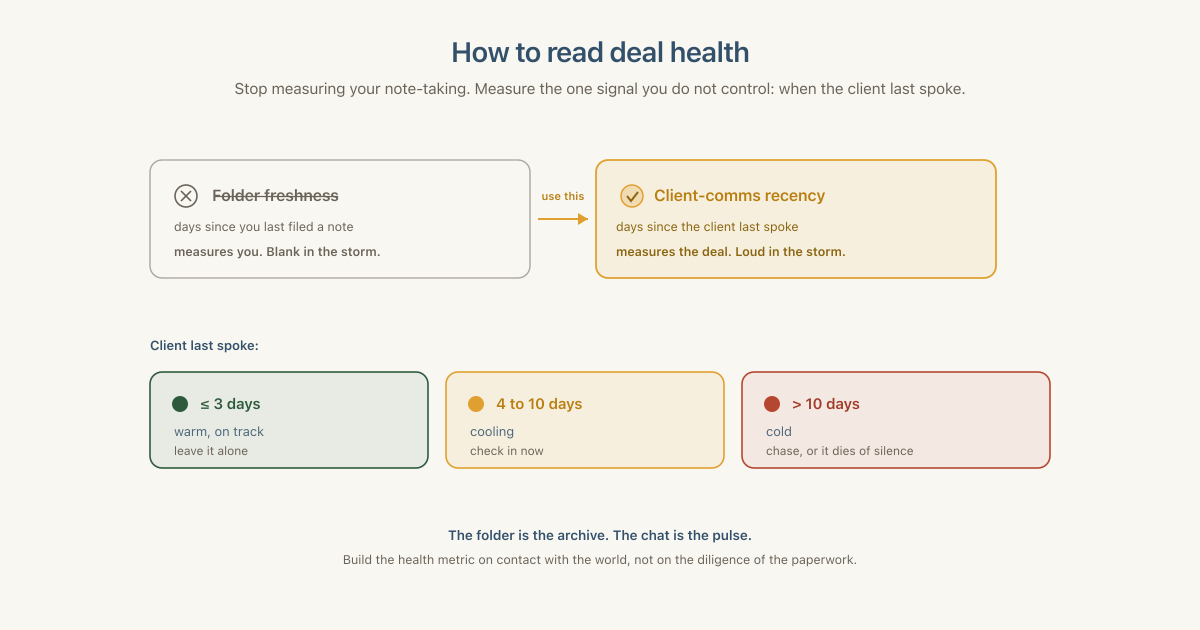
That one move changes the whole posture. You stop grading yourself on your note-taking and start reading the world’s own footprints. The signal you want is almost never the freshness of the record you keep. It is the recency of contact with the reality you cannot edit.
This is not just deals
The shape travels, and once you see it you see it everywhere a record is kept by the people being measured.
A sales pipeline scored by “last activity logged” rewards the rep who updates the CRM, not the rep who is closing. A factory that tracks machine health by when someone last filed a maintenance note will look healthiest on the line nobody has time to inspect. A back-office process judged by how current its documentation is will always look most in control of the cases that have gone quiet, which are often the ones quietly going wrong. In every one of these, the self-kept record drifts toward looking good in the calm and blank in the crisis, and a naive system reads the blank as peace.
The defense is the same each time. Find the signal the subject does not generate about itself. The customer’s reply. The sensor reading. The downstream event. Build your health metric on contact with the world, not on the diligence of the paperwork, because paperwork measures the clerk and the world measures the deal.
What I kept
I did not lose faith in the brain. I built it on purpose and I would build it again. What I lost was the assumption that it is uniformly trustworthy, and that turned out to be the most useful thing it ever taught me. Now I trust it least exactly where I am busiest, and I have wired a second instrument, one I do not maintain, to watch those places for me.
A knowledge base is a mirror you hold up to your own attention. It shows you, with great precision, what you have had time to look at. The danger is mistaking that for a window. Most of the time the difference does not matter. It matters enormously on the nights it tells you the thing on fire is cold.
One more thing, because I am asked it often now. The system underneath this story, a company that runs on documents its own agents read every night, is the thing teams most want me to build for them once they have seen it work. If this essay made you want one, a real brain for your company or your deals, with the failure mode I just walked you through designed out from the start, that is the work I do. Write me at dima@cone.red. The best place to begin is the exact spot this one went wrong: the deal you are most quietly afraid you are forgetting.
Related reading: Orchestration Is the System makes the case that the documents are the runtime and the system around the model is the product. This is the caveat that case needs: the runtime you keep by hand rots fastest where the work is hottest, so the health metric has to read a surface you do not maintain.