The AI-First Company Needed a Stand-Up
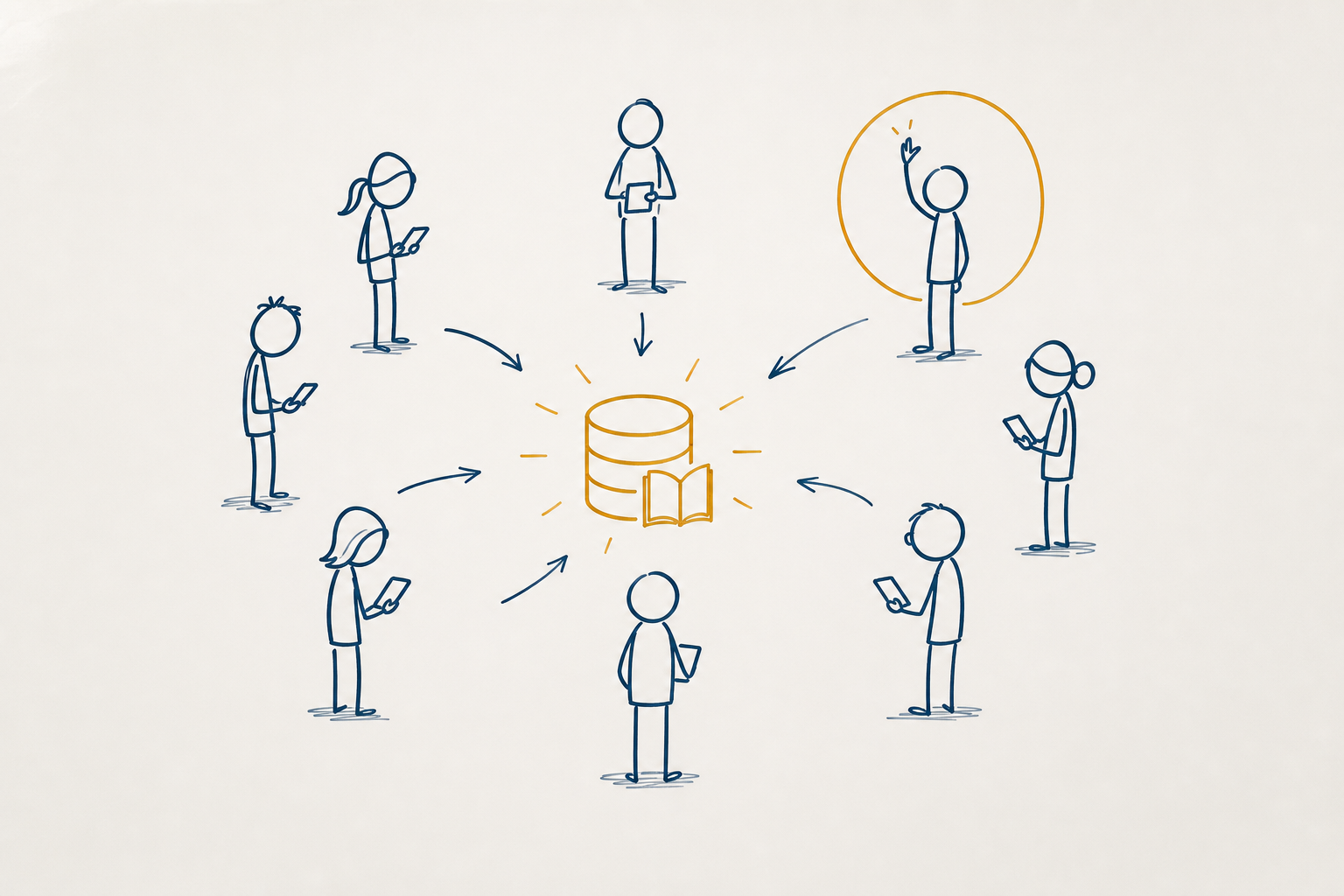
I built a knowledge system good enough to have an answer for almost everything: what a fix looked like last time, why a decision went one way and not another, what the pattern was the last three times something like this happened. It compounds. It is, genuinely, one of the better decisions I’ve made in how I run a company.
It also has a side effect nobody warns you about, and I found it the hard way. The thing that broke wasn’t the system. It was the meetings.
The failure mode that looks like nothing
Here is what it looks like from the inside, because it does not look like a crisis. A recurring team sync, the one meeting where everyone shows up and says where things actually stand, slowly stops generating anything. Not because people are hiding problems. Because somewhere along the way, the team started assuming that if something mattered, it would already be in the system, and if nobody had flagged it, it must be fine.
That assumption is almost never announced. It just accumulates, one unasked question at a time, until the stand-up is either silence or small talk, and the actual state of things is quietly diverging from what everyone believes it is.
A knowledge base you can trust is not the same thing as a team that is still talking to each other.
The research on how companies manage what they know gives this a name. A knowledge-management strategy can lean toward codification, capturing everything in documents and systems so it can be reused without the original person, which works well for routine, repeatable problems, or toward personalization, the harder, slower work of people actually explaining things to each other. The classic finding is that companies leaning too hard on one at the expense of the other lose ground: pure codification tends to miss exactly the tacit, half-formed knowledge that never makes it into a document because nobody thought to write it down yet. What I watched happen on my own team is a specific version of that same trade-off. The mistake isn’t building the system. It’s assuming the system is a complete substitute for the conversation.
Why this is more dangerous than it sounds
The instinct is to treat this as a minor culture problem, something HR-adjacent, not structural. I think that’s wrong, for a specific reason: a system that compounds knowledge only compounds the knowledge that got captured. Everything that didn’t get captured, a doubt someone had but didn’t voice, a decision that drifted without anyone deciding to drift it, a person quietly stuck on something they assumed was obvious to everyone else, doesn’t show up as a gap in the system. It shows up as confidence. The dashboard looks fine. The graph looks fine. The gap is invisible right up until it costs you something real, and by then it’s not a communication problem anymore, it’s a result.
This is the uncomfortable companion to the idea that a company can rebuild itself around AI-first infrastructure. The infrastructure genuinely works. It does not, by itself, guarantee that the humans running it are still checking each other’s assumptions out loud, on a cadence, where it’s socially awkward to stay silent. That check has to be designed for on purpose. It does not fall out of the system for free.
What actually fixes it
Not more documentation, and not canceling the meeting. Two changes did the actual work, in my own company:
- Change what the meeting is for. Stop using a recurring sync to read out status the system already knows. Use it for the one thing the system can’t know yet: what somebody hasn’t said out loud. That reframing alone changes who talks.
- Treat low engagement as a leading indicator, not a scheduling inconvenience. If a sync that used to generate real discussion goes quiet, that is worth investigating with the same seriousness as a dashboard metric moving the wrong direction. It usually means something, and it is cheaper to ask about it in week one than to find out what it meant in week twelve.
The system was never supposed to replace the conversation. It was supposed to make the conversation about the right things: not repeating what’s already known, but surfacing what isn’t. Getting that balance wrong is the actual failure mode of building an AI-first company, and it’s a more common one than the failure mode everyone worries about, which is that the technology won’t work. The technology worked. The org chart still needed the humans to keep talking.
Related reading: The AI-First Company covers what changes structurally when a company rebuilds around AI. This is the honest companion: the failure mode that shows up after the structure is right.
References
- Hansen, M. T., Nohria, N., & Tierney, T. (1999). “What’s Your Strategy for Managing Knowledge?” Harvard Business Review, 77(2), 106-116. https://www.hbs.edu/faculty/Pages/item.aspx?num=7313
- Wegner, D. M. (1987). “Transactive Memory: A Contemporary Analysis of the Group Mind.” In Theories of Group Behavior (Springer). Foundational framework for how teams distribute and retrieve shared knowledge through communication, not just storage. https://en.wikipedia.org/wiki/Transactive_memory
Common Questions
- Doesn't a good knowledge base reduce the need for meetings?
- It reduces the need for meetings whose only purpose is transferring information that's already written down. It does not reduce the need for meetings whose purpose is surfacing what isn't written down yet: a doubt nobody has voiced, a decision that quietly drifted, a person who is stuck and assumed everyone already knew. Those meetings get more valuable as the system gets better, not less, because everything routine has already been absorbed elsewhere.
- How do you know if your team has stopped asking questions?
- The clearest signal is a recurring sync that used to generate discussion sliding into either silence or off-topic small talk. That is not people being busy. It is people privately deciding the meeting has nothing left to offer, usually because they believe the knowledge base already has the answer, whether or not that is actually true.
- What's the actual fix if stand-ups have degraded into silence?
- Do not add more documentation, and do not cancel the meeting. Protect the ritual, shrink it if needed, and change what it's for: not a status readout of things the system already knows, but the five minutes where someone has to say the thing they haven't written down yet. Treat attendance and real engagement in it as a leading indicator worth watching, the same way you'd watch any other early warning signal.