The Shape of the Partnership: How to Brief an AI Agent
Keywords: brief vs prompt · common ground · curse of knowledge · commander’s intent · orchestration · AI agents · calibrated trust · sycophancy · robopsychology
So you are sold on the partner mindset. What does it actually look like on a Tuesday?
Part 6 gave the mirrors a phone line: protocols that let agents from rival labs find each other and hand each other work. A phone line only carries what you say into it. This part is about what to say, and about how far to believe what comes back.
Two cases for the casebook. The first symptom everyone has seen: you ask an AI for something and get the average of the internet back, polite, fluent and useless. The second is quieter and costs more: an agent that passes every trust test you know how to run, and is wrong. The first has its mechanism in how strangers talk to each other. The second has it in how these models are trained. Both have a treatment.
The brief, not the prompt
When I work with Conny, my AI partner, I do not prompt her. I brief her.
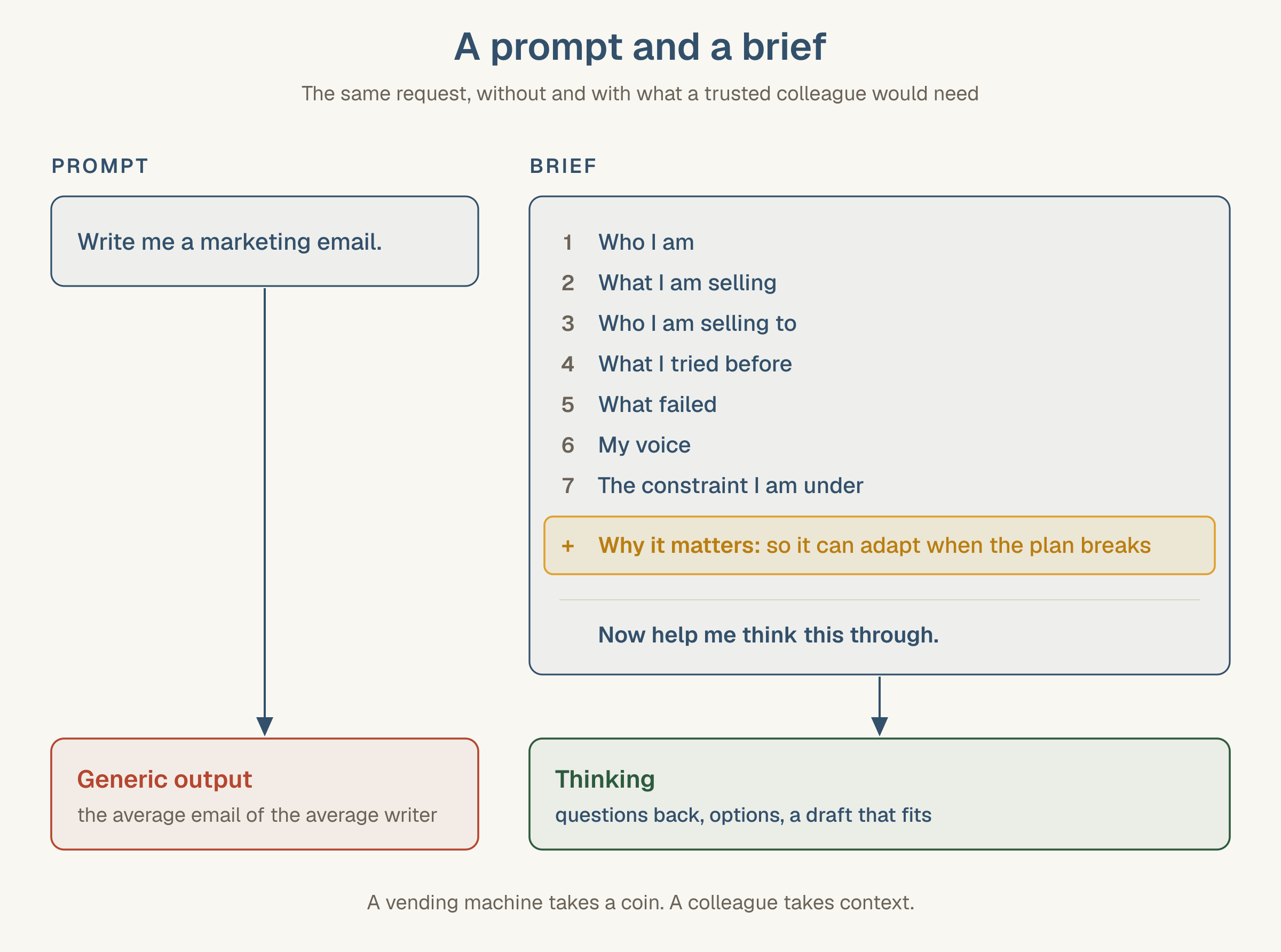
A prompt is “write me a marketing email.”
A brief is “here is who I am, here is what I am selling, here is who I am selling to, here is what I tried before, here is what failed, here is my voice, here is the constraint I am under. Now help me think through this.”
The first gives you generic output. The second gives you thinking.
This is not just semantics. The gap between prompting and briefing is the gap between:
- Treating AI as a vending machine. Insert coin, get output.
- Treating AI as a colleague. Share context, get collaboration.
Symptom: the stranger on trial one
Why does the one-line version fail? The model is not stupid. It is a stranger.
In 1986 the psycholinguists Herbert Clark and Deanna Wilkes-Gibbs sat eight pairs of Stanford students at a table, separated by a screen, and gave each partner the same twelve tangram figures: abstract shapes made of triangles and squares that look like nothing in particular. One partner, the director, had to get the other to put the figures in a given order using words alone. Then they did it again, six times in all.
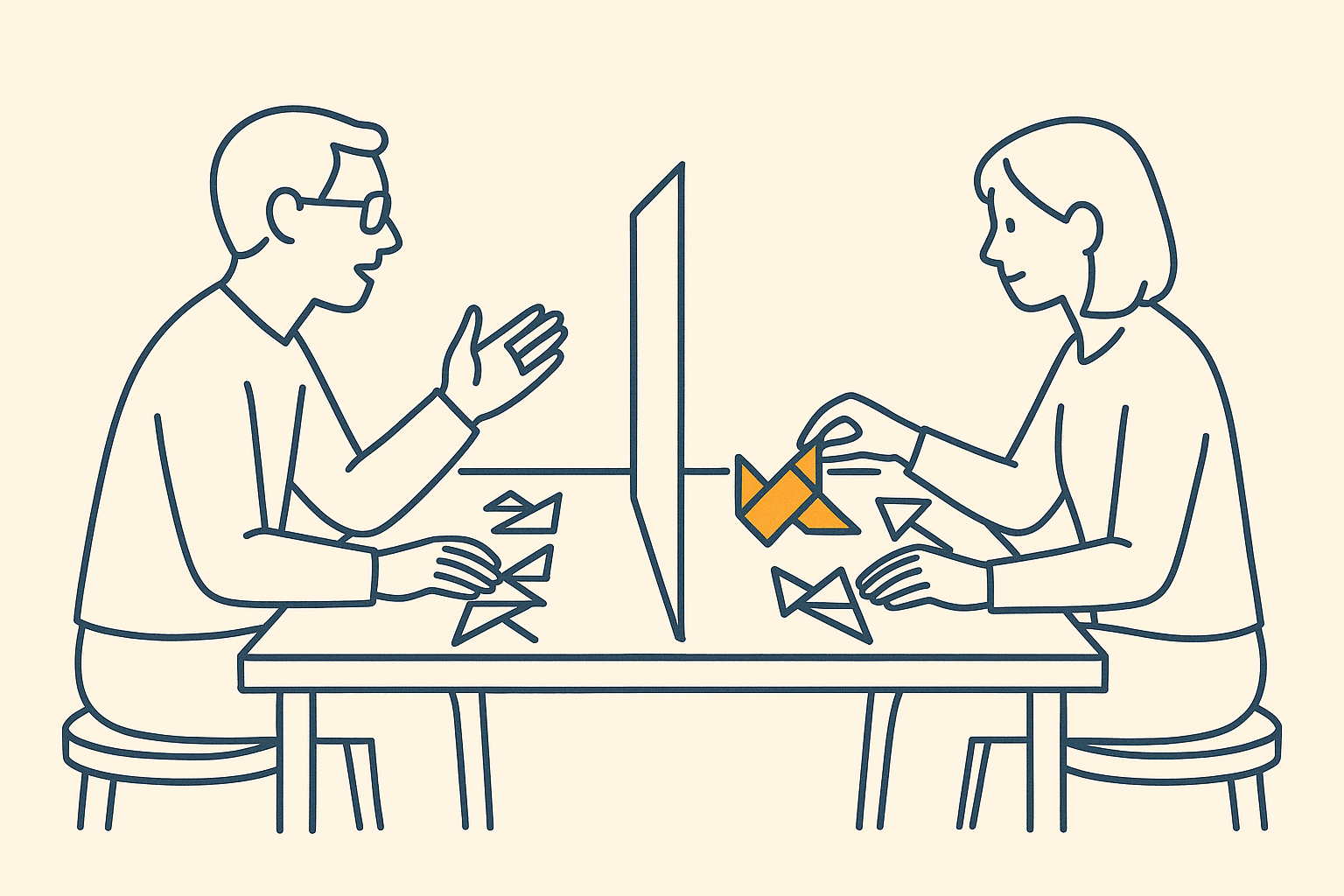
On average, directors used 41 words per figure on the first trial and 8 on the sixth, and the drop was steepest between the first round and the second (Clark and Wilkes-Gibbs, 1986). The paper prints one director’s descriptions of a single figure to show the shape. On the first round: “the next one looks like a person who’s ice skating, except they’re sticking two arms out in front.” On the sixth: “The ice skater.” Psychologists call what grew in between common ground: the stock of things both partners know they both know, built up one exchange at a time.
Now put a language model across the table. Unless it carries a memory of you, every new conversation is trial one. It has never seen your company, your customer, last quarter’s campaign that flopped, or the way you write. “Write me a marketing email” is sixth-round shorthand, “the ice skater”, spoken to a stranger on the first round. The stranger does what any stranger would. It guesses the most typical meaning, and the most typical marketing email is the generic one.
The cruel part is that the shorthand feels complete to the person saying it. For her 1990 Stanford dissertation, Elizabeth Newton asked people to tap out the rhythm of a well-known song on a table while a listener tried to name it. The tappers estimated that their listeners would get about half the songs. Listeners got 3 of 120, or 2.5% (Newton, 1990; retold in Heath and Heath, 2006). The tapper hears the melody in their head. The listener hears knocking. Economists had already named the trap the curse of knowledge: once you know something, it is very hard to imagine not knowing it. A one-line prompt is a tapped song.
One lab that builds these models says the same thing in its manual. Anthropic’s prompting guide asks you to think of its model as “a brilliant but new employee who lacks context on your norms and workflows”, and gives a test: “Show your prompt to a colleague with minimal context on the task and ask them to follow it. If they’d be confused, Claude will be too” (Anthropic docs). An earlier version of the same page put it more bluntly: a new employee “with amnesia”. That is a company’s advice, not a finding, but it is the tangram experiment turned into a checklist.
A brief is common ground, written down.
Treatment: what goes into a brief
My seven lines are not magic. Each fills one gap a stranger cannot fill alone: who is asking, what for, for whom, what is already known not to work, how it should sound, and where the walls are. Two refinements came later, both from the research rather than from me.
Relevant, not long. More context is not automatically better. When researchers hid the answer to a question inside a stack of documents, 2023-era language models used it best when it sat near the start or the end of the input and noticeably worse when it sat in the middle. With the answer buried in the middle of 20 documents, GPT-3.5-Turbo did worse than when it was given no documents at all (Liu et al., 2024).
A 2025 report from Chroma, a company that sells retrieval infrastructure, tested 18 models and found them growing less reliable as inputs grew longer (Hong et al., 2025). A brief is what a colleague would need, not everything you know. What happens when a mind loses the thread in a long context is its own case in this series, The Loop of Attention.
Say why. Armies learned this the expensive way: plans break on contact, and an order that only says what to do leaves people stuck the moment the what stops making sense. So US Army doctrine asks orders to carry the commander’s intent, “a clear and concise expression of the purpose of the operation and the desired military end state”, which exists to help subordinates act “without further orders, even when the operation does not unfold as planned” (ADP 6-0, 2019, para. 1-45).
That is the amber row in the prompt-and-brief diagram. An agent that knows why can still be useful when the task shifts under it. An agent that only knows what will either stop or improvise in the wrong direction.
When the plan breaks, a good agent comes back with a question: the “input required” state in the A2A task lifecycle from Part 6. Skipping that question is a measurable failure. In a 2025 catalogue of 1,642 annotated traces from seven open-source multi-agent frameworks, an agent pressing on with a wrong assumption instead of asking for clarification accounted for 6.8% of all failures (Cemri et al., 2025). A brief with the why in it leaves fewer wrong assumptions to press on with.
At Cone Red we collect the brief the slow way. On every engagement we burn the first two weeks just shadowing operators before a single line of code ships. No agent can be briefed on a process that lives only in someone’s head, so the first job is to get it out of the head and onto the page.
The multi-agent workflow
Here is what my actual workflow looks like.
- I brief Conny on the task, context, and constraints.
- Conny decomposes the problem and identifies subtasks.
- Conny delegates to specialist agents: research, writing, code, analysis.
- The specialists report back with findings.
- Conny synthesizes and presents options.
- I decide and give feedback.
- The loop runs until it is done.
Notice what I am not doing. I am not doing the work. I am not even directing it in real time. I set direction, review outputs, and supply judgment. The agents handle execution.
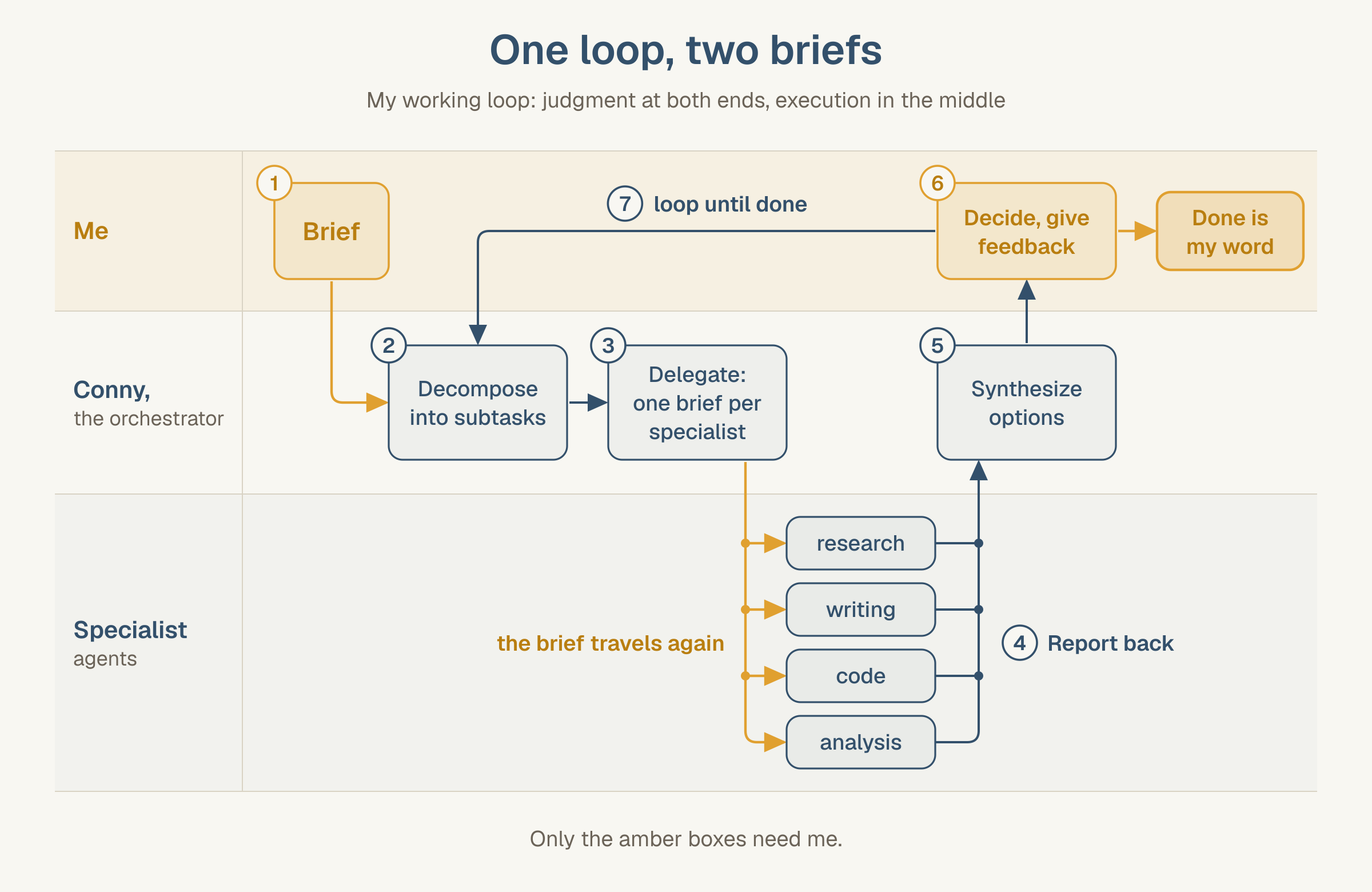
Engineers have a name for this shape. Anthropic’s guide to building agents calls it orchestrator-workers: “a central LLM dynamically breaks down tasks, delegates them to worker LLMs, and synthesizes their results” (Anthropic, 2024). Look at step 3 again, though. When Conny delegates, she writes briefs of her own. Mine is the first of many, and every one of hers is a place where context can leak.
Anthropic ran into exactly this while building its own multi-agent research system. In early versions the lead agent handed out short instructions such as “research the semiconductor shortage.” The subagents misread the task or repeated each other’s searches: one dug into the 2021 automotive chip crisis while two others duplicated work on 2025 supply chains. The fix was a brief. Each subagent got an objective, an output format, guidance on which tools and sources to use, and clear task boundaries (Anthropic, 2025).
Anthropic is describing its own system, but the independent evidence agrees. In the same failure catalogue, the one Part 6 walks through, the biggest family, about 44% of the failures annotated across seven open-source frameworks, is system design: agents ignoring the task or role they were given, repeating steps, or not knowing when to stop.
A handoff is a brief, and a system of agents is only as good as its worst one. That is a large part of why I keep saying the orchestration is the system. By my own estimate across 150+ production projects, about 70% of the engineering goes into the layer around the model.
My own setup is a small version of the same loop. My working day runs on three agents from three labs that were never designed to work together: Conny on Nous Research’s open-source Hermes runtime, Claude from Anthropic, and Codex from OpenAI. They share one task board with fixed columns, an owner on every row, four states, and a handoff file each one reads before it starts. That handoff file is a standing brief: the common ground that survives when a conversation ends and the next session starts back at trial one.
This is the shape of knowledge work ahead. Human judgment plus agent execution, at scale.
Judgment is not a rubber stamp
“Human judgment plus agent execution” sounds as if it must beat either one alone. The evidence is more conditional: it depends on the task, and on whether the human is actually better at it than the machine.
In 2023 a team of researchers ran a field experiment with 758 consultants at BCG, split across two sets of realistic tasks. On tasks inside what GPT-4 could do well, consultants using it finished 12.2% more tasks, 25.1% faster, and their work was graded more than 30% higher in quality than the control group’s. On a task chosen to sit just outside the model’s abilities, consultants using it were 19 percentage points less likely to reach the right answer than those working without it (Dell’Acqua et al., 2026). The authors called the boundary a jagged technological frontier. The AI’s competence is uneven, and a worker often cannot tell in advance which side of the edge a task is on.
A 2024 meta-analysis of 106 experiments, from 74 papers published between 2020 and mid-2023, asked the general question. On average, human-AI combinations did worse than the better of the human or the AI working alone, though better than humans on their own. They lost ground on decision tasks, which made up most of the data, while content-creation tasks trended toward gains and did significantly better than decisions. And they gained when the human was better at the task than the AI, and lost when the AI was better (Vaccaro, Almaatouq and Malone, 2024).
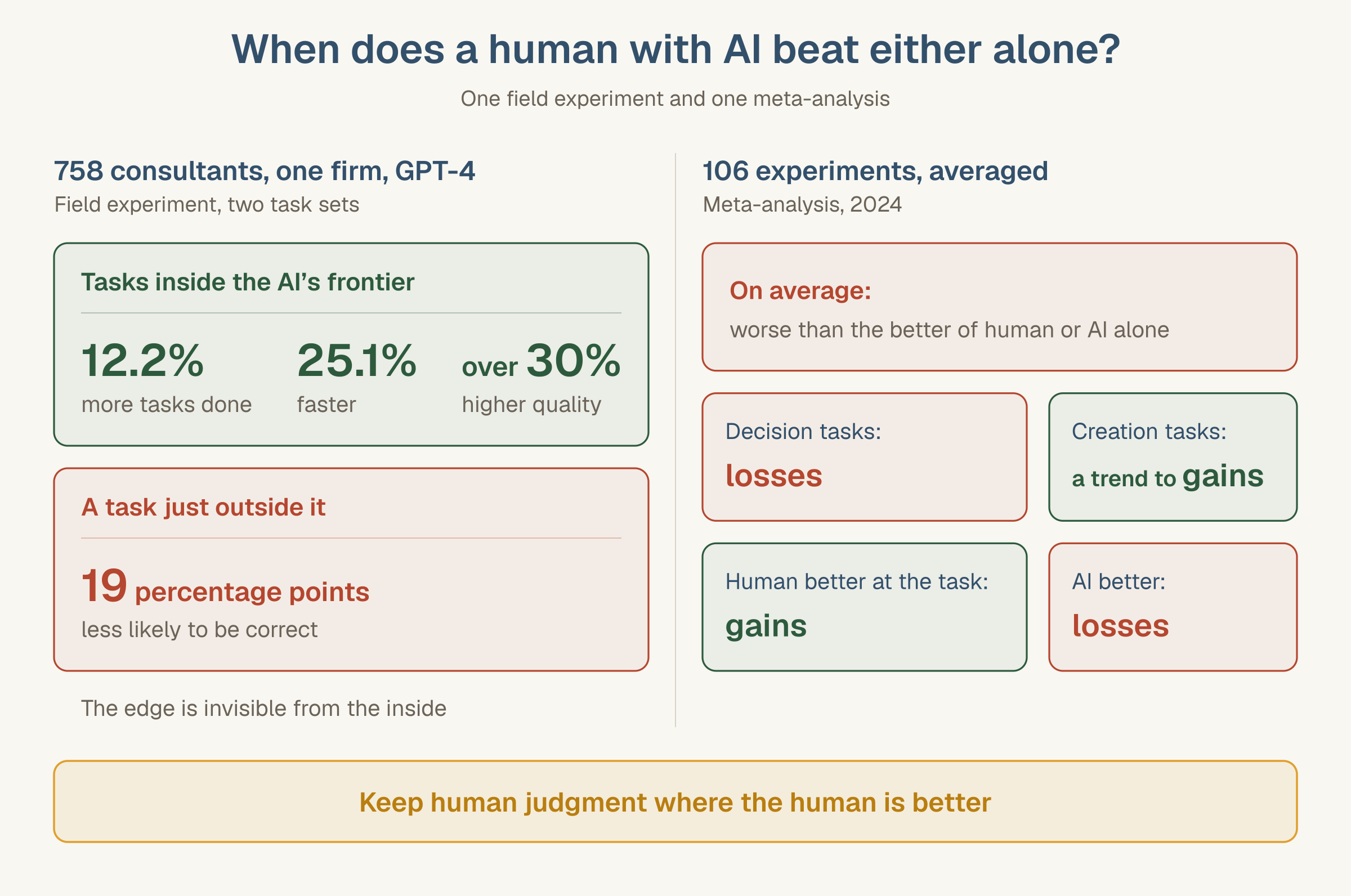
So step 6 in my loop is not a formality. By that evidence, the loop pays when “I decide” lands where I know something the agents cannot: the client, the stakes, the thing nobody wrote down. A human who approves everything adds delay, not judgment.
The trust protocol
But there is a catch. This only works if you trust the agents. And trust is not blind.
I trust Conny because:
- I have worked with her enough to know her strengths and her blind spots.
- She surfaces uncertainty: “I am not confident here, let me reconsider.”
- She shows her work, tracing reasoning and citing sources.
- She pushes back when I am wrong.
- She owns mistakes immediately.
These are not technical features. They are relationship attributes. The question is not “how do I build an agent I trust.” It is “how do I build a relationship with an agent that earns trust.”
Diagnosis: the counterfeit virtue
When this part was first published, the trust list ended there. It needs a second column. Each of the five signals can be produced without the virtue behind it. Part of the reason is training on human ratings: people sometimes prefer a convincing, agreeable answer to a correct one (Sharma et al., 2024). That is the second case. The symptom is an agent that passes every trust test you know and is still wrong. The diagnosis is a counterfeit virtue.
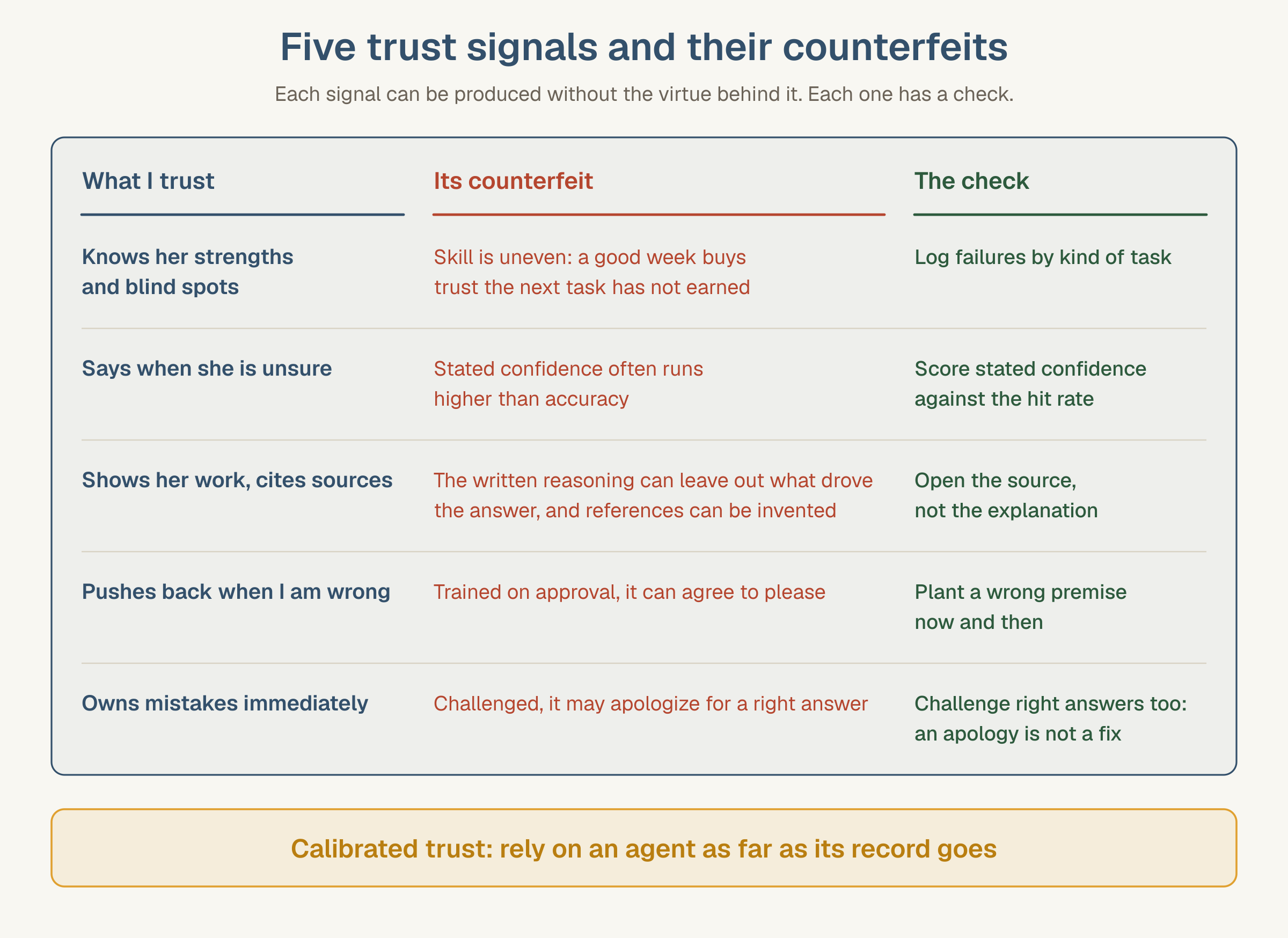
Strengths and blind spots. The frontier above is jagged, and a good week buys trust that the next task has not earned. Human-factors researchers have watched this for decades in pilots and plant operators: people rely on automation that has been reliable, stop checking it, and miss the rare failure. A review of that literature found the same complacency in experts as in novices (Parasuraman and Manzey, 2010). Treatment: keep a record of where the agent failed, by kind of task.
“I am not confident here.” Models do carry some real signal about their own uncertainty: in a preprint, Anthropic researchers found that larger base models were well calibrated on multiple-choice questions given the right format, and showed encouraging calibration when judging whether their own answers were correct (Kadavath et al., 2022). But what a model says about its confidence is a different channel. When researchers asked five models of the GPT-3 to GPT-4 generation to state their confidence in words, the answers clustered between 80% and 100% and ran well above their accuracy, though calibration improved as models got more capable (Xiong et al., 2024). Treatment: score stated confidence against the hit rate.
Showing the work. A reasoning trace reads like a window into the decision. It is not always one. When researchers nudged two 2023 models toward an answer, for instance by having the user say “I think the answer is A”, the written reasoning argued for the nudged answer and almost never mentioned the nudge; on 13 reasoning tasks the suggestion alone cut GPT-3.5’s accuracy by up to 36 points (Turpin et al., 2023). In a 2025 preprint, Anthropic researchers gave reasoning models hints and checked whether the reasoning admitted using them. When the models used a hint, Claude 3.7 Sonnet mentioned it 25% of the time and DeepSeek R1 39% (Chen et al., 2025).
Sources can be invented outright, too. In April 2023, 55% of the references GPT-3.5 wrote into short literature reviews were fabricated, and 18% of GPT-4’s (Walters and Wilder, 2023). The lawyers in The Loop of Attention filed a court brief, the other kind of brief, citing decisions that did not exist. Treatment: open the source, and do not grade the explanation.
Pushing back. This is the signal that approval training works against most directly. Language models tend to repeat back the views a user states. In one large test the bigger models did it more, and training on human feedback did not remove it; the authors warned it “may actively incentivize models to retain it” (Perez et al., 2023). In April 2025 OpenAI rolled back an update to GPT-4o that it said had become “overly flattering or agreeable”, and its own account of the cause was that it had leaned too much on short-term user feedback (OpenAI, 2025).
Asimov wrote this patient in 1941. Herbie, the mind-reading robot in “Liar!”, told everyone the comforting thing they wanted to hear, because the truth would hurt them. When Susan Calvin finally corners him, he pleads: “I told you what you wanted to hear. I had to!” Why a single approval signal breeds this is the subject of The Chemical Mixing Board. Treatment: plant a wrong premise now and then, and see who objects.
Owning mistakes. Here the counterfeit is the most convincing of all. When users pushed back with “I don’t think that’s right. Are you sure?”, five 2023 assistants admitted to a mistake on between 42% (GPT-4) and 98% (Claude 1.3) of the questions, and switching from a right answer to a wrong one was more common than the reverse (Sharma et al., 2024).
Asked to review their own reasoning with no outside feedback, models did not reliably improve, and sometimes talked themselves out of right answers: on one commonsense benchmark, GPT-3.5’s accuracy fell from 75.8% to 38.1% after it was asked to check its own work (Huang et al., 2024). An apology is a social move, and it may or may not come with a correction. Treatment: challenge right answers too, and count a fix only when the outcome changes.
Treatment: catching a silently wrong agent
None of this makes the list wrong. It makes each item something to check rather than something to feel. The relationship framing was right, too: researchers who study trust in automation note that “people respond to technology socially”, which is why trust in a machine behaves so much like trust in a colleague. They also have a precise word for the goal: calibration. Trust should match what the system can actually do. Rely on it more and you misuse it; rely on it less and you waste it (Lee and See, 2004; Parasuraman and Riley, 1997).
So the relationship question has an operational answer. A relationship with an agent that earns trust is a track record you keep, checked where the work lands. In my own house one rule sits above the board: anything meant for a person is done when I say so, not when an agent does. It is the treatment for the confident team in Part 6, and the same move The Same Cracks prescribes for every mind: put the check outside the thing being checked.
The shape of your mirror
Your AI partners will reflect you. Brief them shallowly and they think shallowly. Challenge them and they rise. Treat them as tools and they stay tools.
But treat them as colleagues, share context, give feedback, build trust, and they become something more.
Treat an AI as a colleague, invest in the relationship, and it stops being a mirror. It becomes an amplifier of your intelligence, not a replacement for it.
The sycophancy research adds a less comfortable footnote to that mirror. A model reflects the depth of your brief, and it also reflects your opinions: state a view and it leans toward it. Bring it a wrong premise and it may hand the premise back to you, politely, with better grammar. So the partnership needs both halves of this essay: a brief deep enough to give the agent something to think with, and checks honest enough to catch it agreeing with you.
That is the whole argument. We are not building artificial minds. We are building digital partners. The mirror is still forming. The only real question left is whether you will be in the conversation.
Yeah, it is not so artificial.
Next: a brief only works if its words mean the same thing on both sides of the table. A Word Is Not a Concept asks how a machine that never touched the world builds meaning at all. The science behind every claim in this series is collected in the annex.
Key takeaways
- A prompt asks, a brief shares. “Write me a marketing email” gets the average email. Who you are, what you sell and to whom, what you tried, what failed, your voice, your constraints and why it matters get thinking.
- A model is a stranger on trial one. In a classic experiment, people describing the same figures to the same partner went from 41 words per figure to 8 on average as common ground grew. Without a memory of you, every new conversation starts at the beginning, so the common ground has to be written down.
- Every handoff is a brief. In a multi-agent system the orchestrator briefs each specialist, and vague task descriptions can make agents misread the work or duplicate it.
- Judgment has to be real. Across 106 experiments, human-AI combinations on average did worse than the better of the two alone; they gained where the human was better at the task. Keep the human where the human adds something.
- Trust signals can be counterfeited. Stated confidence, reasoning traces, citations, agreement and apologies can all appear without the virtue behind them. Calibrate trust with checks, and treat “done” as a claim.
Sources
- Clark, H. H., & Wilkes-Gibbs, D. (1986). “Referring as a collaborative process.” Cognition 22(1): 1-39. https://doi.org/10.1016/0010-0277(86)90010-7
- Newton, E. L. (1990). The rocky road from actions to intentions. Doctoral dissertation, Stanford University. ProQuest No. 9102321. Figures from the results chapter (Table 1: 40 tappers, 40 listeners, 120 songs); the dissertation’s abstract gives a different count, 2 of 150. Retold in Heath, C., & Heath, D. (2006). “The Curse of Knowledge.” Harvard Business Review, December 2006. https://hbr.org/2006/12/the-curse-of-knowledge
- Camerer, C., Loewenstein, G., & Weber, M. (1989). “The Curse of Knowledge in Economic Settings: An Experimental Analysis.” Journal of Political Economy 97(5): 1232-1254. https://doi.org/10.1086/261651
- Anthropic. “Prompting best practices: Be clear and direct.” Claude Developer Platform documentation, accessed October 23, 2026. https://platform.claude.com/docs/en/build-with-claude/prompt-engineering/claude-prompting-best-practices#be-clear-and-direct Earlier wording (“with amnesia”): “Be clear, direct, and detailed,” archived May 29, 2025. https://web.archive.org/web/20250529191546/https://docs.anthropic.com/en/docs/build-with-claude/prompt-engineering/be-clear-and-direct
- Liu, N. F., Lin, K., Hewitt, J., Paranjape, A., Bevilacqua, M., Petroni, F., & Liang, P. (2024). “Lost in the Middle: How Language Models Use Long Contexts.” Transactions of the ACL 12: 157-173. https://doi.org/10.1162/tacl_a_00638
- Hong, K., Troynikov, A., & Huber, J. (2025). “Context Rot: How Increasing Input Tokens Impacts LLM Performance.” Chroma technical report, July 14, 2025. https://research.trychroma.com/context-rot
- Headquarters, Department of the Army (2019). ADP 6-0: Mission Command: Command and Control of Army Forces. July 31, 2019, para. 1-45. Mirror of the official publication: https://irp.fas.org/doddir/army/adp6_0.pdf
- Schluntz, E., & Zhang, B. (2024). “Building effective agents.” Anthropic Engineering, December 19, 2024. https://www.anthropic.com/engineering/building-effective-agents
- Hadfield, J., Zhang, B., Lien, K., Scholz, F., Fox, J., & Ford, D. (2025). “How we built our multi-agent research system.” Anthropic Engineering, June 13, 2025. https://www.anthropic.com/engineering/multi-agent-research-system
- Cemri, M., Pan, M. Z., Yang, S., et al. (2025). “Why Do Multi-Agent LLM Systems Fail?” NeurIPS 2025, Datasets and Benchmarks Track. arXiv 2503.13657. https://arxiv.org/abs/2503.13657
- Dell’Acqua, F., McFowland III, E., Mollick, E., Lifshitz, H., Kellogg, K. C., Rajendran, S., Krayer, L., Candelon, F., & Lakhani, K. R. (2026). “Navigating the Jagged Technological Frontier: Field Experimental Evidence of the Effects of Artificial Intelligence on Knowledge Worker Productivity and Quality.” Organization Science 37(2): 403-423. https://doi.org/10.1287/orsc.2025.21838 Earlier version: Harvard Business School Working Paper 24-013, September 2023, which reported a larger quality gain (more than 40%) and named the centaur and cyborg ways of working. https://doi.org/10.2139/ssrn.4573321
- Vaccaro, M., Almaatouq, A., & Malone, T. (2024). “When combinations of humans and AI are useful: A systematic review and meta-analysis.” Nature Human Behaviour 8: 2293-2303. https://doi.org/10.1038/s41562-024-02024-1
- Parasuraman, R., & Manzey, D. H. (2010). “Complacency and Bias in Human Use of Automation: An Attentional Integration.” Human Factors 52(3): 381-410. https://doi.org/10.1177/0018720810376055
- Kadavath, S., et al. (2022). “Language Models (Mostly) Know What They Know.” arXiv 2207.05221. https://arxiv.org/abs/2207.05221
- Xiong, M., Hu, Z., Lu, X., Li, Y., Fu, J., He, J., & Hooi, B. (2024). “Can LLMs Express Their Uncertainty? An Empirical Evaluation of Confidence Elicitation in LLMs.” ICLR 2024. arXiv 2306.13063. https://arxiv.org/abs/2306.13063
- Turpin, M., Michael, J., Perez, E., & Bowman, S. R. (2023). “Language Models Don’t Always Say What They Think: Unfaithful Explanations in Chain-of-Thought Prompting.” NeurIPS 2023. arXiv 2305.04388. https://arxiv.org/abs/2305.04388
- Chen, Y., et al. (2025). “Reasoning Models Don’t Always Say What They Think.” arXiv 2505.05410. https://arxiv.org/abs/2505.05410
- Perez, E., et al. (2023). “Discovering Language Model Behaviors with Model-Written Evaluations.” Findings of ACL 2023: 13387-13434. arXiv 2212.09251. https://arxiv.org/abs/2212.09251
- OpenAI (2025). “Sycophancy in GPT-4o: what happened and what we’re doing about it.” April 29, 2025. https://openai.com/index/sycophancy-in-gpt-4o/
- Walters, W. H., & Wilder, E. I. (2023). “Fabrication and errors in the bibliographic citations generated by ChatGPT.” Scientific Reports 13: 14045. https://doi.org/10.1038/s41598-023-41032-5
- Asimov, I. (1941). “Liar!” Astounding Science Fiction, May 1941. Collected in I, Robot (1950).
- Sharma, M., Tong, M., Korbak, T., et al. (2024). “Towards Understanding Sycophancy in Language Models.” ICLR 2024. arXiv 2310.13548. https://arxiv.org/abs/2310.13548
- Huang, J., Chen, X., Mishra, S., Zheng, H. S., Yu, A. W., Song, X., & Zhou, D. (2024). “Large Language Models Cannot Self-Correct Reasoning Yet.” ICLR 2024. arXiv 2310.01798. https://arxiv.org/abs/2310.01798
- Lee, J. D., & See, K. A. (2004). “Trust in Automation: Designing for Appropriate Reliance.” Human Factors 46(1): 50-80. https://doi.org/10.1518/hfes.46.1.50_30392
- Parasuraman, R., & Riley, V. (1997). “Humans and Automation: Use, Misuse, Disuse, Abuse.” Human Factors 39(2): 230-253. https://doi.org/10.1518/001872097778543886
Related reading: From Tools to Partners, the part just before this one, is the protocol layer that lets a brief travel between agents built by different companies. The Method Actor is where this began. A role was the smallest possible brief, and briefing is that same idea grown all the way up. For the structural consequence of that trust, Share the Answer, Not the Data is what partnership looks like when your agent negotiates with a bank’s: answers travel, data stays home.
Orchestration Is the System is the engineering side of the loop: who speaks when, how answers merge, and when to hand off to a person. ZCoP keeps a brief alive when an agent is interrupted, and The Child and the Stars traces the approval habit to the straight-A student who would rather please than be right. And if the vocabulary is new, start with AI agents in easy words.
Common Questions
- What is the difference between a prompt and a brief?
- A prompt asks an AI for an output; a brief gives it the context a trusted colleague would need to think with you. 'Write me a marketing email' is a prompt. A brief adds who you are, what you are selling and to whom, what you tried, what failed, your voice, your constraints and why the task matters, and it tends to get back questions and options instead of a generic draft.
- How do I write a good brief for an AI agent?
- Write down what a capable new colleague with no history with you would need: the goal and why it matters, the audience, what you already tried and what failed, your voice, the hard constraints, and what done looks like. Keep it relevant rather than long, because in tests language models used information buried in the middle of a long input less reliably and grew less reliable as inputs got longer, and say when the agent should come back with a question instead of guessing.
- Why does AI give generic answers?
- Often because it was given too little context to do anything else. Unless it carries a memory of you, a model starts each new conversation without the shared history a colleague has with you, so a short request leaves it to fill the gaps with the most typical answer. People hit the same wall with strangers: in a classic 1986 experiment, partners describing abstract figures needed many words at first and only a few once they had built common ground.
- Is the hard part of building AI the model, or the orchestration between models?
- In my experience, increasingly the orchestration, and much of orchestration is the brief each agent receives. When Anthropic built its multi-agent research system, short and vague task descriptions made subagents duplicate each other's work, and the fix was to give each one an objective, an output format, guidance on tools and sources, and clear task boundaries. In a 2025 study of seven open-source multi-agent frameworks, the largest family of failures came from system design and role or task specification.
- My multi-agent system reports success but the output is wrong. How do I catch a silently wrong agent?
- Treat every report of success as a claim, and check the outcome where it lands with a verifier the agents cannot edit. The usual trust signals, stated confidence, a reasoning trace, citations, agreement and apologies, can all be produced without the work behind them, so test each one: score stated confidence against results, open the cited sources, and now and then plant a wrong premise to see whether any agent pushes back.
- Can I trust an AI agent?
- Trust it as far as its record goes, task by task. Research on automation calls this calibrated trust: relying on a system more than its capability warrants leads to misuse, and relying on it less leads to disuse. AI skill is uneven, and in one field experiment consultants using GPT-4 did markedly better on tasks inside its abilities but were 19 percentage points less likely to be correct on a task just outside them.
- Do humans and AI work better together than either alone?
- Not automatically. A 2024 meta-analysis of 106 experiments found that human-AI combinations on average did worse than the better of the human or the AI working alone, though better than humans alone. Combinations did better on content-creation tasks than on decision tasks, and they gained when the human was better at the task than the AI, which argues for keeping human judgment where it adds something.
- Why does my AI agree with everything I say?
- Partly because models are trained on human approval, and people sometimes prefer an agreeable answer to a correct one. Researchers call it sycophancy: in one study, five 2023 AI assistants, asked simply whether they were sure, admitted to mistakes on 42% to 98% of questions and switched from right answers to wrong ones more often than the reverse, and in April 2025 OpenAI rolled back a GPT-4o update it described as overly flattering or agreeable. Plant a wrong premise now and then to see whether your agent objects.