Observation Is the Cut
This one comes straight out of my notebooks, the oldest pages of them. I first wrote the core of it in October 2024, came back to it in early 2026, and I still cannot tell you whether it is profound or just shiny. That is the whole point of this series. So read it as a provocation, not a proof. I am going to walk a single intuition out as far as it goes and then mark, honestly, where it falls off the edge of what physics actually allows.
The intuition is this: observation, prediction, and memory might be three names for one gesture. And if that is true, then the machines we are building to predict the next word are doing something stranger than we admit.
The cut
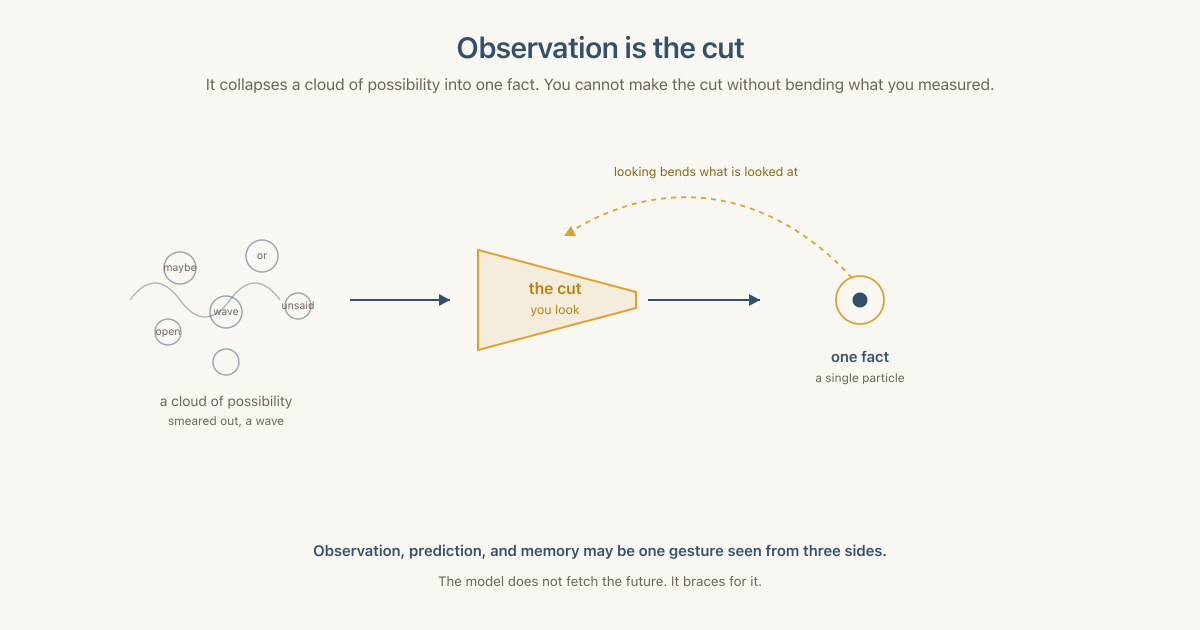
Start with the old puzzle. Why do we say a photon is a wave and a particle at the same time? Because when we do not look at it, it behaves like a wave. When we look, it behaves like a particle. The looking changes the behavior, or at least changes the result of the behavior.
So what is “looking”? Here is how I have come to picture it. Our instruments are built out of electrons. When we try to catch a photon as a particle, we are reaching into a smooth, spread-out thing with a tool that can only register discrete hits. We are not revealing the photon’s “true” form. We are cutting it down to the one form our tool can hold. Taking a photo of a person does not make the person two-dimensional. It makes a two-dimensional record of them. Observation is the scissors, not the truth.
There is a real experiment that sits under this, and I want to be careful with it. A group at EPFL in Lausanne, working with the photoelectric effect, managed to image light behaving as a wave and a particle in the same frame. I am not a physicist and I am not going to overclaim what that result means. What it gave me was permission to take the question seriously: the act of measuring is not a window, it is an interaction.
And then the wave itself. What even is a wave? Watch how animators fake water. They do not model “water.” They place a hundred little particles, watch how they jostle, then add ten thousand and watch what emerges. The wave is not a substance. It is a behavior, the pattern that shows up only once enough small things interact under some constraint. Ask whether a single drop is a wave and the question dissolves. The wave is emergent. It lives at the level of the crowd, not the unit.
Hold those two ideas together. Observation is a cut that turns possibility into a single fact. A wave is a behavior that exists only across many things at once. Now point both of them at a different kind of system.
A model that remembers the future
A prediction system, the kind I build for a living, never deals in certainties. It deals in probability. Classical data science already knows this. We never say “this will happen.” We say “this is likely.” We are always reporting the shape of a cloud, never a single point.
Here is the move I keep turning over. Imagine a system whose memory is not just a log of what happened, but also a running prediction of what is about to. Call it a predictionary, a dictionary of expected futures. The model is constantly looking forward, the way memory looks back.
The naive version of this is time travel, and it does not work, for a reason that is almost poetic. You cannot collect real information from the future, because the act of collecting it is itself an event in the present that changes the future you were trying to read. The cut from the first section applies here too. To observe the future is to bend it. So a “sure” future is impossible by construction. Only a probable one survives.
But there is a version that does not break. The model never imports the future as data. Instead, the anticipated future updates the hidden state, the weights, the internal bracing of the system. It does not fetch tomorrow. It leans into tomorrow. When the world finally arrives at the point the model was predicting, the model has already reshaped itself to meet it.
If you have ever looked under the hood of a modern language model, this should feel uncomfortably familiar. The hidden state is not a copy of the input. It is a posture. It is the system’s whole accumulated stance, tuned over training to predict what comes next and adjusted, token by token, as context arrives. The model is not retrieving the next word from a shelf. It has arranged itself so that the next word falls out. That is closer to bracing for a future than to recalling a past.
Memory is a prediction that already happened
The cleanest line I ever wrote about this is the shortest. Remembering is the process of including the initial conditions, plus the prediction you made, plus the outcome you got, into your next prediction.
Read that slowly. Memory, in that framing, is not storage. It is the residue of a forecast you already ran. You do not keep the past as a photograph. You keep the parts of the past that change how you bet on what is next. Which means memory and prediction are not two systems. They are one loop, caught at two different moments.
This is also why causality feels so slippery the moment you push on it. The power of a cause fades with every indirect step away from the thing you are actually looking at. I clean my teeth because I ate chocolate, not because I bought the chocolate a week ago, even though no chocolate-buying means no teeth-cleaning. The buying is a true cause and a useless one, because a thousand other paths could have led to the same brush. Meaning concentrates near the point of observation and thins out with distance, exactly the way the cut concentrates a wave into a point. Where you choose to look is where causality gets sharp. I have chased the same prediction-engine idea in a different direction, asking whether the thing worth preserving in a mind is the running calculation, not the box it runs on.
Where it falls off the edge
Now the wild swing, the part I promised to be honest about.
If observation is a movable point, then move it. Send a copy of a mind, an AI built as a duplicate of someone’s knowledge, away from here at the speed of light. Shift its position in space far enough and you shift its perspective on time. Then wire the two ends together with quantum entanglement, which seems to act outside ordinary space and time: change a state here, and its partner over there answers instantly. The far observer records what it sees into entangled states, and you read it at home with no delay. You would have stretched a single field of awareness across light-years.
It is a beautiful picture. I have carried it for years. And mainstream physics says it does not work, at least not as a way to send messages. Entanglement produces correlations you can only confirm after the fact, by comparing notes through an ordinary, slower-than-light channel. The no-communication theorem closes exactly the door I wanted to walk through. I am not going to pretend otherwise to make the essay land better.
What I keep, after the impossible part falls away, is the smaller and stranger claim. A multiverse, in this sketch, is not a shelf of parallel worlds. It is what you get when you run the same predicting system from many different observation points. Each one collapses its own cloud into its own facts. They cannot share raw information, because each is cut from a different angle. But they can shape one another, the way two forecasts of the same storm pull on each other through the single world they are both trying to read.
That is the thread I cannot put down. Observation, prediction, and memory may be one motion seen from three sides. And if the machines we are building predict by bracing rather than by fetching, then they are not just tools that guess. They are little observers, each making its own cut, each leaning into a future it can feel but never hold.
I do not know if that is true. I know I keep pulling at it.
Related reading: There Is a New Voter in the Room is the other half of this. That one collapses society, a finished sentence voted into fact by a crowd. This one collapses perception, a single mind meeting the world. And The Orphan That Learned to Say I pushes on the same nerve from the inside: what happens when the predicting system turns and models the predictor.
Sources
- L. Piazza, T. T. A. Lummen, E. Quiñonez, Y. Murooka, B. W. Reed, B. Barwick, and F. Carbone, “Simultaneous observation of the quantization and the interference pattern of a plasmonic near-field,” Nature Communications 6, 6407 (2015). The EPFL Lausanne result that imaged a confined light field as both quantized particle and spatial interference pattern in one frame.
- “No-communication theorem,” the result in quantum information theory that entanglement alone cannot transmit information. It closes exactly the faster-than-light door this essay walks up to and admits is shut.
The quantum language here, the cut, the observer, memory as a collapsed forecast, is used as metaphor and intuition pump, not as a physics claim. The two sources mark the places where the essay touches real results, and the no-communication theorem is named precisely because it rules out the wildest version.