We Are Trying to Save the Wrong Thing
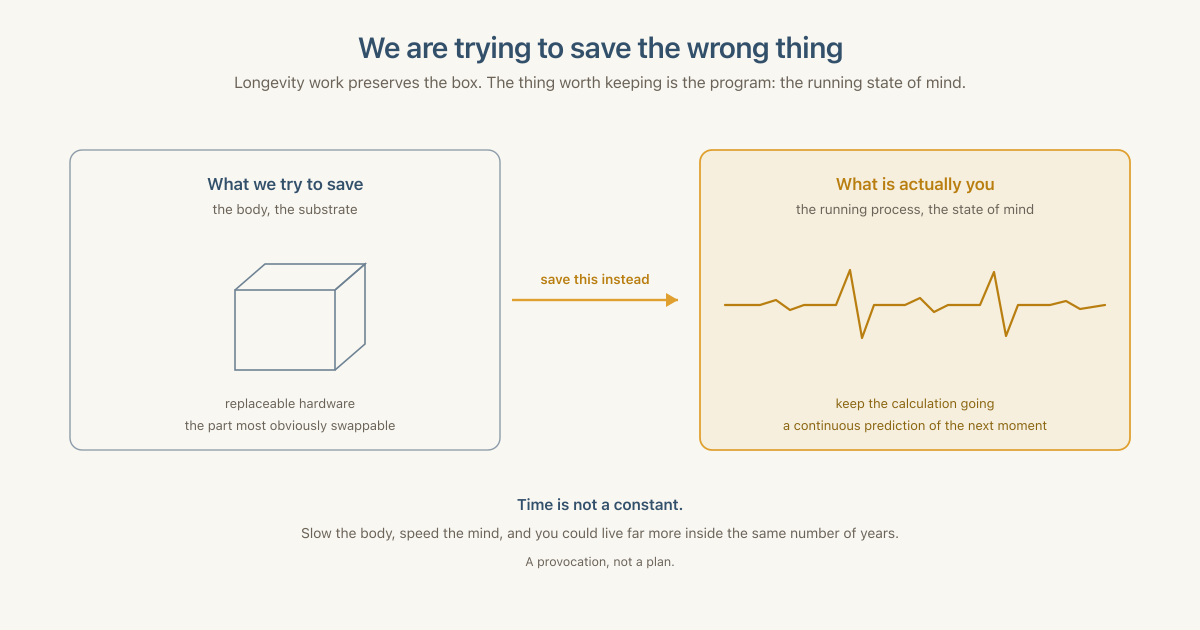
This is a Loose Thread. I have carried it for a while and I still cannot tell whether it is profound or just shiny. I am writing it down to find out, and to hand it to you in case you can see the part I cannot. Treat everything here as a provocation, not a claim. I am not a biologist, and where this touches real science it is reaching, not reporting.
We keep trying to save the box, not the program
When we talk about extending human life, we almost always mean the body. Live to a hundred and fifty, live to two hundred, freeze the tissue, slow the cellular clock. All of it is about preserving the physical machine. Cryonics is, at bottom, an attempt to keep the hardware from rotting until someone invents a way to switch it back on.
But step back and ask the obvious question. What are we, actually? Not the meat. The meat is a substrate. What we are is closer to a process running on that substrate: a computer that takes in signals, calculates the current state of reality, and predicts the next one. The body is the box. The mind is the program. And almost everything we call longevity research is an effort to save the box while saying very little about the program.
That seems backwards to me. If immortality means anything worth wanting, it is not a perfectly preserved corpse waiting to be rebooted. It is the continuity of the state of mind. Keep the program running. The box is negotiable.
You do not live in the present
Here is the part that unsettles me the most, and it is not even controversial in neuroscience.
You never experience the present moment. By the time a signal reaches you and your brain assembles it into “now,” the event is already past. Some milliseconds old. What you call the present is a slightly stale reconstruction, and what you call consciousness is in large part a prediction engine, constantly guessing the next state of reality so that you can act in it before it fully arrives.
So a mind is not a thing sitting in the now. It is a calculation about what comes next, run continuously, on a small slice of input. We are prediction machines that have convinced ourselves we are observers. I have pulled on that same thread elsewhere, where memory itself turns out to be a prediction you already ran. If that is what a mind is, then preserving a mind is not about preserving a snapshot. It is about keeping the calculation going. The state, not the still frame.
Time is not the same for everyone
We treat time as the one fixed thing, the constant we measure everything else against. I am not sure it deserves that status, at least not the lived version of it.
A turtle does not move through the world at our speed. Its life runs on a different clock. And you do not need another species to see this. Time runs differently for a child and for someone old, for one culture and another, for a calm hour and a frightened one. The clock on the wall is a shared fiction we agreed to. The felt rate of time is personal, and it is variable.
Once you accept that the felt rate of time is not fixed, a strange door opens. If the rate is a variable, maybe it is a variable we can act on. And that reframes the whole longevity question. Maybe the goal is not only to add years to the body. Maybe it is to change how much living happens inside each year.
The provocation: slow the body, speed the mind
So here is the loose end I keep pulling at.
What if the path to a longer life is not a slower body in the ordinary sense, but a faster mind against a slower world? If your mind ran much faster than everything around it, the world would appear to move in slow motion, and you would experience far more inside the same span. A hundred subjective years packed into far fewer calendar ones. Or the same calendar years lived at much higher resolution.
There is an old constraint that used to bind this. For most of history, your mind was throttled by how slowly you could communicate and travel. A thought could only go as far and as fast as a horse, a letter, a ship. The world set the pace. But we have spent a century demolishing exactly those limits. Communication is instant. Travel is fast. The external constraints that used to keep mind and world in lockstep are mostly gone.
Which leaves a stranger possibility. If the mind is the thing worth keeping, and the body is just hardware, then maybe the move is to let the mind run fast while the body is allowed to slow down, and to lean on external systems to handle the physical world at speed. Robotize the substrate. Replace the parts that wear out. Keep the one component that is actually you, the brain, the running calculation, and let everything around it become serviceable, swappable, slow.
I want to be honest about how far past my competence this runs. The senses are not simple. The brain is doing layers of calculation I do not understand, on top of a constant churn of biological noise underneath. I do not know what it would even mean to speed up the relevant layer without breaking the rest. This is the part where I most need the people who actually know the biology to tell me where the idea snaps.
Why I am leaving it loose
I keep coming back to the same reframe, and that is usually a sign there is something in it. We pour enormous effort into preserving the body, the one part of us that is most obviously replaceable, and almost none into the question of what it would mean to preserve and extend the actual state of mind. We treat clock time as fixed when the only time we ever experience is the felt kind, and the felt kind bends.
I do not have the answer. I have a suspicion that we are optimizing the wrong variable, and a hunch that time is more negotiable than we let ourselves believe.
If this changed how you see one thing for a day, it did its job. Now tell me where it breaks.
Related reading: Observation Is the Cut is the closest companion to this one: if a mind is a forward-running prediction, then memory, observation, and the future may be one gesture. The Orphan That Learned to Say I asks the other half of the question, not how long the process runs, but how it ever became a self in the first place.